Summary: A blast door is only as effective as the installation behind it. A blast resistant door installation service that understands what correct installation means structurally is the other half of the equation. Frame alignment, anchor integrity, seal compression, hardware function, and documentation all have to be right before a door earns its stated blast rating in the field.
What Does a Blast Resistant Door Installation Service Actually Include?
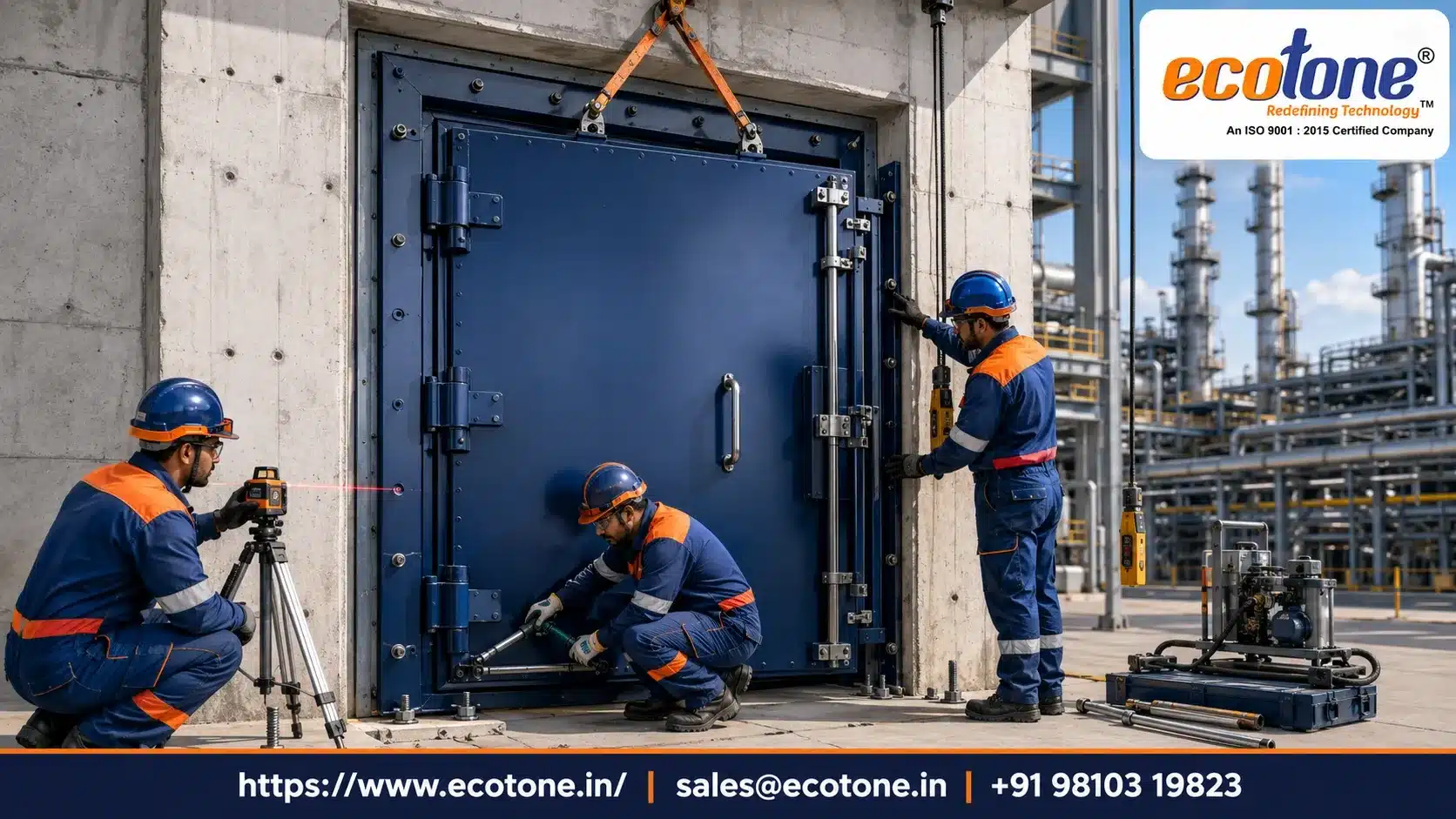
Installation goes beyond lifting a door leaf into a frame. A blast resistant door installation service covers pre-installation structural checks, frame alignment verification, anchor installation and torque verification, seal and gasket fitting, hardware commissioning, and final documentation confirming the installed assembly matches certified design intent. Each step must be completed in sequence.
What Is Supervised Blast Door Installation and Why Does It Matter?
Supervised blast door installation means a qualified engineer or manufacturer representative is present during the installation process, not just at the end for a sign-off inspection. Supervision ensures that frame positioning is checked before anchors are set, that anchor embedment and spacing match the structural design, and that hardware torques and seal compressions are verified in real time rather than assumed. The difference between a supervised and an unsupervised installation can be invisible to the eye but critical under dynamic blast loading.
What Does a Blast Door Site Installation Guide Cover?
A blast door site installation guide provides the step by step technical instructions specific to the door being installed, including dimensional tolerances, anchor specifications, seal fitting sequences, and hardware commissioning checks. It translates the manufacturer’s engineering intent into actionable on-site instructions that installers can follow without needing to interpret structural drawings independently. A site guide is particularly important when installation is carried out by a third party contractor rather than the manufacturer’s own team.
For Any Inquiries Please Email
Our team typically responds within 24 hours on business days.
Contact UsHow Does Installation Differ Across Site Types?
For blast resistant doors research lab settings, installation often involves working within active facilities where surrounding spaces remain occupied throughout. Scheduling, dust control, vibration management, and temporary access arrangements become as important as the technical installation itself, since disrupting live research operations carries its own risk alongside the structural work.
For blast resistant doors university lab installations, access constraints in older campus buildings frequently require custom rigging and handling approaches. Large blast doors often cannot be moved through standard corridor widths to reach the installation point, so planning the full access route is a mandatory pre-installation step that should be agreed with the facilities team before any equipment arrives on site.
For blast resistant doors petrochemical complex projects, installation has to be coordinated around live plant operations, often within rigorous permit to work systems that govern every activity in a process area. These systems add planning and documentation overhead to every step, making pre-installation coordination with the plant safety team essential before work begins.
The quality of the blast resistant door manufacturing process determines how straightforward field installation actually is. Doors fabricated to tight dimensional tolerances drop into position correctly and require minimal adjustment, while doors with accumulated manufacturing errors require remedial work on-site before installation can proceed, adding cost and time to the project.
For a cast in frame blast resistant door, installation of the frame itself happens during construction before the door leaf is ever fitted. This means manufacturer site involvement is needed at two separate project stages rather than one, and coordination with the main contractor’s concrete pour schedule is non negotiable.
How Does Ecotone Systems Deliver Its Installation Service?
At Ecotone Systems Pvt. Ltd., the blast resistant door installation service is treated as a continuation of the manufacturing process rather than a separate activity handed off to a third party. Over 10 years of experience across petrochemical, military, power generation, and research sectors means installation teams understand what correct frame setting, anchor verification, seal compression, and hardware commissioning looks like for each specific door type and site condition. Every installation is documented to provide traceability between the certified design and the completed installation, which matters when insurers or regulators later audit the facility.
Conclusion
A blast resistant door installation service that includes supervision, a clear site installation guide, and documented commissioning bridges the gap between a certified door specification and a reliably performing installation. Getting the installation right is part of the same safety outcome as getting the door right. Working with a manufacturer that controls both sides of that process gives facility owners and safety officers genuine confidence in the protection their doors actually provide.
Frequently Asked Questions
Can a standard contractor install a blast resistant door?
A general contractor can handle the physical installation, but supervised blast door installation by a qualified engineer is needed to verify structural compliance.
How long does blast resistant door installation typically take?
Timelines vary by door size and site conditions, but most single door installations take one to two days including commissioning and documentation.
What happens if a blast door frame is misaligned during installation?
Misalignment affects seal compression and structural load transfer, so it must be corrected before the door is commissioned, which can require significant remedial work.
Does Ecotone Systems provide on-site installation support across India?
Yes, Ecotone Systems provides on-site installation coordination and supervision for projects across India and, where required, internationally.
What documentation is provided after installation?
Installation documentation typically includes as-built records, anchor verification data, hardware commissioning checks, and traceability back to the door’s design certification.
Trusted by India's Leading Brands
Hover to pause · Logos scroll continuously