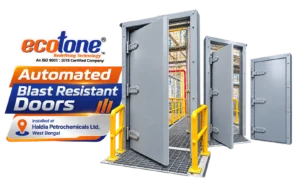

Summary: Petrochemical sites are where blast door engineering effectively started as a distinct discipline, and it remains the sector most people associate with the term. Blast resistant doors petrochemical complex specifications exist because vapor cloud explosions, process unit incidents, and equipment failures are recognised, quantifiable risks across refineries and chemical plants, not rare hypotheticals.
Why Do Petrochemical Complexes Need Blast Resistant Doors?
Guidance such as API RP 752 addresses explosion, fire, and toxic release hazards to personnel in permanent buildings at refineries and chemical operations. Control rooms and administrative buildings near process units routinely reference this guidance when specifying blast resistant doors petrochemical complex requirements.
What Are Blast Doors Industrial Complex Applications Used For?
Blast doors industrial complex installations extend beyond petrochemical refining into gas processing and pipeline compression facilities. Wherever flammable materials are handled at scale, occupied buildings near the process area need doors engineered against a defined overpressure scenario, not standard commercial hardware.
How Do Petrochemical Plant Safety Doors Differ from Standard Doors?
Petrochemical plant safety doors are engineered against dynamic blast loading rather than static loads, accounting for deflection, rebound, and structural response over the short duration of a blast event. Seals and hardware also need to resist the corrosive conditions common at process facilities.
For Any Inquiries Please Email
Our team typically responds within 24 hours on business days.
Contact UsHow Is Peak Reflected Pressure Calculated for Petrochemical Sites?
Engineers calculate a peak reflected pressure blast door value based on the specific vapor cloud or process explosion scenario for that building’s location, factoring in congestion, confinement, and standoff distance. This figure, not a generic average, drives the door’s structural design.
What Blast Ratings Are Common in Petrochemical Facilities?
Ratings vary by proximity and hazard, but a 40 bar blast resistant door specification represents the high end used where buildings sit closest to high consequence units, since rating and standoff distance are directly linked.
Do Petrochemical Doors Also Need Fire Resistance?
Yes, since process incidents frequently involve fire alongside overpressure. A BS 476 blast door fire rating is commonly specified alongside blast performance for petrochemical buildings, ensuring the door continues protecting occupants if a blast event is followed by a pool fire or jet fire.
What Reference Threats Do Engineers Use in Petrochemical Design?
Some engineers reference established benchmarks such as the MK117 bomb blast door standard for comparative severity, even though petrochemical threats are process related rather than munitions based, since it offers a well documented pressure and impulse profile.
What Sizes Are Available for Petrochemical Complex Doors?
Blast resistant door sizes across a petrochemical site vary from standard control room entries to larger equipment access doors on compressor buildings, each validated independently against the same blast criteria.
How Does This Compare to Other High Hazard Sectors?
The layered blast and fire requirements here echo blast resistant doors nuclear power station projects, where structural and fire performance combine in one assembly.
Repeated exposure considerations, familiar from blast resistant doors missile launch site design, occasionally apply to petrochemical flare and test areas too.
Wrap around loading logic, first discussed for blast resistant doors ammunition bunker installations, can apply where adjacent process units sit close together.
Usability concerns raised for blast resistant doors research lab settings apply equally to control rooms with frequent operator access.
Even the daily traffic considerations relevant to blast resistant doors university lab projects mirror what petrochemical control room doors experience.
How Does Ecotone Systems Support Petrochemical and Industrial Projects?
At Ecotone Systems Pvt. Ltd., over 10 years of experience across petrochemical, power generation, and chemical processing sectors underpins every petrochemical door project. Doors are engineered to withstand up to 40 bar peak reflected overpressure, with fire resistance up to 180 minutes in line with BS 476 Part 20 and 22, in single wing, double wing, and partition configurations. Standard sizes of 4ft x 8ft and 8ft x 8ft cover most control room and shelter openings, with custom dimensions up to 4m x 6m, hatches, and blow out panels available for specialised process area applications.
Conclusion
Blast resistant doors petrochemical complex specifications sit at the foundation of process plant building siting strategy, informed by decades of industry incident data and recommended practices like API RP 752. Getting blast rating, fire performance, and door sizing right for each specific building location protects both personnel and continuity of operations. Working with a manufacturer experienced across petrochemical and adjacent high hazard sectors ensures that integration happens correctly from design through installation.
Frequently Asked Questions
What standard guides blast door siting at petrochemical plants?
API RP 752 provides widely used guidance for managing explosion, fire, and toxic release hazards to personnel in process plant buildings.
Do all buildings on a petrochemical site need blast doors?
No, requirements depend on proximity to process hazards and the building’s occupancy, determined through a site specific risk assessment.
What blast rating is typical for a refinery control room?
It depends on standoff distance and hazard severity, with ratings up to 40 bar used for buildings closest to high consequence units.
Do petrochemical blast doors need fire resistance too?
Yes, since process incidents can involve both overpressure and fire, many specifications require combined blast and fire performance.
Can petrochemical blast doors be customised for different building types?
Yes, sizes and configurations vary across a site, from standard control room doors to larger equipment access openings.
Trusted by India's Leading Brands
Hover to pause · Logos scroll continuously