Our Clients
Trusted by India's Leading Brands
Hover to pause · Logos scroll continuously
500+
Projects Completed
40+
Years Experience
200+
Happy Clients
15+
States Covered














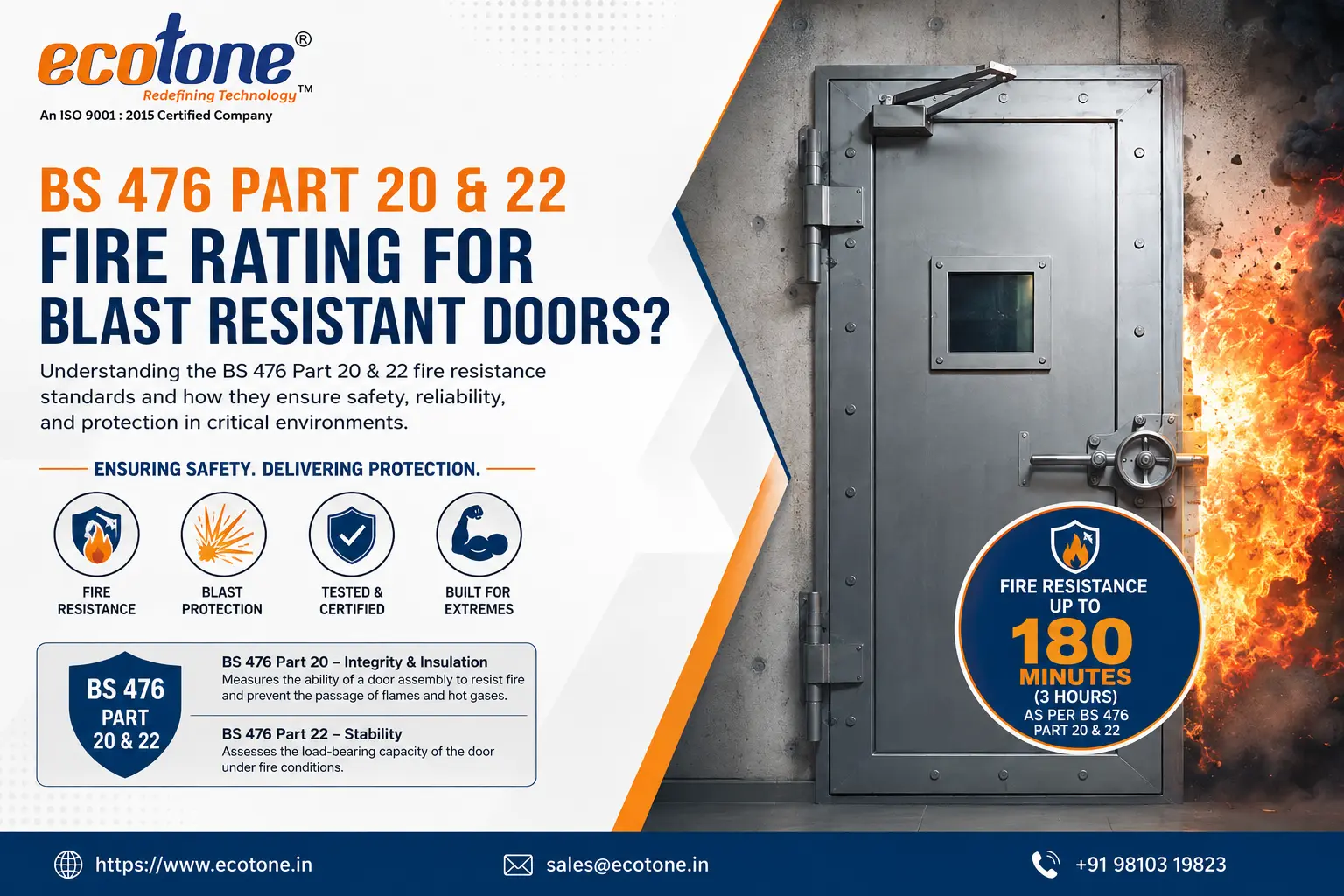
Summary: Anyone who has sat through a fire safety review for a high hazard facility knows how often BS 476 comes up in fire door discussions. A BS 476 blast door fire rating is not just a paperwork requirement; it tells you whether a door holds back fire long enough for people to get out. For blast resistant doors specifically, that fire performance sits alongside the blast rating, not instead of it.
Part 20 sets the furnace conditions and temperature curve. Part 22 applies those conditions to door sets, screens, and shutter assemblies, checking integrity and insulation as fire progresses. Together, this makes up the BS 476 part 20 22 door standard, in place since the late 1980s.
Blast resistant doors face a double challenge. They must survive an explosion’s peak pressure, then keep working as a fire barrier afterward. A BS 476 blast door fire rating confirms the assembly meets recognised fire performance benchmarks on top of its blast resistance, a door that survives a blast but fails under fire hasn’t solved the problem.
A 180 minute fire rated blast door suits the upper end of fire risk, where evacuation routes are long or the hazard involves flammable liquids or gas. Reaching that duration calls for thicker insulating cores, heat resistant seals, and hardware rated for extreme temperatures.
Our team typically responds within 24 hours on business days.
Contact UsEven with EN 1634-1 as the modern benchmark, BS 476 Part 22 stays valid for UK regulations and remains widely used for specialist fire doors, largely on its track record. For manufacturers working across older and newer projects, decades of furnace test evidence carry real weight with regulators.
A BS 476 blast door fire rating is not a box to tick after the blast engineering is done, it is part of the same safety equation. Whether a project calls for a 180 minute fire rated blast door or a shorter duration, the test evidence under the BS 476 part 20 22 door standard needs to be current, traceable, and matched to the exact door being installed. At Ecotone Systems, doors are engineered and tested to meet blast and fire performance together, so facility owners get one certified solution rather than two separate compromises, whether the requirement is a standard fire rated blast door or a high-demand 40 bar blast resistant door.
Yes, resistance to fire testing under BS 476 remains accepted, with transition timelines running into coming years.
EN 1634-1 is generally the more demanding modern test, but BS 476 Part 22 evidence is still widely accepted for compliance.
Yes, many blast resistant doors combine high blast overpressure ratings with fire resistance up to 180 minutes.
Part 20 defines the furnace conditions and temperature curve that Part 22 applies to door sets and similar elements.
Not automatically, doors installed under the standard applicable at the time generally remain compliant if evidence is intact.
Hover to pause · Logos scroll continuously