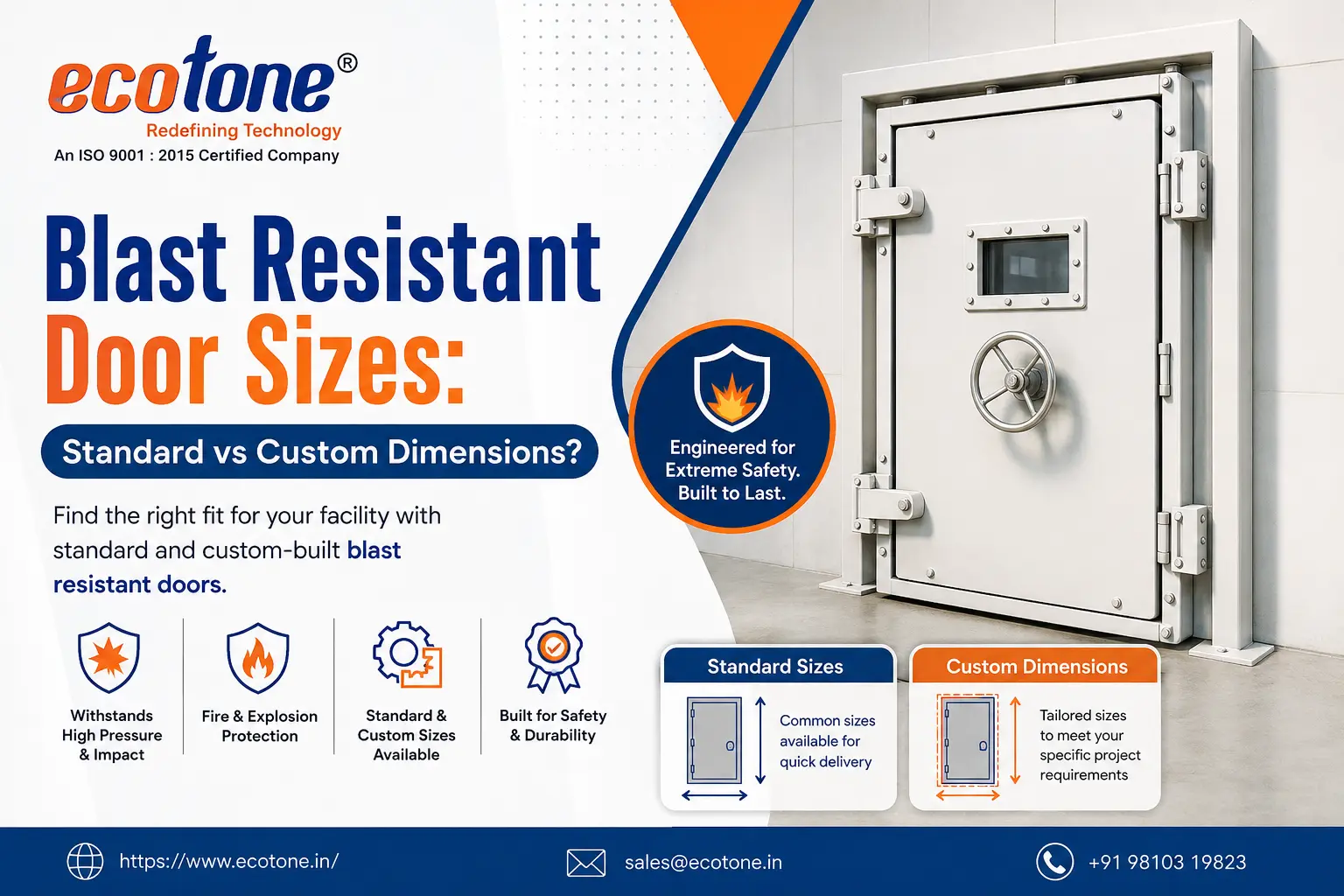
Summary: Size is one of those specs that gets glossed over early in a blast door project, right up until it becomes the reason a design gets sent back. Getting blast resistant door sizes wrong at the drawing stage is an expensive mistake to catch late. The bigger the opening, the harder it gets to keep deflection, rebound, and structural response within safe limits under real blast loading, which is why size and blast rating have to be engineered together, not chosen separately.
What Is Standard Blast Resistant Door Sizes?
Most manufacturers work from a small set of proven configurations for blast resistant door sizes before anything gets customised. As a baseline, single wing doors are commonly supplied at 4ft x 8ft, while double wing doors typically start at 8ft x 8ft. These sizes cover a large share of industrial openings such as compressor rooms, transformer enclosures, and control room entries, and because they’re based on repeatable design and test data, they tend to be faster to specify and quote than a fully bespoke unit.
How Do Large Blast Door Dimensions Change the Engineering?
Once an opening moves beyond standard sizing, large blast door dimensions introduce a different set of engineering challenges. A bigger door leaf means more surface area for blast pressure to act on, which increases total load, deflection, and the demands placed on hinges, latching points, and the surrounding frame anchorage. Many manufacturers can accommodate sizes up to around 4m x 6m for wide or tall openings, but at that scale, every additional dimension has to be checked against the same blast criteria the door is rated for, not assumed to scale linearly from a smaller tested unit.
When Do You Need a Custom Blast Resistant Door Size?
A custom blast resistant door size becomes necessary whenever the opening doesn’t match standard dimensions, whether that’s an unusually wide vehicle access point, a non-rectangular opening, or a retrofit into an existing structure with fixed constraints. Custom sizing also comes into play for smaller specialised elements like hatches, access panels, and blow out panels, which are built for controlled pressure release rather than full personnel access. In every case, custom dimensions still need to be validated against the same blast pressure, impulse, and fragment criteria used for standard sizes.
For Any Inquiries Please Email
Our team typically responds within 24 hours on business days.
Contact UsWhat Standards Govern Blast Resistant Door Sizes and Ratings?
Size doesn’t exist in isolation from performance. A door engineered to resist a 40 bar blast resistant door rating at a standard 4ft x 8ft opening won’t automatically perform the same way at double the dimensions without re-analysis. Many projects also reference the MK117 bomb blast door standard, based on a cased 500lb charge at 100ft standoff, as the design threat regardless of door size. On top of blast performance, doors installed in facilities with combined fire risk often need a BS 476 blast door fire rating alongside their blast rating, which affects material thickness and seal design as much as the blast load itself.
How Does Ecotone Systems Handle Blast Resistant Door Sizes?
At Ecotone Systems Pvt. Ltd., blast resistant door sizes span standard configurations through to fully custom dimensions. Standard installations are typically supplied at 4ft x 8ft for single doors and 8ft x 8ft for double doors, while larger or specialised openings can be manufactured up to 4m x 6m or to project specific requirements. Smaller elements such as hatches, access panels, and blow out panels are also available. Every door is engineered to withstand up to 40 bar peak reflected overpressure with fire resistance up to 180 minutes in line with BS 476 Part 20 and 22, and doors can be fitted with manual, pneumatic, hydraulic, or electric operating systems depending on the application.
Conclusion
Getting blast resistant door sizes right is as much a structural decision as a spatial one. Standard dimensions work well for the majority of industrial openings, but large blast door dimensions and genuinely custom blast resistant door size requirements demand fresh engineering analysis, not scaled up assumptions. With over 10 years of experience serving petrochemical, military, power, and high security sectors, Ecotone Systems Pvt. Ltd. designs and manufactures doors across this full-size range, backed by rust inhibition primers, zinc rich coatings, and finishes suited to long term protection in harsh environments.
Frequently Asked Questions
What is the standard size for a blast resistant door?
Single wing doors commonly start at 4ft x 8ft, while double wing configurations typically begin at 8ft x 8ft.
How large can a blast resistant door be made?
Many manufacturers, including Ecotone Systems, can produce doors up to around 4m x 6m or larger for custom projects.
Does a bigger door mean a lower blast rating?
Not necessarily, but larger openings need fresh structural analysis to confirm the same blast rating still applies at that size.
Are custom blast resistant door sizes more expensive?
Generally, yes, since a custom blast resistant door size requires bespoke engineering and testing rather than reusing standard design data.
Can small hatches and panels also be blast resistant?
Yes, hatches, access panels, and blow out panels are commonly manufactured for controlled pressure release in smaller openings.
Trusted by India's Leading Brands
Hover to pause · Logos scroll continuously