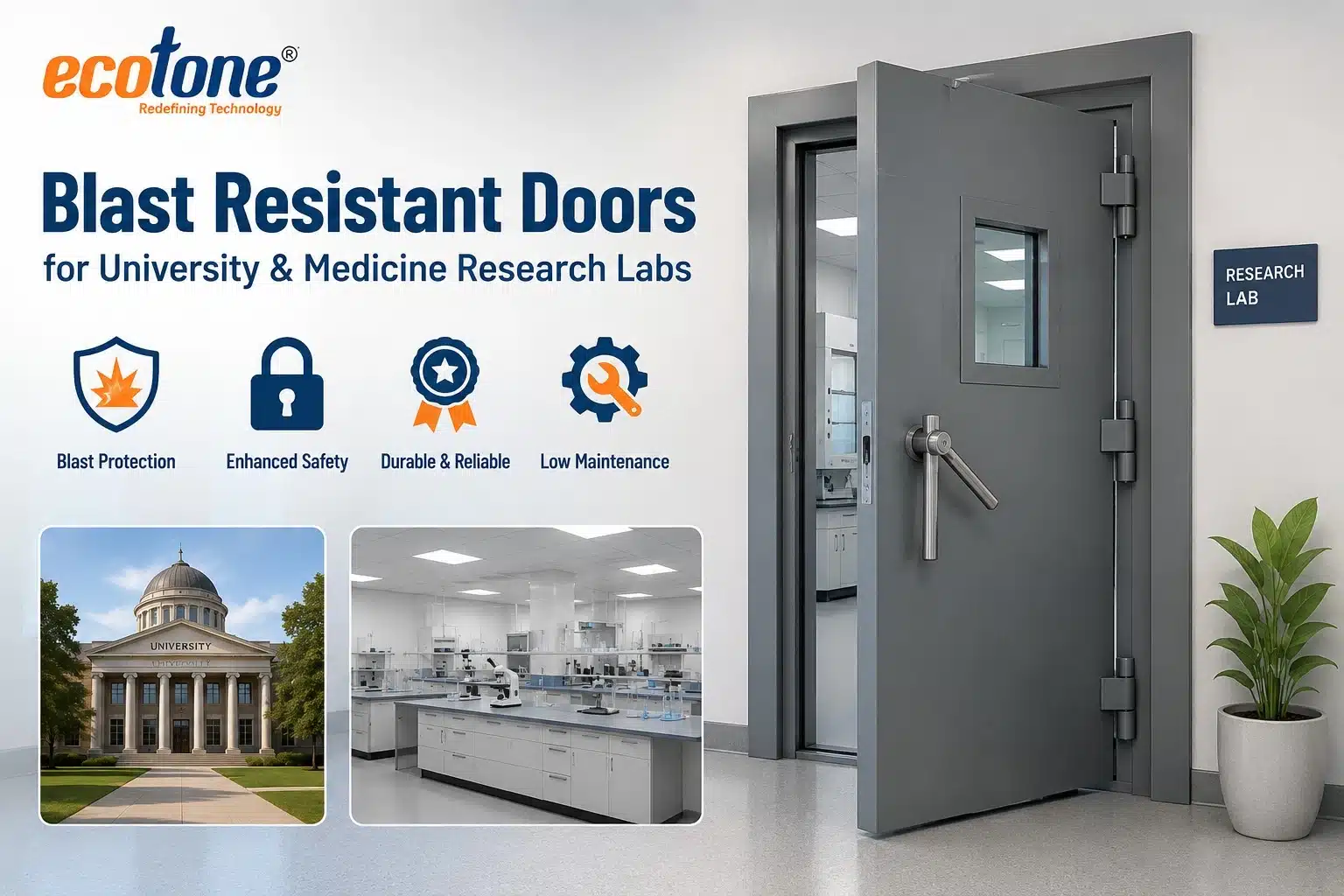
Summary: University campuses and medical research centres don’t look like high hazard sites from the outside, yet many hold classification levels under building code that put them closer to industrial risk than expected. Blast resistant doors university lab specifications exist because certain research spaces, virology suites, pharmaceutical synthesis labs, high pressure gas research, and select engineering departments, carry genuine explosion potential that building codes formally recognise and regulate.
Why Do University Research Labs Need Blast Resistant Doors?
Building codes such as the International Building Code classify laboratory spaces exceeding certain hazardous material thresholds as High Hazard Group H occupancies, which carry stricter fire resistance and structural containment requirements than standard business occupancy labs. Once a research space crosses that threshold, blast resistant doors university lab specifications often become part of the design response, protecting adjacent corridors and other lab units from a contained incident.
What Is a Blast Door Medicine Research Facility Specification?
A blast door medicine research facility specification typically applies to spaces working with pressurised gas systems, volatile solvents, or synthesis processes involving reactive intermediates, common in pharmaceutical and biomedical research settings. These specifications sit closer in spirit to the containment logic used for blast resistant doors research lab projects generally, though medical facilities often add biosafety and access control layers on top of the structural blast requirement.
How Does Laboratory Blast Door Safety Differ from Industrial Applications?
Laboratory blast door safety has to account for frequent daily use by researchers and staff, unlike many industrial or defense blast doors that see far less routine traffic. Hardware durability, vision panels, and smooth operation matter as much as raw blast performance, since a door that’s inconvenient to use daily tends to get propped open, defeating its purpose entirely. Engineers still calculate the peak reflected pressure blast door value for the maximum credible event in that specific lab, but usability is weighted more heavily in university settings than in a standalone defense facility.
For Any Inquiries Please Email
Our team typically responds within 24 hours on business days.
Contact UsHow Are Blast Ratings Calculated for University Lab Doors?
Rating calculations follow the same underlying principles used across the industry, including reference frameworks such as the MK117 bomb blast door standard when engineers want a comparative severity benchmark, though actual university lab scenarios are almost always smaller scale than that reference threat. Ratings expressed as a 40 bar blast resistant door specification are far more common in petrochemical or defense contexts than on campus, where lab specific calculations typically call for a more moderate rating matched to realistic laboratory quantities.
Do University Labs Need Fire Rated Blast Doors Too?
Yes, fire performance is frequently just as important as blast resistance, since many lab incidents involve fire following a pressure event from solvents or reactive byproducts. A BS 476 blast door fire rating is commonly specified alongside blast resistance for higher hazard university and medical labs, similar in principle to the layered protection seen in projects like blast resistant doors nuclear power station and blast resistant doors ammunition bunker installations, even though the underlying scale of risk is very different.
What Sizes Are Available for University and Medical Lab Doors?
Blast resistant door sizes for campus and medical research settings tend to favour standard access dimensions, since most lab entries use conventional door openings rather than the large bay configurations seen in facilities like blast resistant doors missile launch site installations. Larger equipment access doors are occasionally required for bigger research spaces, but standard sizing covers the majority of university and medical lab projects.
How Does Ecotone Systems Support University and Medical Research Facilities?
At Ecotone Systems Pvt. Ltd., over 10 years of experience across high hazard sectors extends directly into university and medical research applications. Doors are engineered to withstand up to 40 bar peak reflected overpressure where required, with fire resistance up to 180 minutes in line with BS 476 Part 20 and 22, available in single wing, double wing, and partition configurations. Standard sizes of 4ft x 8ft and 8ft x 8ft suit most laboratory access points, with custom dimensions, hatches, and access panels available for specialised research spaces.
Conclusion
Blast resistant doors university lab specifications sit at the intersection of building code compliance, daily research operations, and genuine explosion containment. Whether the driver is a High Hazard Group H classification, pressurised gas research, or reactive chemistry, the door has to be engineered for that specific lab’s realistic risk profile, not scaled directly from a defense or industrial benchmark. Working with a manufacturer familiar with both laboratory operations and blast engineering makes that balance achievable across a campus or medical research portfolio.
Frequently Asked Questions
Do all university labs need blast resistant doors?
No, only labs classified under higher hazard occupancy categories due to chemical, gas, or reactive material quantities typically require them.
Are medical research facility blast doors different from standard lab doors?
They often add biosafety and access control requirements alongside blast resistance, depending on the specific research being conducted.
How strong do university lab blast doors need to be?
Ratings are matched to the maximum credible event for that lab, usually far more moderate than industrial or defense grade specifications.
Do these doors need to support frequent daily use?
Yes, laboratory blast door safety accounts for regular researcher traffic, so usability is weighted heavily alongside blast performance.
Can university lab doors also be fire rated?
Yes, many higher hazard labs specify both blast resistance and fire rating together in a single certified door assembly.
Trusted by India's Leading Brands
Hover to pause · Logos scroll continuously