
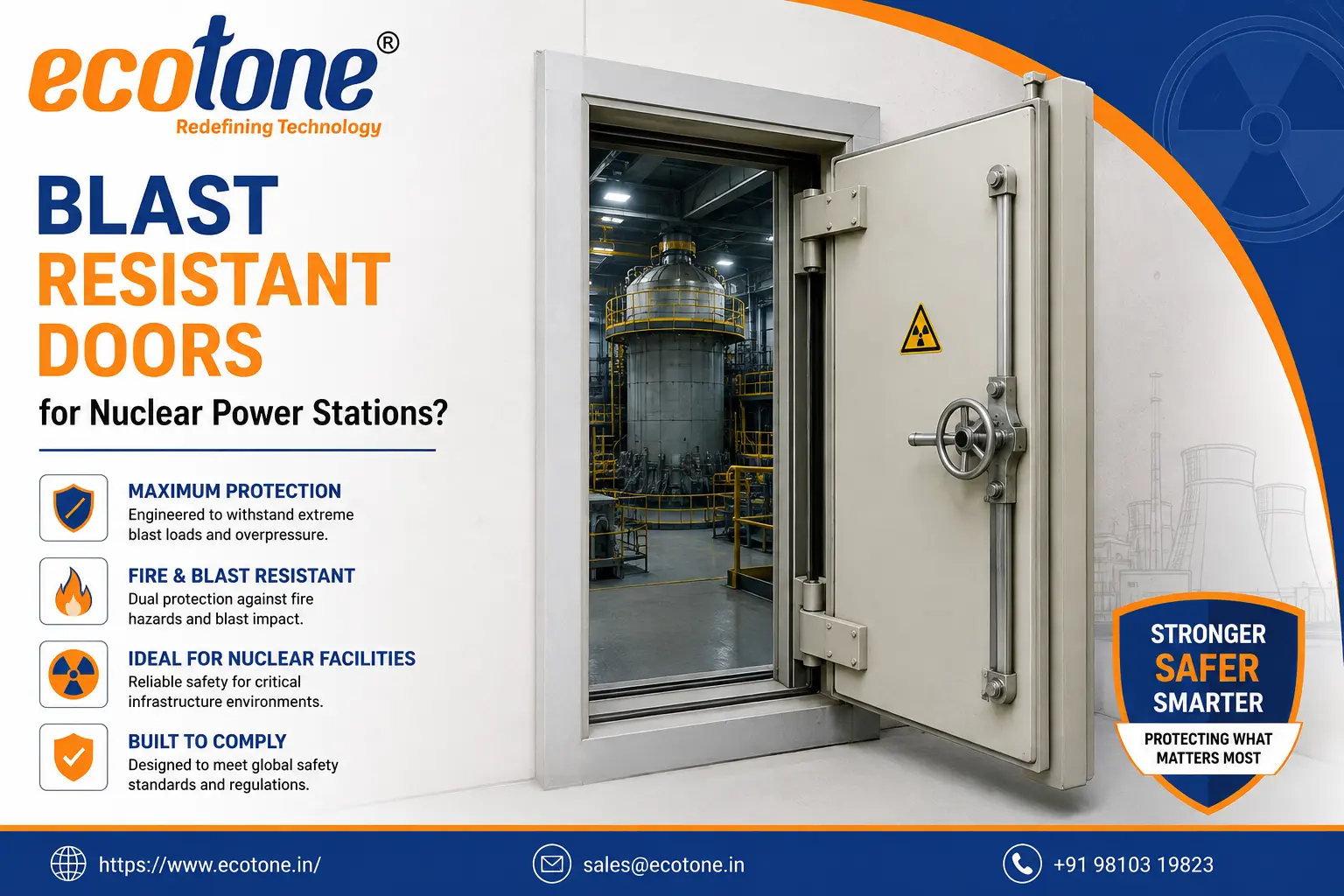
Summary: Nuclear facilities operate under a different threat model than almost any other industrial site, and the doors protecting their vital areas reflect that. Blast resistant doors nuclear power station specifications aren’t written around a single generic explosion scenario, they’re built to defend against a defined set of adversary capabilities, including vehicle borne explosives, that regulators require every licensed plant to withstand. Getting this specification right isn’t optional, it’s a condition of the facility’s operating license.
Why Do Nuclear Power Stations Need Blast Resistant Doors?
Regulators such as the US Nuclear Regulatory Commission require licensed reactors to defend against a defined Design Basis Threat, a set of adversary characteristics that includes armed intrusion and explosives, which is exactly why blast resistant doors nuclear power station specifications exist as a distinct category. Blast doors nuclear facility installations sit at the perimeter of vital areas, protecting the equipment and systems whose failure could endanger public safety. Unlike a typical commercial building, a nuclear facility’s doors are tested against this defined threat profile rather than a generic worst-case assumption, which is what separates blast resistant doors nuclear power station projects from standard industrial specifications.
What Makes High Security Doors Nuclear Plant Installations Different?
High security doors nuclear plant applications combine blast resistance with strict access control, since a vital area door has to resist forced entry as much as it resists overpressure. This dual requirement is central to how blast resistant doors nuclear power station projects get specified. That usually means reinforced multi point locking, tamper resistant hardware, and integration with card access or biometric systems, layered on top of the same structural analysis used for any serious blast door. The peak reflected pressure blast door value the assembly is designed against still drives the core structural decisions, but access control adds a security engineering layer most industrial blast doors don’t need.
How Are Blast Loads Calculated for Nuclear Facility Doors?
Design threats for nuclear sites are often based on vehicle borne explosive scenarios, and engineers frequently reference established benchmarks such as the MK117 bomb blast door standard when translating a threat weight into the structural criteria that blast resistant doors nuclear power station assemblies must meet. Once the equivalent charge and standoff distance are set, the resulting reflected pressure and impulse are used to size the door leaf, frame, and anchoring. Ratings expressed as a 40 bar blast resistant door specification are common in high hazard sectors, and nuclear facility doors are frequently designed to comparable or higher severity depending on site specific threat assessments.
For Any Inquiries Please Email
Our team typically responds within 24 hours on business days.
Contact UsDo Nuclear Facility Blast Doors Also Need Fire Ratings?
Yes, and this is where the specification for blast resistant doors nuclear power station projects gets even more layered. A blast event at a nuclear facility can easily be followed by fire, so many vital area doors are also required to carry a BS 476 blast door fire rating, sometimes up to 180 minutes, in addition to their blast performance. Sizing matters here too, since blast resistant door sizes vary considerably across a plant, from smaller access hatches into control areas to larger doors serving equipment bays, and each size has to be independently validated against both the blast and fire criteria.
How Does Ecotone Systems Support Nuclear Facility Projects?
At Ecotone Systems Pvt. Ltd., over 10 years of experience across petrochemical, military, and power generation sectors translates directly into the layered requirements nuclear facilities demand. Doors are engineered to withstand up to 40 bar peak reflected overpressure, with fire resistance up to 180 minutes in line with BS 476 Part 20 and 22, in single wing, double wing, and partition configurations. Standard sizes of 4ft x 8ft and 8ft x 8ft cover most vital area openings, while custom dimensions up to 4m x 6m, along with hatches and access panels, address the specialised openings nuclear facilities often require.
Conclusion
Blast resistant doors nuclear power station projects sit at the intersection of structural blast engineering, fire safety, and physical security, and no single discipline can be treated as an afterthought. Whether the requirement is driven by a defined design basis threat, a specific blast rating, or combined fire and access control performance, the door has to be engineered as one integrated system. Working with a manufacturer experienced across high security and high hazard sectors is what makes that integration possible.
Frequently Asked Questions
What standard defines the threat nuclear power plant doors must resist?
In the US, the NRC’s Design Basis Threat under 10 CFR 73.1 defines the adversary capabilities, including explosives, that vital area doors must withstand.
Are nuclear facility blast doors different from industrial blast doors?
Yes, they typically combine blast resistance with strict access control and fire performance within a single certified assembly.
What blast rating is typical for nuclear power station doors?
Ratings vary by site specific risk assessment, but many use benchmarks comparable to a 40 bar blast resistant door specification.
Do nuclear plant doors need fire resistance as well as blast resistance?
Often yes, since a blast event can be followed by fire, requiring both structural blast performance and a recognised fire rating.
Can blast doors for nuclear facilities be custom sized?
Yes, vital area openings vary widely, so custom dimensions alongside standard sizes are common across a single facility.
Trusted by India's Leading Brands
Hover to pause · Logos scroll continuously