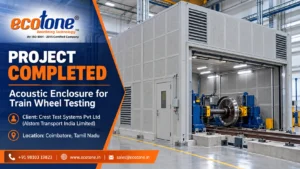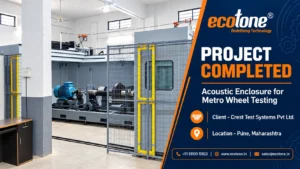
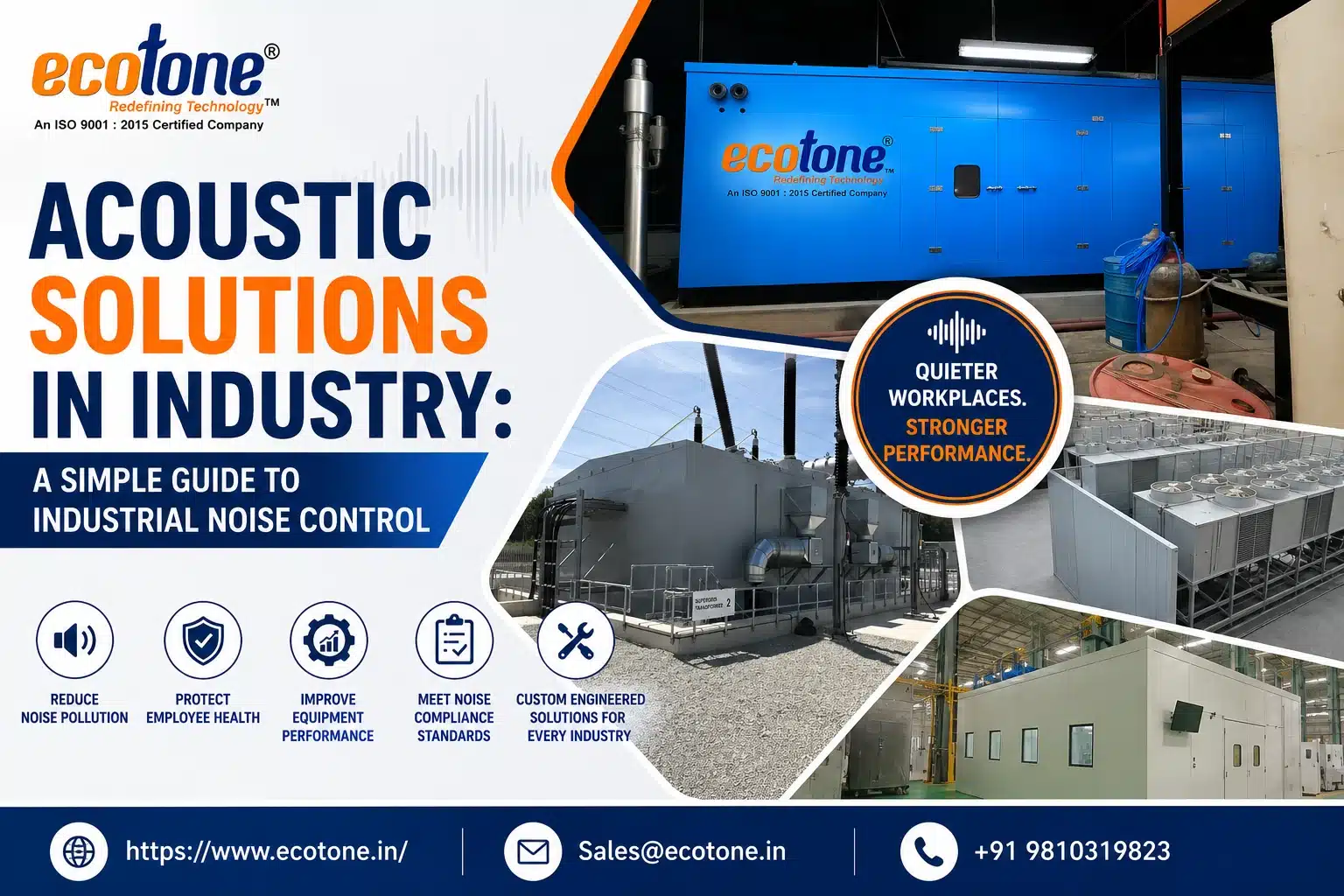
Walk into any factory and you’ll hear it before you see anything. Compressors hissing. Turbines roaring. Generators rumbling in the background. Exhaust fans pushing air through ducts, making that low hum that never really goes away. For years, people just lived with it. Noise was “part of the job.” That’s changing now. Rules around worker health have gotten stricter, and so have the rules about what a plant can send out into the neighbourhood around it. Acoustic engineering isn’t an afterthought anymore. It’s part of how plants get planned from day one.
Ecotone Systems has worked on this exact problem for years — how do you cut noise without slowing airflow, blocking access to machines, or stopping production? This guide breaks it down in plain terms: why noise control matters, what’s actually out there, and how to pick the right option for your situation.
Why Industrial Noise Control Matters
People tend to treat noise as background annoyance and nothing more. But the numbers tell a different story. Left unchecked, noise hurts workers, wears out machines, and damages a plant’s standing with the community around it.
Hearing damage and fatigue. Long exposure above 85 decibels, without protection, causes permanent hearing loss. Workers near compressors or generators often lose their hearing slowly — they don’t notice until the damage is already done. And even below that level, constant noise raises stress hormones. By hour ten of a twelve-hour shift, that difference shows.
Productivity takes a hit too. Loud floors make instructions harder to hear. That leads to mistakes near moving machinery, delays, and sometimes rework that didn’t need to happen. It adds up quietly, shift after shift.
Then there’s compliance. Safety authorities set hard limits on noise exposure for good reason. Ignore them and you’re looking at fines, warnings, or in worse cases, a forced shutdown until things get fixed. In India, Pollution Control Boards now treat noise almost the same way they treat air and water pollution — seriously, with real consequences.
Vibration adds another layer. Noise and vibration usually travel together. A machine that vibrates too much wears out faster — bearings loosen, fasteners work themselves free, foundations take stress they weren’t built for. That means more maintenance, more downtime, more cost.
And then the neighbors. Power plants, cement units, manufacturing units — a lot of them sit close to homes these days as cities grow. Complaints pile up, regulators get involved, and reputations take a hit that can limit future growth.
The right acoustic solution handles all of this at once. A safer workplace, and a better relationship with the community around it. That’s the kind of thinking Ecotone Systems brings to every project.
For Any Inquiries Please Email
Our team typically responds within 24 hours on business days.
Contact UsCommon Acoustic Solutions Used in Industry
There’s no single fix that works everywhere. What you need depends on where the noise comes from, how loud it is, what frequency it’s in, how much space you have, and whether airflow needs to keep moving. Here’s a look at the seven main options used across industry today.
1. Acoustic Enclosures
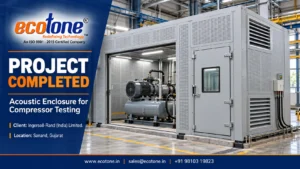
Think of Acoustic Enclosures as a shell built around noisy equipment — trapping sound close to the source instead of letting it spread across the whole plant. Commonly used around:
- Diesel generators
- Compressors
- Turbines
- Blowers
- Pumps
- Other industrial machinery
What they get you:
- Noise reduction anywhere from 40 to 50 dB, depending on the build
- Weather protection if the equipment sits outdoors
- Better operator safety, since hot or moving parts stay separate
- Panels that hinge or lift off, so maintenance doesn’t mean tearing the whole thing apart
Ecotone Systems builds these with a modular panel setup — solid noise reduction, without making it a hassle to reach the machine when something needs checking. That matters a lot on equipment that runs around the clock.
2. Noise Barriers
A noise barrier doesn’t wrap around the machine. It sits between the noise source and whatever needs protecting — a wall or screen that blocks the sound’s path.
Where they're used:
- Construction sites
- Highways
- Manufacturing plants
- Cooling towers
- Outdoor equipment yards
Barriers make sense where a full enclosure isn’t realistic — say, around a large cooling tower, or along a plant’s edge that faces someone’s backyard. Ecotone Systems designs each barrier’s height, weight, and material based on exactly what kind of noise it needs to stop.
3. Sound Attenuators
These sit inside ducts and ventilation systems, cutting noise made by moving air — without choking off the airflow itself.
Where they show up:
- Air handling units (AHUs)
- Cooling towers
- Generator ventilation systems
- Industrial exhaust systems
Inside one, air moves through baffles lined with sound-absorbing material. The material soaks up the noise while the air keeps moving through with barely any resistance. Getting that balance right — real noise reduction without hurting airflow — takes careful engineering, and it’s a spot where Ecotone Systems’ experience really shows.
4. Acoustic Louvers
Regular louvers let sound travel through almost unblocked. Acoustic louvers don’t. Angled, sound-absorbing blades let air in and out while keeping most of the noise where it belongs.
Good fit for:
- Power plants
- Data centers
- Manufacturing units
- Compressor rooms
Anywhere that needs steady airflow — a data center that has to stay cool, a compressor room that needs ventilation — acoustic louvers let air move freely while keeping noise contained.
5. Acoustic Doors
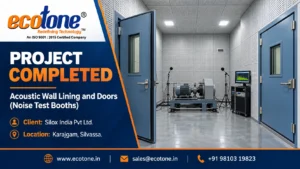
Here’s something people often miss: you can build near-perfect sound-blocking walls, and a regular door will leak most of that work away. Acoustic doors close that gap.
Common spots for these:
- Generator rooms
- Test laboratories
- Compressor rooms
- Control rooms
Ecotone Systems builds these with multiple layers inside the core, tight compression seals, and hardware built to hold up under heavy daily use — so the Acoustic Doors performs close to what the surrounding wall already does.
6. Acoustic Wall & Ceiling Panels
Sound doesn’t just come from a source. It bounces. Hard walls and ceilings reflect noise over and over, and a room can feel loud even when the actual source isn’t that bad. Acoustic wall and ceiling panels absorb that reflection instead of letting it build up, which is why they’re such a common fix in spaces where echo is the real problem.
Used in:
- Control rooms
- Offices
- Production areas
- Laboratories
Cut the echo, and instructions get easier to hear, and people don’t wear out as fast by the end of the day.
Industries That Need Acoustic Solutions
This isn’t limited to one type of business. Anything running rotating machinery, combustion equipment, or high-volume airflow is a candidate. Ecotone Systems has worked across sectors including:
- Power Generation
- Oil & Gas
- Petrochemical Plants
- Cement Industry
- Steel Plants
- Automotive Manufacturing
- Pharmaceutical Facilities
- Food Processing
- Data Centers
- Mining Operations
- Infrastructure Projects
- Airports & Railways
Each one comes with its own quirks. Pharma needs panels that are easy to clean and meet hygiene standards. Data centres need louvers that don’t hurt cooling. Cement plants need enclosures that can take dust and heat without falling apart. A generic product rarely survives real-world conditions like these, which is why knowing the sector matters just as much as knowing acoustics.
Benefits of Industrial Acoustic Solutions
Get this right, and the payoff goes well beyond a better number on a compliance report:
- Lower noise across the shop floor and control areas
- Better long-term health outcomes for employees
- Fewer headaches with safety and pollution rules
- Machines that run better and wear out slower
- Less vibration reaching nearby structures
- Higher productivity from clearer communication and less fatigue
- Better standing with the community around the plant
- Fewer complaints, which protects a facility’s room to grow
None of this is a one-time win either. Plants that handle noise control properly from the start tend to spend less on repairs down the line, run into fewer regulatory surprises, and keep their people longer.
Choosing the Right Acoustic Solution
There’s no universal product here. A good industrial noise control system gets built around:
- What kind of noise it is — airborne, structure-borne, or both
- The frequency — a low rumble and a high-pitched whine need different treatments entirely
- How much reduction is actually needed — and what those costs to achieve
- Airflow requirements — does the fix need to keep air moving for cooling or exhaust
- Maintenance access — can someone still get to the equipment easily
- Weather and fire resistance — outdoor or high-heat spots need the right materials
- How much space is available — retrofits almost always have less room than new builds
- Whatever rules apply to that specific industry
Work through these upfront, and you avoid the most common mistake out there: installing something generic that looks fine on paper but underperforms the moment it hits real conditions. Ecotone Systems starts every project by mapping out exactly these factors for the client’s site, then builds a solution around them — sometimes a single enclosure, sometimes a full combination of barriers, attenuators, and vibration isolation — built for what’s actually there, not a standard spec sheet.
Conclusion
Acoustic solutions aren’t a quick patch. They’re a long-term investment in safety, efficiency, and staying on the right side of regulations. Enclosure, barrier, attenuator, louver, door, vibration isolation — whichever combination fits, the right setup cuts noise significantly without hurting how the equipment performs. And the cost of skipping this step — hearing damage claims, fines, worn-out equipment, unhappy neighbors — almost always outweighs doing it right the first time.
A properly engineered system means reliable noise reduction, fewer compliance issues, and a workplace that’s genuinely safer to be in. For companies looking to get this right, Ecotone Systems brings the engineering background to find the real source of a noise problem and design something that holds up — from a basic enclosure to a full ventilation-integrated system built for the long haul.
Frequently Asked Questions
How much noise can an acoustic enclosure actually reduce?
Somewhere between 40 and 50 dB in a well-built one — the exact number depends on the panel design and what’s inside. Ecotone Systems builds each enclosure around the specific equipment rather than reusing a fixed template, so the performance actually holds up once it’s installed.
What's the difference between a noise barrier and an acoustic enclosure?
An enclosure wraps around the equipment itself. A barrier is a separate wall placed between the source and whatever’s on the other side — a plant boundary facing a residential street, say. Barriers come in handy when a full enclosure just isn’t practical.
Can sound attenuators cut noise without hurting airflow?
Yes. That’s really the whole point of them. Air passes through baffles lined with absorbent material, losing very little pressure while the material soaks up the noise. That’s why they’re used in AHUs, cooling towers, and exhaust systems where airflow can’t be sacrificed.
Do I need separate solutions for vibration and airborne noise?
Usually, yes. Enclosures, barriers, and attenuators handle sound moving through the air. Vibration isolators — springs, rubber mounts, and the like — handle noise and wear coming from the structure itself. Ecotone Systems typically checks both during an assessment, since fixing only one tends to leave the real issue half-solved.
How do I figure out which solution is right for my facility?
It comes down to the noise source, how loud it is, how much space you’ve got, airflow needs, and whatever rules apply to your industry. Rather than picking something off a spec sheet, it’s worth getting the site assessed. That’s how Ecotone Systems approaches it — working through these factors with the client before recommending anything, so the system installed actually matches the real conditions on the ground.
Trusted by India's Leading Brands
Hover to pause · Logos scroll continuously