Our Clients
Trusted by India's Leading Brands
Hover to pause · Logos scroll continuously
500+
Projects Completed
40+
Years Experience
200+
Happy Clients
15+
States Covered














An Acoustic Steel Door is a heavy-duty steel door engineered to stop airborne sound from passing through a doorway. Also called a soundproof metal door or acoustic metal door, it combines a dense steel shutter, a sound-absorbing core, and sealed edges to bring a doorway’s noise control close to that of a solid wall.
For plant engineers, architects, and facility managers dealing with generator rooms, compressor houses, test cells, or studios, understanding how this door works is the first step to solving a noise complaint.
A well-insulated wall can block most sound, but an ordinary door with gaps around its frame and base acts like an open window for noise. In generator rooms, pump houses, and test cells, the door is usually the weak point that causes a space to fail its noise target. A metal acoustic door closes that gap by matching the leaf’s mass and sealing to the surrounding wall, rather than leaving an untreated opening in an otherwise soundproofed room.
Steel door soundproofing works through four combined mechanisms, not one single feature.
Heavier steel skins resist being set into vibration by sound waves, so less energy passes through. This follows the basic mass law of acoustics, where doubling a panel’s surface weight adds roughly 5 to 6 dB of transmission loss.
The rock wool core inside the leaf absorbs sound energy that does make it past the outer steel skin, damping it before it reaches the other side.
Neoprene or EPDM gaskets maintain continuous contact around the frame, closing the narrow gaps where sound would otherwise leak freely, since even a small opening can undo much of a door’s rated performance.
An automatic seal drops to meet the floor the moment the door closes, sealing the one gap that gaskets on the sides and top cannot reach.
STC, or Sound Transmission Class, is a single number derived from lab testing that summarises how much sound a door assembly blocks across the speech frequency range. According to the Steel Door Institute, STC is tested under ASTM standards that measure the entire assembly, including the door, frame, and any glazing, and the scale is logarithmic, so a 3-point increase roughly doubles the sound reduction achieved. A lab figure is the best-case result; on site, a poorly grouted frame, worn seals, or an uneven floor can quietly reduce that number by several decibels, which is why correct installation matters as much as the door itself.
Soundproof steel doors are specified wherever a loud mechanical space sits next to an occupied one. Common applications include generator and DG rooms, compressor and pump rooms, engine or product test cells, control rooms, recording studios, auditoriums, conference rooms, and hospital plant rooms. Many of these doors are also available with fire ratings and double-glazed acoustic vision panels, so visibility or fire compliance does not have to come at the cost of sound insulation.
Match the STC rating to the actual noise source and the wall it sits in, since a door rated higher than its surrounding wall will not improve the room’s overall performance. Ask for the laboratory test report for the exact door build, confirm the gasket material and drop seal type, and check how the frame will be grouted into the opening. For sites needing both noise control and airflow, a louvered variant of the acoustic door may be a better fit than a fully sealed leaf.
An acoustic steel door earns its place in noisy industrial and commercial spaces by combining mass, absorption, and sealed edges rather than relying on thickness alone. Choosing the correct STC rating, verifying lab test reports, and ensuring correct site installation are what separate a door that performs on paper from one that genuinely quiets a room. Ecotone Systems designs, manufactures, and installs steel acoustic doors across India, with STC ratings from 36 to 50 and options for fire rating and vision panels, for teams evaluating a soundproof door for their next project.
An acoustic steel door uses a steel shutter, rock wool core, and sealed perimeter to block noise at the doorway, with STC ratings of 36 to 50 depending on thickness and build, making it the standard choice for plant rooms, test cells, and studios needing reliable steel door soundproofing.
A regular steel door has no sound-absorbing core or sealed edges, while an acoustic steel door adds rock wool infill and continuous gaskets to block noise.
Yes, many manufacturers offer fire-rated acoustic steel doors that combine sound insulation with fire protection for industrial buildings.
Depending on thickness and STC rating, a soundproof steel door can reduce noise by roughly 36 to 50 decibels under lab conditions.
Yes, an ungrouted or poorly fitted frame can reduce real-world performance significantly, even with a high-rated door leaf.
Steel doors generally offer better durability, fire resistance, and lower long-term maintenance compared to wooden acoustic doors.
Ecotone Systems is a leading provider of acoustic solutions, specializing in Acoustic Enclosures for Industrial Plants and Sound Proof Chambers that effectively reduce noise pollution.
Industrial plants are filled with high-decibel noise from generators, compressors, blowers, turbines, and heavy machinery. Continuous exposure to such noise levels can lead to serious health issues, including hearing loss and stress-related disorders. Moreover, government regulations and environmental norms mandate industries to keep noise levels within permissible limits. This is where Acoustic Solutions play a crucial role in helping industries manage and reduce noise pollution effectively.
At Ecotone, we design and manufacture Acoustic Enclosures for Industrial Plants that help industries meet these noise control requirements efficiently.
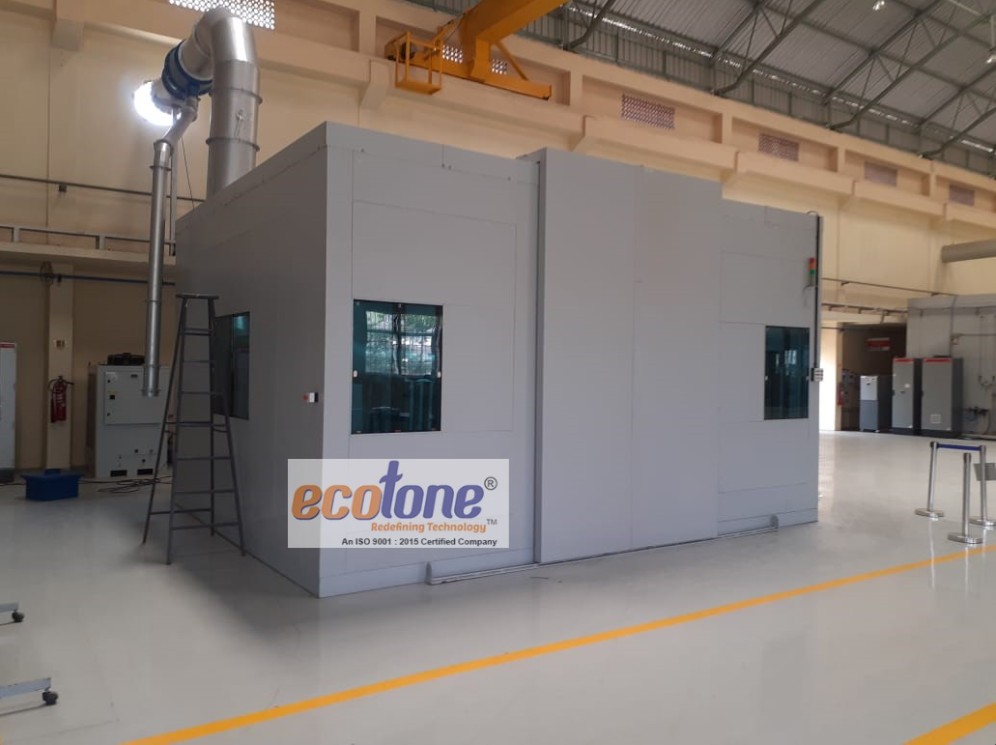
An Acoustic Enclosure is a specially designed structure that surrounds noisy equipment, significantly reducing the noise it generates. Our enclosures are custom-built to meet industry-specific needs, ensuring maximum noise reduction without affecting machine performance. As a trusted provider of Acoustic Solutions, we help industries achieve a quieter, safer, and more efficient working environment.
From power plants and manufacturing units to refineries and heavy engineering industries, Ecotone provides robust Acoustic Enclosures for Industrial Plants that enhance worker safety and operational efficiency.
While acoustic enclosures target specific machinery, Sound Proof Chambers provide a noise-free environment for testing, research, and operational needs. These chambers are widely used in automotive, aerospace, electronics, and research laboratories. As part of our range of Acoustic Solutions, they help ensure accurate, disturbance-free results across critical applications.
With years of expertise in acoustic solutions, Ecotone Systems is committed to delivering high-quality acoustic products. Our Acoustic Enclosures for Industrial Plants and Sound Proof Chambers are designed to meet international standards while ensuring durability, efficiency, and cost-effectiveness.
Hover to pause · Logos scroll continuously