Search for “acoustic foam” and you will find thousands of cheap packs promising a quiet room. Most buyers stick a few wedges on the wall, switch on the machine or the music, and wonder why the neighbours still complain. The foam did its job. It just wasn’t the right job.
Let’s sort out what acoustic foam does, what it doesn’t, and which soundproofing solutions you need when the noise problem is bigger than an echoey room.
Absorption is not blocking
This is the single most misunderstood point in acoustics. Two different problems get lumped together.
Echo & Reverb Inside a Room
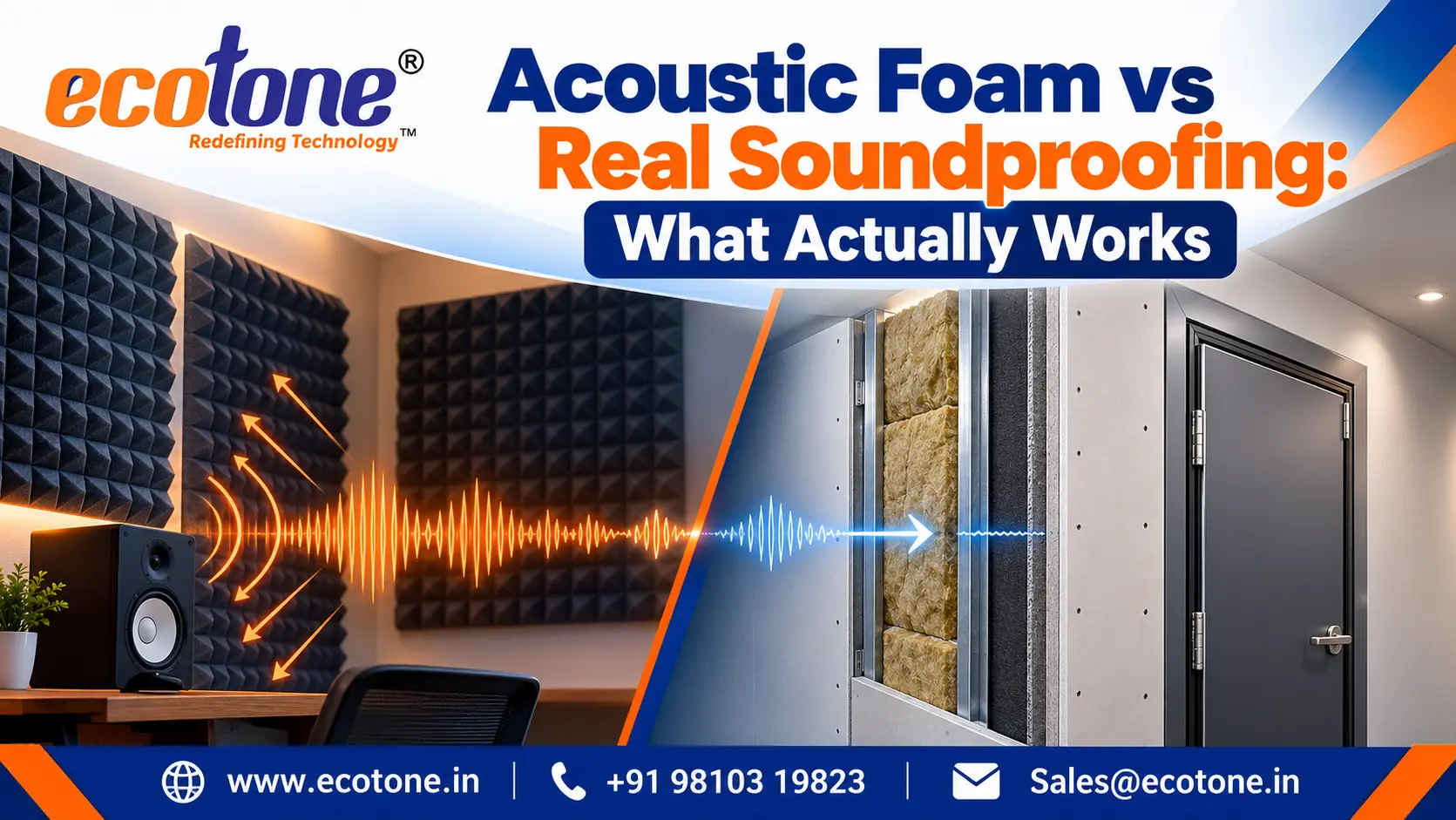
This is an absorption problem. Sound bounces off hard walls, floors and ceilings, and speech turns muddy. Acoustic foam, sound foam board and studio foam soak up some of that energy, so the room sounds cleaner.
Noise Passing Through a Wall
This is a blocking problem. Stopping it takes mass, density, sealed gaps and decoupled layers. A light foam tile has almost none of these. Stick it on a thin partition and the noise on the other side stays about the same.
Ask yourself one question before buying anything: do I want a calmer room, or do I want less noise leaving or entering it? The answer decides everything.
Where acoustic foam does well
Foam earns its place in the right setting.
Recording & Podcast Setups
Small recording corners, voice-over booths and podcast setups.
Offices
Offices with hard surfaces and too much chatter bounce.
Test Rooms & Labs
Test rooms and labs where reflections must be controlled.
Quick Acoustic Treatment
Quick, low-cost fixes for mid and high frequencies.
Thickness matters. A one-inch tile handles high frequencies and little else. Go thicker, and add bass traps in corners, if low-frequency boom is your complaint. Density and fire rating matter too, especially in commercial and industrial spaces. Cheap foam can be a hazard if it isn’t flame-retardant.
Where acoustic foam falls short
Foam struggles with low frequencies. The rumble of a generator, the thump of a compressor and the hum of a transformer pass through it. Denser materials such as mineral wool or fibreglass panels absorb more across the range, which is why many studio builders prefer them over basic foam.
And as we said, foam alone will not soundproof a wall. Anyone selling it as a complete answer is oversimplifying.
Better options for different problems
Hanging Sound Panels & Baffles
For large halls, workshops, canteens and open offices, suspended baffles work better than wall foam. They catch sound from several angles and don't need wall space. Ecotone Systems supplies acoustic ceiling baffles built for exactly these high-ceiling spaces.
Acoustic Wall Panels
Fabric-wrapped panels with a mineral wool or fibre core give better absorption than plain foam and look more finished. They suit conference rooms, auditoriums and control rooms.
Soundproof Doors & Curtains
Doors are usually the weakest point in any room. A gap under the door can undo a good wall. Sealed acoustic doors and heavy soundproof curtains deal with the leaks that foam can't touch.
Acoustic Enclosures
If one noisy machine is the whole problem, treating the room is the hard way. Enclosing the source is smarter. Ecotone Systems builds custom enclosures for generators, turbines, blowers and compressors, so the noise is contained where it starts.
Barriers & Silencers
For outdoor noise, or for airflow paths like ducts and exhausts, noise barriers and industrial silencers do the heavy lifting.
A simple way to choose
Identify the Noise Source
Is it inside the room, outside, or one particular machine?
Check the Frequency
Chatter and music are mid to high. Machinery tends to be low.
Decide the Goal
Better sound quality calls for absorption. Less noise travelling calls for blocking.
Think About the Space
A bedroom studio and a 50,000 sq ft plant need very different answers.
Check Safety Ratings
Fire performance counts as much as the decibel figures.
Most real projects need a mix: some absorption, some mass, and a few sealed gaps.
When to call a specialist
A few foam panels from a marketplace are fine for a home setup. For factories, test facilities, power plants, hospitals or any place with compliance targets, guessing gets expensive. Wrong material, wrong thickness, and you pay twice.
Ecotone Systems designs soundproofing solutions around the actual noise source, the site conditions and the target level, rather than selling a standard kit. That covers everything from anechoic wedge foam for test chambers to full acoustic enclosures and modular rooms.
Final word
Acoustic foam is a useful tool, but only for the job it was made for. Use it to tame echo. Use dense, sealed, engineered solutions to stop noise. Get that distinction right and you will save money, time and a lot of frustration.
Planning an acoustic project and not sure where to start? Talk to the team at Ecotone Systems and describe your noise problem. A short conversation can save you from buying the wrong thing.
Trusted by India's Leading Brands
Hover to pause · Logos scroll continuously