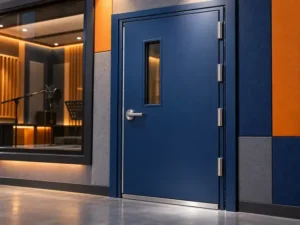

When a fire breaks out, every minute counts. A correctly specified, properly installed wooden fire rated doors doesn’t just delay the spread of flames — it creates the critical window for safe evacuation and emergency response. Ecotone Systems engineers these moments of protection into every door we manufacture.
As a leading wooden fire rated doors manufacturer in India, Ecotone Systems combines certified fire performance with the warmth and design flexibility of timber — meeting the dual demand of life-safety compliance and premium interior aesthetics.
For Any Inquiries Please Email
Our team typically responds within 24 hours on business days.
Contact UsWhy Wooden Fire Rated Doors Are the Preferred Choice in 2026
The global wooden fireproof door market, valued at $7.8 billion in 2026, is projected to nearly double by 2035 — driven by tightening building codes, rising urban construction, and growing awareness of passive fire protection systems. Architects, builders, and facility managers are increasingly specifying wooden fire doors not as a checkbox, but as a deliberate safety investment.
What makes wooden fire doors stand apart:
Aesthetics that comply
Unlike steel alternatives, wooden fire doors integrate naturally into luxury hospitality, corporate interiors, and premium residential projects without compromising the design intent.
Passive protection that works 24/7
No power source, no activation trigger. These doors resist fire and smoke simply by being properly specified and installed.
Tested system performance
Modern standards treat the fire door as one integrated system, not a mix-and-match of components. Every element — glass, glazing beads, sealing systems, and hardware — must appear in the same test report.
Regulatory alignment
Stringent fire safety codes under NFPA 80 and EN 1634 are accelerating material upgrades across construction markets. Ecotone’s doors are tested to meet both international benchmarks and Indian standards (IS 3614).
Ecotone Systems — Fire Door Expertise You Can Rely On
Ecotone Systems is not a catalogue supplier. We are a specialist manufacturer with hands-on expertise in acoustic and architectural door engineering. Every wooden fire rated doors we produce goes through controlled manufacturing, third-party testing, and documented certification — because a fire door that hasn’t been tested to standard is simply a door.
What sets us apart:
Third-party certified performance
Our doors carry certifications from recognized testing authorities, with full documentation of fire resistance, thermal stability, and structural integrity.
Integrated system design
Hardware, seals, hinges, and vision panels are specified as part of the tested assembly, not sourced separately. Compliance now extends throughout the building’s operational life, requiring test reports, surveillance evidence, installation certificates, and field labels.
In-house customization
We work directly with architects and project managers to specify door assemblies that fit the opening, rating, finish, and acoustic requirement — not the other way around.
Sustainable manufacturing
Our doors use sustainably sourced timber and non-toxic fire-retardant treatments, supporting green building certifications like IGBC and LEED.
Technical Specifications — Ecotone Wooden Fire Rated Doors
| Feature | Details |
|---|---|
| Fire Resistance Ratings | 30, 60, 90, and 120 minutes |
| Standards Compliance | IS 3614, EN 1634, BS 476, NFPA 80 |
| Core Options | Solid timber, mineral wool insulated core |
| Surface Finishes | Natural veneers, laminates, painted finishes |
| Acoustic Performance | Up to 45 dB Rw (combined fire + acoustic models) |
| Vision Panels | Fire-rated glazing available across all ratings |
| Hardware Compatibility | Fire-rated hinges, CE/UL-certified closers, panic bars, electro-magnetic hold-open devices |
| Sealing System | Intumescent strips + smoke seals on all four edges |
Specifier’s Note: For egress compliance, doors must provide a minimum clear opening width of 32 inches at 90 degrees, a minimum height of 80 inches, and a threshold with a maximum vertical rise of 0.5 inches — and these dimensions apply regardless of fire rating. Ecotone’s team can advise on compliant sizing during the specification stage.
Where Ecotone Fire Doors Are Specified
Commercial & Corporate Spaces
Office buildings, IT parks, and co-working campuses demand fire doors that meet NBC (National Building Code) requirements while blending into modern interior fit-outs. Our 60-minute and 90-minute rated doors are widely specified for stairwell enclosures, server rooms, and common corridors.
Hospitals & Healthcare Facilities
Healthcare occupancies carry stricter requirements — patient room doors must provide a minimum clear width of 41.5 inches to accommodate stretchers and wheelchairs, in addition to fire rating. Ecotone manufactures wider-format fire doors with the appropriate closers and hardware for medical environments.
Hotels, Resorts & Luxury Residences
Guest room entry doors, stairwell access doors, and spa area partitions all require fire-rated solutions that don’t look institutional. Our veneer-faced fire doors are specified in 5-star properties across India for exactly this reason.
Educational Institutions
Schools, colleges, and universities require fire doors across classroom corridors, laboratories, and assembly areas. Our 30-minute and 60-minute rated doors offer a cost-effective, code-compliant solution for institutional projects.
High-Rise Residential Buildings
Apartment entry doors and common lobby doors in buildings above 15 metres are required to be fire-rated under NBC 2016 norms. Ecotone supplies apartment developers with fire doors that meet these requirements at scale, with consistent finish quality across hundreds of units.
Frequently Asked Questions
What is the difference between a fire door and a fire rated door?
The terms are used interchangeably, but “fire rated door” is more precise — it indicates the door has been tested and certified to resist fire for a specific duration (e.g., FD30, FD60, FD90, FD120). A generic “fire door” without certification provides no verified protection.
How do I know which fire rating I need?
The required rating depends on the building type, occupancy, and the compartmentation strategy defined in the fire safety design. In India, NBC 2016 Part 4 specifies minimum ratings by building use and zone. Ecotone’s team can assist with specification guidance based on your project drawings.
Can wooden fire doors also provide acoustic insulation?
Yes. Ecotone manufactures combined fire + acoustic doors that offer both a fire resistance rating and a sound reduction index (Rw) of up to 45 dB — ideal for recording studios, conference rooms, hospitals, and hotel corridors.
Are Ecotone fire doors suitable for external use?
Our current range is designed for internal use. For external-facing fire doors, please contact our team to discuss project-specific requirements and appropriate material options.
Trusted by India's Leading Brands
Hover to pause · Logos scroll continuously