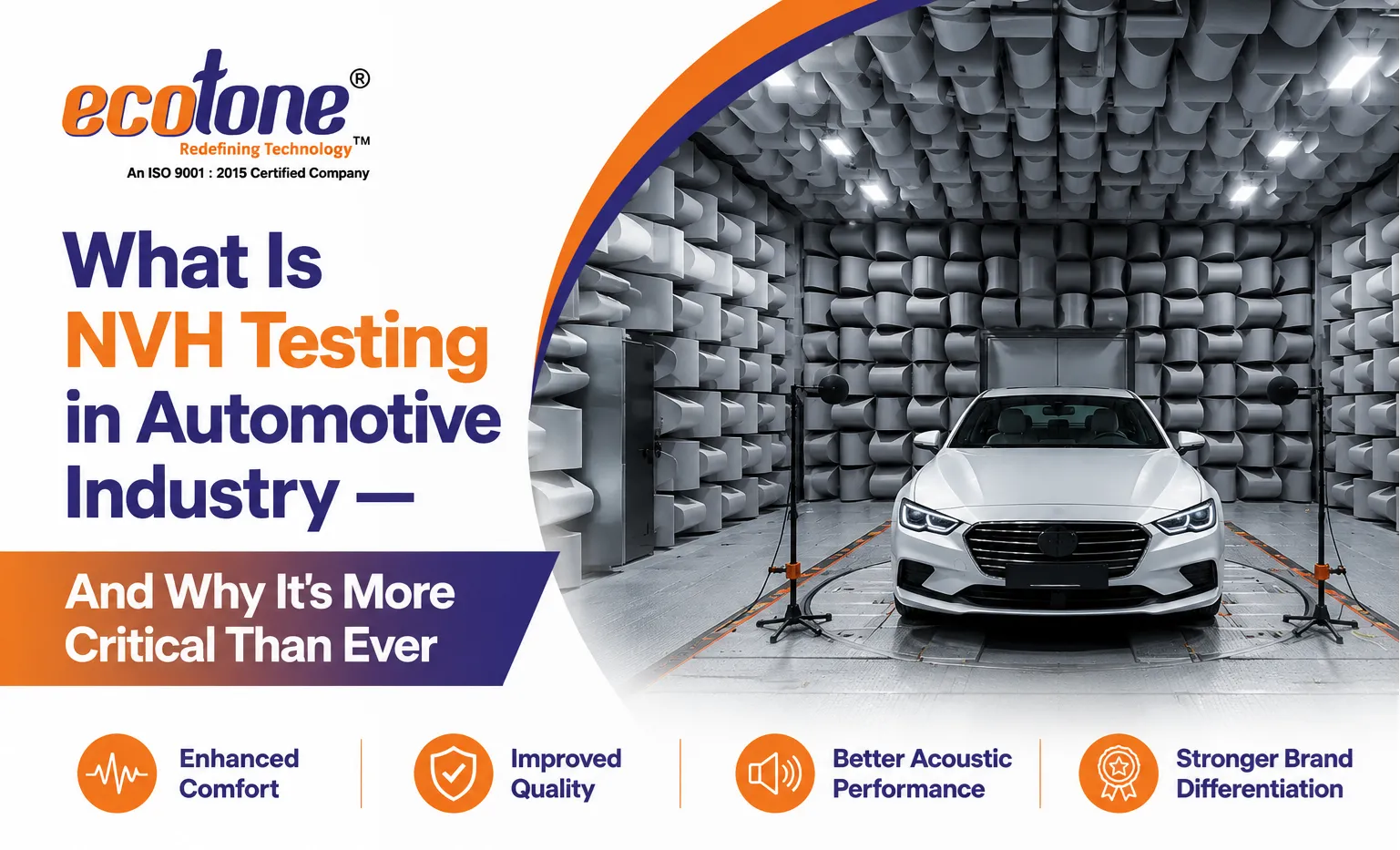
NVH stands for Noise, Vibration, and Harshness, which refers to the sound, vibration, and ride characteristics that engineers measure, analyze, and control in every vehicle. Close a car door in a well-built vehicle. You hear that solid, satisfying thunk. Not a rattle, not a hollow clap — just a clean, confident sound. Then you pull onto the highway and the cabin stays quiet, even as the speedometer climbs. That experience didn’t happen by luck. Dozens of engineers spent months making sure it did.
That’s NVH testing. And if you’ve never heard of it, you’ve almost certainly felt its results.
First — What Does NVH Even Stand For?
NVH is short for Noise, Vibration, and Harshness. Three separate things, but deeply connected in practice.
Noise is the acoustic side — engine hum, wind sneaking past door seals, road surfaces drumming through the floorboard, a pump somewhere whining at a frequency just annoying enough to notice after an hour of driving.
Vibration is physical. It moves through metal, through seat foam, through a steering wheel into your palms. Some vibration is expected — you’re sitting inside a machine, after all. But too much, or vibration at the wrong frequency, crosses a line from “driving a vehicle” to “being shaken inside a tin box.”
Harshness is harder to pin down, which is exactly what makes it interesting. It’s the combined feeling of too much noise and too much vibration hitting you at once. Engineers actually bring in groups of people, seat them inside test vehicles, and ask them to rate how uncomfortable things feel. That data gets fed back into the design process. It’s one of the few places in automotive engineering where “it just feels bad” is a valid technical input.
So, What Is NVH Testing in Automotive Industry?
At its core, NVH testing in the automotive industry is how manufacturers find and fix unwanted noise and vibration before a vehicle reaches the customer.
The process happens mostly during development — before production tooling is finalized, before parts go into high-volume manufacturing. Engineers take components like motors, gearboxes, pumps, and compressors and put them through controlled acoustic tests. They measure sound pressure levels, map vibration patterns, and look for resonance behavior that could become a problem in the real world.
The whole point is early detection. A gear whine that’s barely noticeable at the component stage can become genuinely unpleasant once that gearbox is bolted into a car chassis. Fix it at the component level, and you save enormous time and cost. Try to fix it after production starts, and you’re in trouble.
For Any Inquiries Please Email
Our team typically responds within 24 hours on business days.
Contact UsElectric Vehicles Changed Everything About NVH Testing
Here’s something most people don’t think about. In a petrol car, the engine is constantly making noise — and that noise actually covers up a lot of other sounds. A slightly noisy water pump, a faint rattle from the dashboard, a buzz from the HVAC blower. The engine drowns it all out.
Remove the engine, as electric vehicles do, and suddenly the cabin is very, very quiet. Which sounds like a good thing — until you realize every other sound that was previously hidden is now completely audible.
This is why NVH testing has become significantly more demanding in the EV era. An electric motor that would have been perfectly acceptable in a combustion vehicle might be genuinely annoying in a battery-electric one. Inverter whine, cooling fan noise, tire roar — all of it becomes the dominant acoustic experience. Getting that right requires serious infrastructure.
What Ecotone Systems Built in Chennai
This is where the engineering side gets genuinely interesting.
Ecotone Systems Pvt. Ltd. recently completed the design, manufacture, and installation of a custom NVH Test Chamber for a leading Automotive Test Systems Company in Chennai. Not an off-the-shelf solution — a purpose-built acoustic NVH testing environment engineered specifically for automotive component evaluation.
The facility needed a chamber that could deliver high-precision acoustic measurements while supporting the practical realities of a working test lab. Safe access, efficient test cycles, industrial durability, and — most importantly — acoustic performance rigorous enough to trust the data coming out of it.
Ecotone Systems delivered the full solution. Every element.
The chamber’s core is a multi-layer acoustic isolation structure — heavy steel construction combined with high-density insulation and internal absorption lining. The goal is simple: nothing from outside the chamber enters the measurement. Every decibel recorded inside comes only from the component being tested. That level of acoustic isolation is what separates a proper NVH testing chamber from a quiet room with foam on the walls.
One of the more distinctive engineering choices in this installation is the pneumatic sliding door. It operates vertically, driven by pneumatic cylinders, and seals the chamber with enough acoustic tightness to prevent sound leakage during NVH testing. Smooth, automated, repeatable — and it holds the acoustic seal that the whole chamber depends on.
The installation also included a vibration isolation system to decouple the chamber floor from structural vibration in the building, an integrated access platform for test operators, and complete acoustic absorption lining across internal surfaces.
What Gets Tested in a Chamber Like This?
Plenty. Electric motors under load, gearboxes running through their speed ranges, hydraulic pumps, fuel system components, inverters, drivetrain assemblies. Anything that rotates, pumps, or generates mechanical force is a candidate for NVH testing evaluation.
Each test asks essentially the same questions. Where is the noise coming from? At what frequency does it appear? Is there a structural resonance making it worse? And critically — does this component meet the acoustic standard the vehicle program requires?
A Wider Portfolio Behind That One Project
The Chennai installation reflects what Ecotone Systems does across a broader range of acoustic engineering solutions. NVH testing Chambers, Acoustic Enclosures, Reverberation Chambers, Sound Transmission Loss Chambers, Engine Test Cells, and Industrial Noise Control solutions — the company has built serious expertise across all of them.
For automotive manufacturers, NVH testing facilities, and research labs across India, Ecotone Systems has become a go-to partner when the acoustic environment itself needs to be engineered, not just assembled.
Because when you’re trying to measure sounds that are almost imperceptibly small, the room you measure them in matters just as much as the instruments you use.
Trusted by India's Leading Brands
Hover to pause · Logos scroll continuously