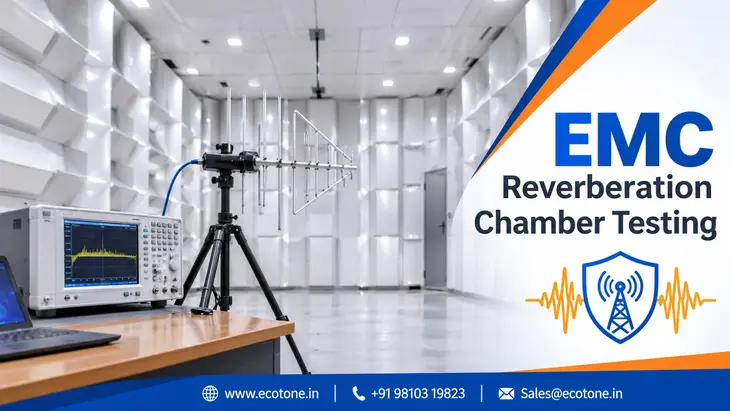
Electronic equipment must survive strong radio frequency fields. EMC Reverberation Chamber Testing checks this by exposing a product to a controlled, uniform field inside a shielded metal room. If you are comparing a Reverberation Chamber Manufacturer , this guide explains what the method involves and what to ask.
What Is EMC Reverberation Chamber Testing?
It is a test method where a metal cavity and a rotating paddle create a statistically uniform electromagnetic field. IEC 61000-4-21 sets the procedures for IEC 61000-4-21 testing, including radiated immunity testing.
How does a mode-stirred chamber work?
A paddle rotates and changes the field pattern inside the room. Over a full rotation, the average field becomes uniform around the equipment under test. This is the mode-stirred chamber approach.
What is a mode-tuned chamber?
A mode-tuned chamber moves the paddle to fixed positions and measures at each step. A mode-stirred chamber rotates it continuously. Both are common, and your test plan decides which suits you.
What is the lowest usable frequency?
The lowest usable frequency is the point below which the field is no longer statistically reliable. Chamber size mainly sets it, so larger chambers reach lower frequencies. Ecotone lists four models (RVC-80, RVC-200, RVC-400 and RVC-1000).
What Are the Benefits?
RF Field Uniformity
The paddle averages the field, which supports repeatable results across test runs.
Efficient High-Field Testing
Reverberation chambers can reach strong fields without the very large amplifiers some other methods need. Confirm achievable levels per model.
Handling and Installation
Ecotone’s acoustic chambers are offered in modular, relocatable and custom-built forms. Ask whether the same applies to your EMC model. Installation usually covers site study, shell build, paddle system, instrumentation and field uniformity verification.
A Note on Echo Reduction
Echo control is an acoustic goal. An EMC chamber is built to reflect energy, not absorb it.
Is an EMC Reverberation Chamber Porous?
No. It needs a sealed, conductive shell so the field stays inside and outside signals stay out. Porous absorbers belong to anechoic rooms. Acoustic chambers also reflect sound, but they work differently. For that side, see Acoustic Reverberation Chamber Design .
Where Is It Applied?
Manufacturing Plants
Control panels, drives and sensors.
Power Plants
Protection relays and control electronics.
Data Centres
Servers and networking hardware.
Hospitals
Medical electronics that must resist interference.
Airports, Metro and Railway Facilities
Signalling and communication equipment.
Oil and Gas Facilities
Instrumentation used near heavy electrical load.
Technical Specifications
| Parameter | Detail |
|---|---|
| Governing standard | IEC 61000-4-21 |
| Models listed | RVC-80, RVC-200, RVC-400, RVC-1000 |
| Test focus | Radiated immunity testing |
| Stirring method | Paddle system (mode-stirred or mode-tuned) |
| Lowest usable frequency | Depends on size; confirm per model |
| Dimensions, shielding, NRC, fire class, recycled content | Request from Ecotone |
Why Ecotone Systems?
Ecotone’s site states ISO 9001:2015 certification, 40+ years of experience and 500+ completed projects. Its listed clients include DRDO, HAL and IIT Kanpur. Its stated scope covers design, manufacture, installation and qualification of reverberation chambers.
Frequently Asked Questions:
What is EMC Reverberation Chamber Testing used for?
It checks whether equipment withstands strong RF fields, using the uniform field created by a paddle.
How much does a chamber cost?
No price is published. Cost depends on size, shielding, design, quantity and installation. Request a quotation.
Which facilities benefit?
Industrial plants, data centres, hospitals, transport systems, power and oil and gas sites rely on equipment tested this way.
Does the chamber use recycled materials?
No recycled content claim is published for these chambers. Ask Ecotone for material details.
Does it reduce echo?
No. Echo control is an acoustic concern. An EMC chamber is designed to reflect electromagnetic energy.