Our Clients
Trusted by India's Leading Brands
Hover to pause · Logos scroll continuously
500+
Projects Completed
40+
Years Experience
200+
Happy Clients
15+
States Covered













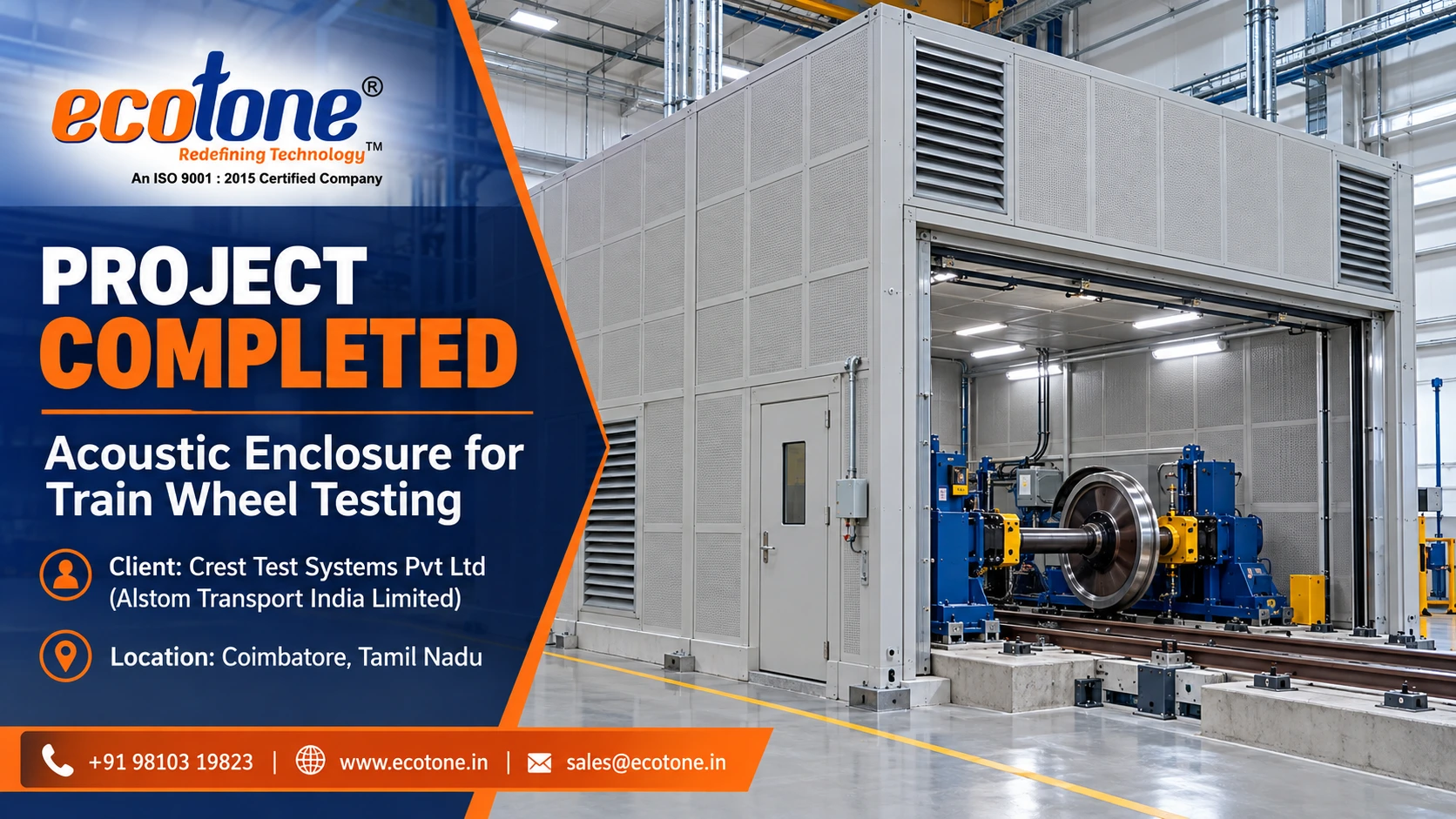
When Crest Test Systems Pvt Ltd was setting up a wheel testing line for Alstom Transport India Limited at their Coimbatore facility, the challenge wasn’t just building an enclosure — it was building one that could survive a testing regime most industrial noise-control solutions were never designed for.
Most acoustic enclosures are specified for steady-state noise: a compressor humming, a DG set running at a fixed load, a blower turning at constant RPM. Train wheel testing doesn’t work that way. A wheelset under test goes through repeated load cycles, sudden impact events, and rotational noise that shifts in intensity as the test progresses. An enclosure built for constant noise will underperform the moment it meets a load spike it wasn’t designed to absorb.
For a facility supplying test data to an OEM like Alstom, that gap isn’t just a comfort issue — it affects whether the site can run continuous test cycles without noise complaints, compliance flags, or downtime to fix an underperforming enclosure after the fact.
Our team typically responds within 24 hours on business days.
Contact UsRather than adapting a standard enclosure design, Ecotone Systems’ engineering team worked backward from the wheel testing rig’s actual duty cycle — its peak impact noise, its rotational frequency range, and its heat output under sustained operation. That meant three design decisions carried more weight than usual:
Panel selection for a wider noise band. The composite panel buildup, layering a dense outer skin over a high-density mineral wool or acoustic foam core, was sized to handle impact peaks as well as continuous noise, not just an average dB(A) figure.
Ventilation calculated, not templated. A lined, baffled air path was sized specifically to the rig’s heat load, so the enclosure could vent hot air without opening a straight-line path for sound to travel through — the single most common weak point in enclosures that look fine on paper but leak noise on site.
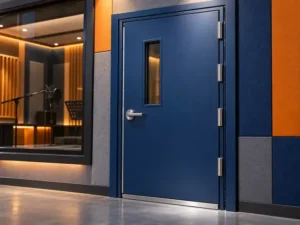
Access built for a working test lab. Vision panels and properly sealed doors let technicians observe and reach the rig mid-cycle without repeatedly breaking the acoustic seal, something a testing facility running frequent cycles can’t compromise on.
Every panel and duct run was mapped out in AutoCAD assembly drawings before fabrication, so the crew erecting the enclosure on site in Coimbatore was working from an exact plan rather than adjusting on the fly.
The enclosure hit its target noise reduction on the first test — no follow-up work on the door seals, no adjustments to the ventilation path. That matters more than it might sound: door gaskets and duct leaks are typically where enclosures start failing months after installation, not on day one. Getting both right at commissioning meant the Coimbatore facility could move straight into regular testing operations without a punch list of fixes trailing behind the install.
Rail component testing is a niche application, but the lesson from this project applies broadly: an enclosure’s real performance comes from how well it’s matched to the machine’s actual behaviour, not from a panel’s lab-rated STC number. For anyone evaluating an acoustic enclosure manufacturer for a testing environment, this project is a working example of what that match looks like in practice — and what it takes to get it right the first time.
Hover to pause · Logos scroll continuously