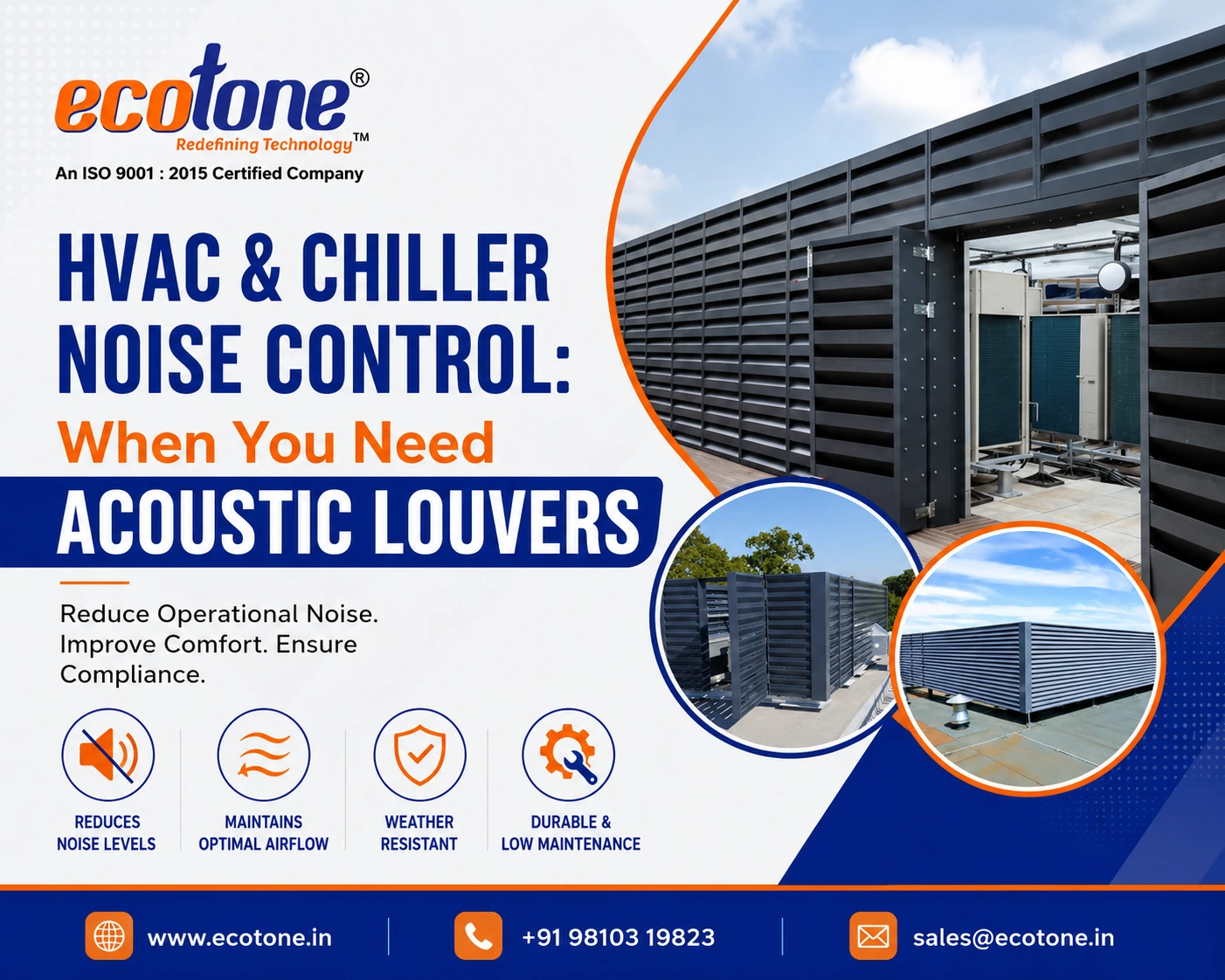
The complaint usually starts small. A tenant mentions the hum from the roof during a lease renewal call. A neighbour email the property office about noise after 10pm. Then, if nothing changes, it stops being a polite email and becomes a formal complaint to the city. By the time most facility managers start researching a fix, they’re already somewhere on that timeline — which is exactly the position HVAC acoustic louvers are built to solve.
Unlike a full enclosure, which wraps around a piece of equipment, acoustic louvers are typically installed at the openings themselves — the wall or screen where a mechanical room, chiller yard, or rooftop unit needs air to move freely but sound needs to stay contained. At Ecotone Systems, this is one of the most common noise control questions we get: whether HVAC acoustic louvers are the right call for a specific building, and what actually separates an effective one from a louver that just looks the part.
Why Rooftop and Mechanical Room Equipment Gets This Loud
Large fans, compressors under load, and refrigerant lines vibrating against sheet metal all add up fast. Measured close to the source, a chiller or rooftop unit regularly hits 75 to 95 dB — loud enough to travel a long way across an open roof or straight through a screen wall that was never designed with acoustics in mind.
Three situations tend to push that noise from “background hum” into “active complaint”:
- Mixed-use buildings where a mechanical room or rooftop equipment sits close to residential units
- Dense urban lots where property lines sit close enough that sound carries straight into a neighbor’s space
- Older buildings where the mechanical yard or screen wall was built before current noise codes existed, and now falls short simply because the rules changed around it
The equipment isn’t broken in any of these cases. It’s working exactly as designed. The sound is just escaping through an opening that was never built to manage it.
For Any Inquiries Please Email
Our team typically responds within 24 hours on business days.
Contact UsWhat Acoustic Louvers Actually Do
A standard louver — the kind found on most mechanical screen walls and equipment yards — is built for weather protection and airflow, full stop. Acoustics were rarely part of the original design. HVAC acoustic louvers take that same basic form (angled blades that let air pass while blocking rain and debris) and add internal acoustic treatment, usually perforated metal facing over a sound-absorptive core, engineered specifically to attenuate noise as air moves through.
The mechanism comes down to a few things working together. Deeper blade depth gives sound waves a longer path to travel before they escape, which matters more than most people expect. Absorptive fill inside the blades — commonly mineral wool — converts sound energy into heat instead of letting it reflect straight through. And careful attention to free area, meaning the actual open space air can move through, keeps the unit’s cooling performance intact rather than choking it off in the name of noise reduction.
That last point is where a lot of louver installations go wrong. Add too much acoustic material and you cut airflow enough to stress the equipment behind it. Too little, and the noise reduction barely registers. Getting HVAC acoustic louvers right means balancing both requirements at once, not optimizing one at the expense of the other.
How Do You Know You Need Them?
Not every mechanical yard or rooftop screen needs acoustic treatment. Here’s what usually tips the decision:
A tenant or neighbor has already complained. This is the most common trigger, and it rarely resolves on its own — one documented complaint is often reason enough to act before it escalates into a lease dispute.
You’ve received a noise violation notice. Most cities cap decibel levels at the property line, often with stricter limits after 10 or 11pm. Equipment that runs continuously puts a building on a compliance clock the moment a notice arrives.
You’re planning new construction or a major retrofit near residential space. Specifying HVAC acoustic louvers into the original design is far cheaper than retrofitting after complaints start rolling in.
Your project is targeting LEED, WELL, or similar certification. Acoustic comfort keeps showing up more heavily in scoring criteria, and louvers designed for noise control support that goal without adding bulk to the building envelope.
A sound survey shows nighttime dB levels over the local limit. This is usually the clearest signal of all — when the numbers say you’re over the line, acoustic louvers are often the least disruptive fix available, especially compared to relocating equipment or rebuilding a screen wall entirely.
Acoustic Louvers vs. a Full Enclosure
Facility managers sometimes assume an enclosure is the only option, but for many rooftop and mechanical yard situations, acoustic louvers are the better fit. Enclosures wrap tightly around individual pieces of equipment and tend to work best when a single unit needs significant, targeted noise reduction. Louvers, on the other hand, are built into the openings of a larger structure — a mechanical room wall, a rooftop screen, an equipment yard fence — and make more sense when the goal is managing airflow openings across a broader space rather than isolating one unit.
Neither is universally better. It comes down to the layout: existing screen walls and openings tend to favor louvers, while standalone equipment with no surrounding structure often calls for an enclosure instead.
What to Look for When Sourcing HVAC Acoustic Louvers
A few things worth checking before committing to a supplier:
Tested acoustic performance data, not just a general noise-reduction claim
Free area percentage, confirmed against your equipment’s actual airflow requirements
Weather performance, since louvers still need to keep out rain and debris while doing acoustic work
Blade depth and construction, since deeper, well-engineered blades typically outperform shallow ones on noise attenuation
Custom sizing capability, since screen walls and mechanical openings rarely match standard dimensions exactly
How Ecotone Systems Approaches This
Every project starts with an on-site or remote noise assessment — actual dB readings, the noise code that applies to the property, and the airflow requirements of the equipment behind the opening. From there, Ecotone Systems designs HVAC acoustic louvers around the specific opening size, airflow needs, and target noise reduction, rather than pulling a generic size off a shelf and hoping it fits.
Final Thoughts
Rooftop and mechanical yard noise complaints tend to get more expensive the longer they sit — through fines, tenant turnover, or a strained relationship with whoever’s next door. HVAC acoustic louvers address the problem right at the opening where sound is escaping, without sacrificing the airflow your equipment needs to run properly.
If rooftop or mechanical room noise has landed on your desk, Ecotone Systems can help you figure out whether acoustic louvers are the right call for your building and design something built around your actual equipment and openings. Reach out for a free noise consultation to see what it would take to quiet things down for good.
Frequently Asked Questions
How much noise reduction can HVAC acoustic louvers provide?
Performance varies with blade depth and design, but well-engineered HVAC acoustic louvers typically reduce noise by 10-20 dB at the opening — enough to meaningfully cut how loud equipment sounds beyond the property line, depending on the specific application.
Will acoustic louvers restrict airflow to my equipment?
Not if they’re sized correctly. The key is matching the louver’s free area to your equipment’s actual airflow requirements — undersized or overly dense acoustic treatment is what causes performance issues, not the presence of acoustic material itself.
Are acoustic louvers or a full enclosure better for rooftop equipment?
It depends on the layout. Louvers work well when equipment sits behind an existing screen wall or opening; enclosures make more sense for standalone units with no surrounding structure. Many facilities end up using both in different spots.
How long does it take to install HVAC acoustic louvers?
Standard-sized replacements for existing openings can often be installed in a day or two. Custom-sized louvers for irregular screen walls or mechanical yards typically take several weeks from design to installation, depending on opening size and site access.
Can acoustic louvers resolve a noise violation on their own?
In many cases, yes — since the underlying issue is usually how sound escapes through an opening rather than a defect in the equipment itself. That said, a full noise assessment is the best way to confirm louvers alone will bring a site back into compliance versus needing additional treatment.
Trusted by India's Leading Brands
Hover to pause · Logos scroll continuously