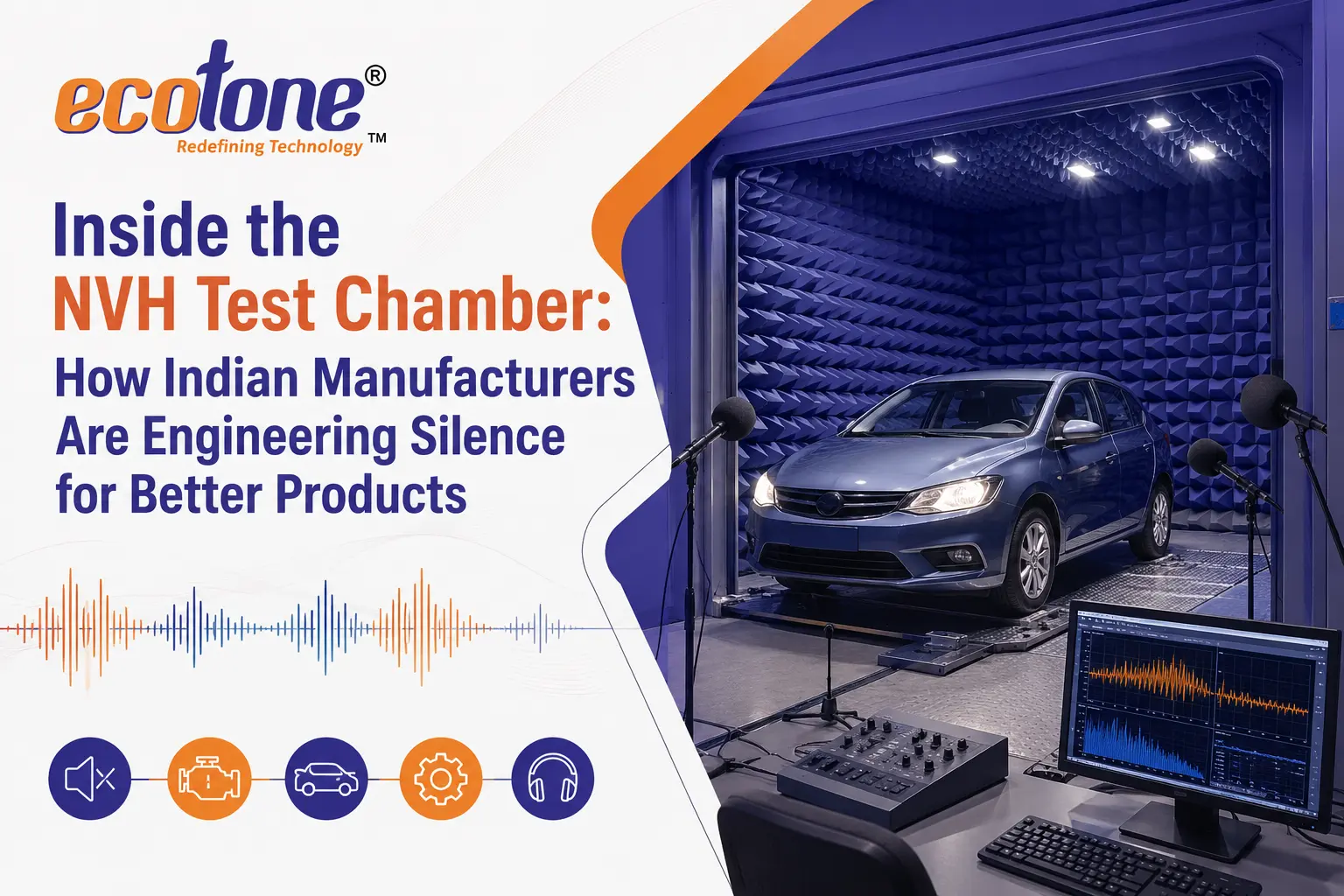
Step onto an automotive shop floor, an appliance R&D lab, or an aerospace component facility and you’ll usually find that the quietest room in the building is also the most important one. That room is an NVH test chamber. It’s where engineers go to find out what a product actually sounds like once every other noise source has been removed from the equation.
Noise, vibration, and harshness testing didn’t used to get much attention. Now it’s one of the things manufacturers obsess over. An electric vehicle motor, a washing machine compressor, a jet engine bracket, a 5G antenna mount — at some point, each of these has to answer a fairly blunt question: how does it sound and feel once you put it under real, controlled stress? That’s the job this kind of acoustic facility is built for.
This piece walks through what an NVH test chamber actually does, how it compares to the other acoustic environments engineers rely on, and why so many industries (automotive especially, but also electronics, defense, and consumer appliances) have started treating this infrastructure as essential rather than optional. Along the way we’ll get into anechoic chambers, semi anechoic chambers, reverberation chambers, noise test booths, anechoic wedges, and metallic anechoic wedges — the full toolkit, more or less.
What Is an NVH Test Chamber, really?
Strip away the acronym and an NVH test chamber is just a carefully built room. Its job is to isolate a product or component from outside noise and vibration so engineers can measure its own acoustic and vibrational signature without interference. NVH stands for Noise, Vibration, and Harshness — three things that sound similar but aren’t quite the same.
Noise is the audible part, the sound you can actually hear. Vibration is the physical movement transmitted through a structure — a floor, a seat, a housing. Harshness is harder to pin down because it’s about perception: how unpleasant or jarring a given noise-and-vibration combination feels to an actual person sitting in the car or standing next to the machine. A loud engine can still feel smooth. A quiet one can feel rough and cheap. Separating those qualities, rather than lumping them together, is most of what this kind of testing is for.
Inside the chamber, the walls, ceiling, and often the floor are lined with material that absorbs sound rather than bouncing it back. That detail matters more than it might seem. In a normal room, sound reflects off every hard surface and mixes with the original signal, which makes it nearly impossible to isolate what a part is actually doing acoustically. Strip the reflections out and you get something close to free-field conditions — like standing in an open field with nothing nearby to bounce sound back at you.
This is roughly why an NVH test chamber has become non-negotiable in industries where acoustic comfort, vibration limits, or noise compliance directly affect whether a product passes inspection or gets returned by an unhappy customer.
For Any Inquiries Please Email
Our team typically responds within 24 hours on business days.
Contact UsWhy Industries Are Investing Heavily in NVH Test Chambers
Not that long ago, noise and vibration testing happened at the end of the line — almost an afterthought, something you checked once the design was already locked in. That’s shifted. Electric vehicles don’t have a loud engine to hide behind anymore, 5G networks are scaling fast, and people expect appliances that don’t sound like they’re falling apart. As a result, this kind of testing now happens early, often well before a product is anywhere near finished.
Take EVs as an example. Without engine noise masking everything else, a slightly whining motor or a loose bracket rattle becomes obvious almost immediately to a driver who would never have noticed it in a combustion vehicle. Manufacturers catch these issues in dedicated acoustic chambers long before a vehicle ever reaches a dealership. 5G hardware goes through something similar — base stations and antenna assemblies get tested for vibration tolerance and acoustic behavior under high-frequency conditions that didn’t really exist as a testing category a few years back.
Home appliances follow the same logic, just with lower stakes and tighter margins. A washing machine that shakes too hard during a spin cycle, or a fridge compressor that hums louder than it should, shows up in reviews fast. An NVH test chamber gives manufacturers actual numbers to work with instead of someone on the factory floor saying “yeah, that sounds about right” and moving on.
Anechoic Chambers: The Foundation of Free-Field Acoustic Testing
To make sense of any of this, it helps to start with the anechoic chamber, since it’s really the parent concept behind most of what an NVH facility is doing.
An anechoic chamber is a room built to almost completely eliminate sound reflections and outside interference. The name comes from “an-echoic” — without echo, more or less exactly what it sounds like. Every interior surface, walls, ceiling, sometimes the floor too, gets treated with absorptive material so sound waves don’t bounce back into the space. What you end up measuring is the direct sound coming off the test object itself, with almost nothing reflected or ambient mixed in.
Why does that matter so much? Because even tiny echoes can throw off a frequency measurement. If an engineer is trying to characterize the exact output of a speaker, a vehicle part, or some electronic device, a small reflected echo can distort the data just enough to be a problem. An anechoic chamber takes that variable off the table entirely — it’s the closest thing to testing in an open field with nothing nearby.
Ecotone Systems builds full anechoic chambers, semi anechoic chambers, hemi anechoic chambers, and smaller mini anechoic chambers, designed around international standards like ISO 3744 and ISO 3745. These show up across automotive testing, appliance development, defense work, and academic research — basically anywhere precise, repeatable acoustic measurement isn’t optional.
Semi Anechoic Chambers: Built for Real-World Testing Conditions
A full anechoic chamber absorbs sound on every surface, including the floor. A semi anechoic chamber does something different on purpose: walls and ceiling get the absorptive treatment, but the floor stays solid and reflective. That’s not a compromise so much as a practical fix for a real problem.
Heavy test objects — full vehicles, engines, large industrial equipment — need something solid underneath them. A soft, fully absorptive wedge floor simply can’t carry that kind of weight reliably over time. A semi anechoic chamber splits the difference: tightly controlled acoustic conditions overhead and on the walls, paired with a load-bearing floor that, conveniently, also mimics how sound behaves on real pavement under a moving vehicle.
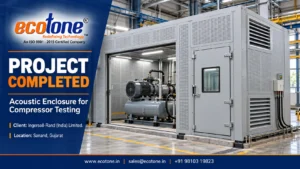
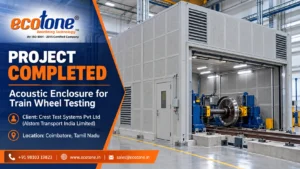
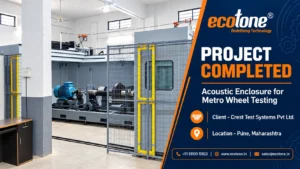
This setup turns out to be especially useful for automotive work. Vehicle run-up tests, steering wheel vibration checks, engine bay noise evaluation, exhaust and intake measurement, seat rail vibration — all of it tends to happen inside this type of chamber. Engineers also use it to study powertrain mounting behavior, structure-borne noise, and where exactly a noise source is hiding inside a complex assembly.
Ecotone Systems builds semi anechoic chambers specifically for automotive component and full-vehicle testing, compliant with standards like ISO 3744. The flooring is built to handle heavy equipment without compromising the acoustic treatment on the walls and ceiling above it.
Reverberation Chambers: Measuring Sound Power, Not Direction
Here’s the counterintuitive part: sometimes engineers actually want a room that reflects sound instead of absorbing it. That’s the whole point of a reverberation chamber, and it does a job that’s genuinely different from what an anechoic chamber or an NVH facility is built for.
A reverberation chamber uses hard, reflective surfaces to create a highly diffuse acoustic field. Rather than measuring sound coming from one direction, engineers use that reflected, bouncing field to calculate total sound power — how loud a machine actually is overall, regardless of which way the sound happens to travel. That makes reverberation chambers genuinely useful for things like HVAC equipment, industrial machinery, generators, and household appliances, where the question is total output, not direction.
They’re also used to test how well acoustic materials themselves absorb sound — wall panels, insulation products, that sort of thing — since a reverberant environment makes it easier to measure how much sound a material lets through versus how much it eats.
The catch is that a reverberation chamber can’t simulate free-field conditions the way an anechoic chamber can, so it’s not the right tool for directional analysis or fine electro-acoustic work. But for sound power compliance and product certification, it’s hard to beat on cost and reliability. A lot of facilities end up running both — a reverberation chamber and an anechoic chamber — depending on which question they’re actually trying to answer that day.
Noise Test Booths: Compact, Practical Acoustic Control
Not everything needs a walk-in chamber. For smaller components, routine quality checks, or testing built directly into a production line, a noise test booth is usually the more sensible option.
A noise test booth is a smaller acoustic enclosure meant to isolate one product or component for measurement, without the footprint or cost of a full chamber build. Manufacturers who need repeatable, standardized noise testing baked into their production process — rather than a separate dedicated facility — tend to lean on these.
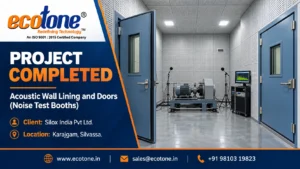
The booths still borrow the same sound-absorbing and vibration-isolation principles as larger acoustic chambers, just scaled down for smaller objects: motors, compressors, electronic devices, sub-assemblies. If you’re running high volumes of quality checks, building a noise test booth into the line usually makes more sense than dedicating real estate to a full chamber for routine work.
Anechoic Wedges: The Material Science Behind Silence
None of these chambers do anything without the right material on their walls, and that’s where anechoic wedges come in.
If you’ve ever seen photos of a recording studio or acoustic lab, you’ve probably noticed those pyramid or wedge-shaped foam structures lining the walls. The shape isn’t decorative — it’s the actual mechanism. The angled surfaces force sound waves to bounce around internally multiple times within the wedge instead of reflecting straight back into the room. Each internal bounce bleeds off a bit more energy into the foam, until there’s almost nothing left to reflect.
This geometry handles a much wider range of frequencies than a flat panel ever could, which is why it’s become the default treatment in anechoic chambers, semi anechoic chambers, and most other acoustic chamber builds. The depth and density of the wedges get calculated around the lowest frequency the chamber needs to absorb — lower frequencies need deeper wedges, full stop.
Metallic Anechoic Wedges: Engineered for Demanding Industrial Environments
Foam wedges work great in most settings, but some industrial, defense, and research environments need something tougher. That’s the gap metallic anechoic wedges fill.
Instead of foam, these are built from rigid metal structures designed to hold their acoustic performance even in conditions that would degrade foam over time — moisture, chemical exposure, general industrial wear. The rigid core resists deformation, so the wedge geometry, and therefore the absorption performance, stays consistent for years rather than slowly drifting.
These tend to show up where measurement accuracy and mechanical toughness both matter: automotive NVH testing chambers that take a beating from heavy equipment, aerospace acoustic facilities, electroacoustic product labs, defense and telecom research sites, and industrial spaces where hygiene or chemical resistance isn’t negotiable.
Ecotone Systems manufactures metallic anechoic wedges built for exactly these conditions — a longer-lasting, lower-maintenance alternative wherever foam simply won’t hold up.
Choosing the Right Chamber for Your Testing Needs
With this many options on the table, anechoic chambers, semi anechoic chambers, reverberation chambers, noise test booths, it’s worth just asking directly: which one actually fits what you’re trying to measure?
If precision and directional accuracy are the priority, go with a full anechoic chamber. If you’re testing something heavy that still needs a load-bearing surface, a semi anechoic chamber is the better fit. If the question is total sound power for compliance or certification, a reverberation chamber usually gets there faster and cheaper. And for smaller-scale or production-line testing, a noise test booth tends to be the practical answer.
Most facilities, in practice, don’t pick just one. They build out a mix — early-stage component checks in a noise test booth, full-system validation later in a dedicated acoustic chamber — depending on where a product is in its development cycle.
Final Thoughts on Industrial Acoustic Testing Infrastructure
As products across automotive, electronics, telecom, and consumer appliances keep getting more complex, the need for precise, standards-compliant acoustic testing infrastructure isn’t going away. An NVH test chamber, backed by the right mix of anechoic chambers, semi anechoic chambers, reverberation chambers, noise test booths, anechoic wedges, and metallic anechoic wedges, gives engineers something to actually work from instead of guesswork.
Ecotone Systems has built its name around delivering this kind of infrastructure end to end — consultancy through turnkey installation — for clients across automotive, aerospace, defense, telecom, and consumer electronics. As testing standards keep tightening and products keep getting quieter, well-engineered acoustic environments are only going to matter more. Ecotone Systems continues building chamber designs around real industrial needs rather than generic, one-size-fits-all setups.
Trusted by India's Leading Brands
Hover to pause · Logos scroll continuously