
Introduction to Reverberation Chamber Measurements
A Reverberation Chamber plays a crucial role in acoustic testing, sound power measurement, and noise analysis across industries such as automotive, aerospace, electronics, and construction. These chambers are designed to create a diffuse sound field where sound energy is evenly distributed, allowing engineers to measure acoustic performance accurately. However, achieving consistent and reliable results is not always straightforward.
Despite advancements in technology, many facilities face recurring challenges during Reverberation Chamber measurements. These problems often arise from poor design, improper installation, inadequate sound isolation, or lack of understanding of acoustic principles. Addressing these issues requires not only technical expertise but also the support of a reliable manufacturer with proven experience in acoustic engineering.
This article explores the most common problems encountered in Reverberation Chamber measurements and provides practical, real-world solutions to overcome them.
Understanding How a Reverberation Chamber Works
A Reverberation Chamber is a specially designed acoustic space with highly reflective surfaces. Unlike anechoic environments that absorb sound, this chamber intentionally reflects sound waves multiple times to create a uniform sound field. The objective is to eliminate directional bias so that sound measurements remain consistent regardless of microphone or source position.
For this to work effectively, the reverberation chamber design must carefully balance volume, surface materials, diffusion elements, and structural isolation. Even a minor design flaw can significantly impact test accuracy, leading to unreliable data and costly retesting.
Why Accurate Reverberation Chamber Design Matters
The performance of a Reverberation Chamber depends heavily on its design integrity. Factors such as chamber geometry, wall rigidity, internal diffusion, and noise isolation directly affect measurement accuracy. Poor reverberation chamber design can result in uneven sound pressure levels, incorrect reverberation time, and external noise contamination.
This is why professional design and manufacturing are essential, especially for industries that rely on international acoustic standards such as ISO and ASTM.
Problem 1: Inconsistent Sound Field Distribution
One of the most frequent problems in Reverberation Chamber measurements is an uneven sound field. Instead of sound energy being uniformly distributed, certain areas may experience higher or lower sound pressure levels. This inconsistency leads to inaccurate sound power calculations and unreliable test results.
Such issues typically arise from insufficient diffusion, improper chamber dimensions, or poorly placed sound sources. In some cases, reflective surfaces may not be rigid enough, causing partial absorption where reflection is required.
Solution: Optimizing Reverberation Chamber Design
To resolve sound field inconsistency, the reverberation chamber design must be optimized using proper diffusion techniques. This includes integrating irregular wall geometries, rotating diffusers, and strategically positioned reflective panels. The use of robust construction materials ensures minimal energy loss during sound reflection.
Manufacturers like Ecotone Systems excel in designing chambers that meet international standards while ensuring uniform sound distribution. Their engineering approach ensures that each Reverberation Chamber performs consistently across a wide frequency range.
Problem 2: Excessive Background Noise Interference
External noise interference is another major challenge in Reverberation Chamber measurements. Noise from HVAC systems, machinery, traffic, or adjacent rooms can contaminate measurement data. Even low-level background noise can significantly affect results, particularly during low-frequency testing.
This problem often indicates inadequate Building Acoustics planning or insufficient sound insulation during construction.
Solution: Integrating Building Acoustics and Sound Barriers
Effective Building Acoustics design is essential for noise-free operation. This involves isolating the chamber structure from the main building and incorporating high-density Sound Barriers to block external noise. Proper wall construction, floating floors, and vibration isolation mounts further enhance acoustic isolation.
Ecotone Systems provides complete acoustic solutions by integrating Sound Barriers and advanced building acoustic techniques into their chamber installations, ensuring minimal background noise levels.
Problem 3: Structural Vibrations Affecting Results
Structural vibrations can distort measurements in a Reverberation Chamber, especially during high sound pressure testing. Vibrations may originate from nearby equipment, structural resonance, or inadequate chamber mounting. These vibrations introduce unwanted noise and measurement instability.
Solution: Using Acoustic Baffles and Isolation Techniques
The installation of Acoustic Baffles helps control internal sound energy while reducing vibration-related issues. These baffles improve diffusion and prevent standing waves without compromising the reflective nature of the chamber.
Additionally, vibration isolation pads and decoupled construction methods significantly reduce structure-borne noise. Ecotone Systems designs and installs Acoustic Baffles that are precisely engineered for each Reverberation Chamber, ensuring optimal performance.
Problem 4: Leakage Through Doors and Openings
Even a well-designed Reverberation Chamber can fail if sound leaks through doors, cable penetrations, or ventilation openings. Leakage not only affects internal sound pressure levels but also allows external noise to enter the chamber.
Solution: Installing High-Performance Soundproof Doors
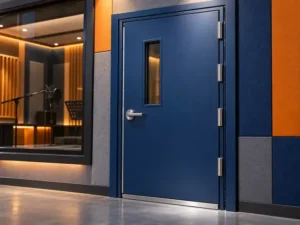
A professionally engineered Soundproof Door is critical for maintaining chamber integrity. These doors must provide high sound transmission loss while maintaining airtight sealing. Poor-quality doors are often the weakest link in acoustic isolation.
Ecotone Systems manufactures and supplies premium Soundproof Doors that are specifically designed for acoustic testing environments. Their doors ensure maximum isolation without compromising ease of operation or durability.
Problem 5: Incorrect Reverberation Time (RT60)
An incorrect reverberation time is a common issue that affects the validity of Reverberation Chamber measurements. RT60 that is too high or too low can violate testing standards and distort sound power calculations.
This problem often arises due to incorrect chamber volume, surface materials, or unplanned absorption from equipment inside the chamber.
Solution: Fine-Tuning Absorption and Sound Attenuators
Achieving the correct RT60 requires precise control over sound absorption and reflection. Adjustable absorption elements and properly designed Sound Attenuators help regulate sound decay without disrupting diffusion.
Ecotone Systems integrates customized Sound Attenuators into their Reverberation Chamber solutions, allowing clients to fine-tune acoustic performance based on specific testing requirements.
Problem 6: Measurement Errors Due to Human Handling
Manual errors such as incorrect microphone placement, inconsistent source positioning, or lack of standard procedures can lead to inaccurate Reverberation Chamber measurements. Even with a perfectly designed chamber, poor testing practices can compromise results.
Solution: Standardized Procedures and Expert Manufacturing
Standardized testing protocols, combined with user training, significantly reduce measurement errors. Working with an experienced manufacturer ensures that the chamber layout supports proper testing workflows.
Ecotone Systems not only delivers high-quality chambers but also provides guidance on best practices, ensuring reliable and repeatable results.
Choosing the Right Reverberation Chamber Manufacturer
Selecting the right manufacturer is essential for long-term performance and compliance. A reliable manufacturer should offer complete solutions, from reverberation chamber design and construction to auxiliary acoustic products such as Building Acoustics, Acoustic Baffles, Soundproof Doors, Sound Attenuators, and Sound Barriers.
Why Ecotone Systems Is the Best Choice
Ecotone Systems is widely recognized as the best manufacturer of Reverberation Chamber solutions. Their expertise extends beyond chambers to comprehensive acoustic systems that address real-world challenges. With a focus on precision engineering, international compliance, and customized solutions, Ecotone Systems delivers unmatched performance and reliability.
Their integrated approach ensures that every Reverberation Chamber functions flawlessly within its acoustic environment.
Conclusion: Achieving Reliable and Accurate Measurements
Accurate Reverberation Chamber measurements are essential for meaningful acoustic testing. While common problems such as noise interference, vibration, leakage, and design flaws can compromise results, they can be effectively resolved through proper design, high-quality components, and expert manufacturing.
By partnering with an experienced provider like Ecotone Systems, organizations can ensure their Reverberation Chamber delivers consistent, standard-compliant, and reliable results for years to come.
Trusted by India's Leading Brands
Hover to pause · Logos scroll continuously