Anechoic Wedges Manufacturer | Acoustic PU Foam
Summary: Anechoic wedges are pyramid-shaped sound absorbing elements, made either from fire-retardant polyurethane (PU) foam or from fiberglass-filled perforated metallic sheet, that line the interior surfaces of an anechoic chamber to absorb sound energy and eliminate reflections. This page is written for acoustic chamber builders, automotive and aerospace test labs, and facility engineers in India who are specifying anechoic wedge material, comparing PU foam against metallic wedges, or trying to understand what a tested absorption coefficient actually means before ordering.
Is This Anechoic Wedges Guide Right for You?
01
Who It's For
Anechoic and semi-anechoic chamber builders, automotive NVH labs, engine test cell operators, and acoustic research facilities that need sound absorbing wedge material for a new chamber or a chamber refurbishment.
02
When to Use This Guide
Before finalising an anechoic wedges manufacturer in India, while comparing PU foam and metallic wedge options, or when specifying wedge material for a chamber that needs to absorb low frequency sound.
What Are Anechoic Wedges?
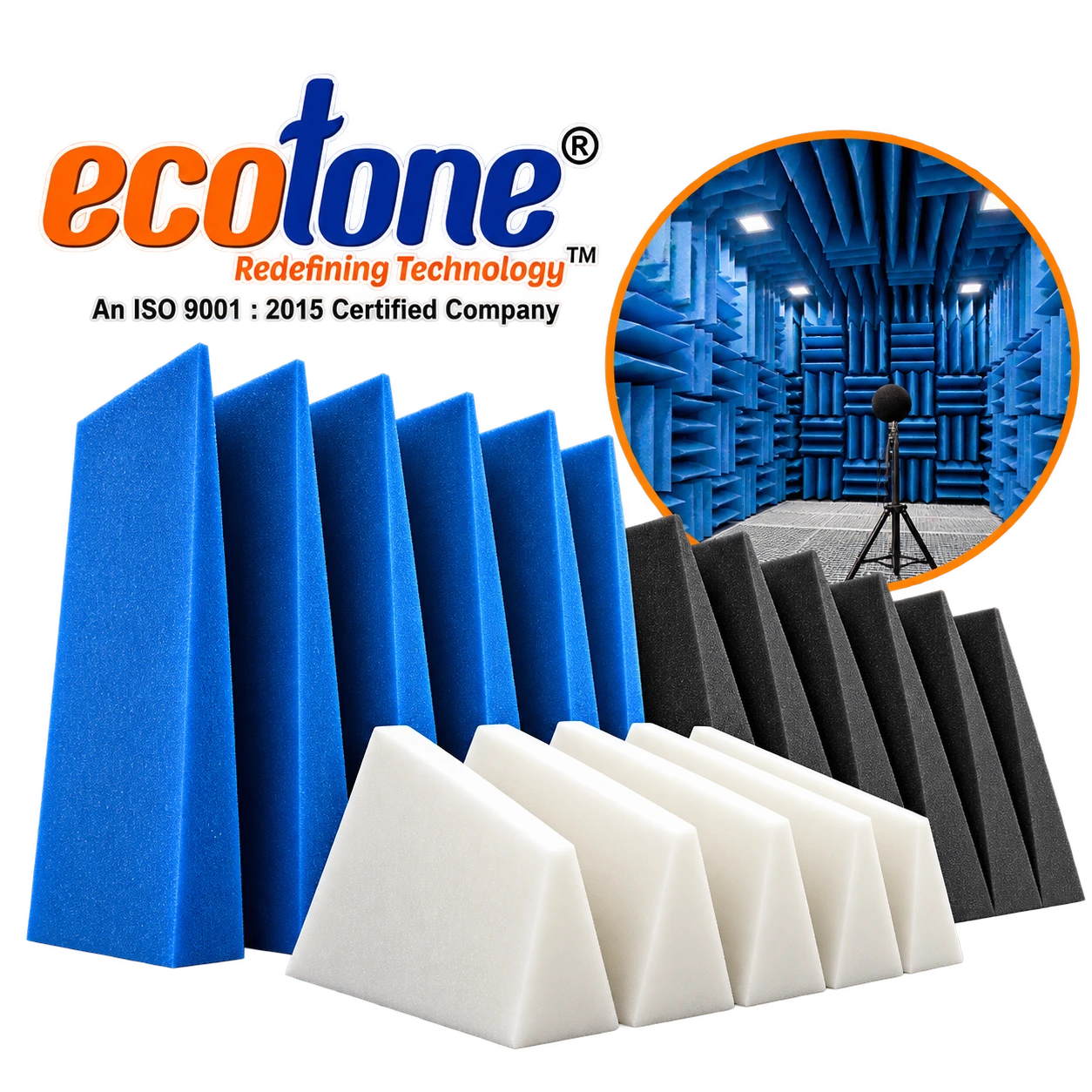
Anechoic wedges are pyramid-shaped acoustic elements fixed to the walls, ceiling, and sometimes floor of an anechoic chamber, engineered to absorb sound energy across a target frequency range so that reflections are eliminated and a true free-field acoustic environment is created. Two main material types are used: PU foam anechoic wedges, made from grey, fire-retardant, low-density polyurethane foam, and metallic anechoic wedges, made from powder-coated perforated metallic sheet filled with fiberglass, typically specified for larger chambers that need to absorb lower frequencies for vehicle or engine testing. The pyramid geometry itself does most of the acoustic work, its increasing cross-section gradually transitions the wedge’s acoustic impedance from that of air to that of the absorptive core, which is what allows the wedge to absorb sound rather than reflect it back into the room. If you needed the one-line definition, that’s it. The sections below cover what actually separates a wedge that performs to its tested rating from one that only looks the part.
Why Indian Test Labs and Chamber Builders Are Specifying Tested, Certified Wedge Material
An anechoic chamber’s performance is only as good as the wedge material lining it, and a wedge’s absorption performance is meaningless without reference to how it was tested. Random Incidence Sound Absorption Coefficient (RISAC) testing, performed under standards such as ISO 354 and its Indian equivalent IS-8225, measures how much sound a material absorbs across multiple frequency bands in a reverberation room, not as a single, universal number. Fire performance matters just as much in an enclosed test environment, which is why credible PU foam wedges are tested for flammability under standards such as UL 94. This guide explains what to check in a wedge’s tested data sheet before you specify material for a new or refurbished anechoic chamber, whether that’s PU foam or fiberglass-filled metallic wedges for low frequency, heavy-duty applications.
Specifications, Benefits, Applications & Installation Process
| Parameter | PU Foam Anechoic Wedge | Metallic Anechoic Wedge (MW-1) |
|---|---|---|
| Core material | 32D FR low density polyurethane foam | Perforated metallic sheet filled with fiberglass |
| Color | Grey | Multi-color, powder coated |
| Density | 30 ± 1 kg/m³ | Higher mass, structural metal shell |
| Fire performance | UL 94 tested, HF-1 class | Non-fire catching material |
| Typical lifespan | Standard chamber lining lifespan | Up to 25 years |
| Best suited for | Mid to high frequency, general chambers | Low frequency, large or heavy-use chambers |
| Testing standard | ISO 354 / IS-8225 (RISAC) | ISO 3744 / ISO 3745 (chamber qualification) |
| Benefit | Impact |
|---|---|
| Reflection elimination | Creates a true free-field acoustic environment |
| Tested performance | RISAC data confirms real absorption, not assumption |
| Fire safety | FR foam and non-combustible metallic options available |
| Long service life | Metallic wedges rated up to 25 years |
| Impact resistance | Metallic wedges withstand heavy-use test environments |
| Low maintenance | Metallic wedges are easy to clean and re-finish |
| Design flexibility | Multi-color options match facility branding |
| Application | Typical Wedge Type |
|---|---|
| General acoustic and NVH chambers | PU foam anechoic wedges |
| Automotive and engine test chambers | Metallic anechoic wedges (low frequency) |
| Electronics and small device test chambers | PU foam anechoic wedges |
| Aerospace acoustic test facilities | Metallic or foam, per frequency requirement |
| Chambers with fuel or flammable material exposure | Metallic anechoic wedges |
| Audiometric and research chambers | PU foam anechoic wedges |
| Chamber refurbishment and re-lining projects | PU foam or metallic, per original design |
| Step | Action |
|---|---|
| 1. Frequency requirement study | Confirm lowest frequency the chamber needs to absorb |
| 2. Material selection | Choose PU foam or metallic wedges based on frequency and use |
| 3. Wedge fabrication | Foam moulded or metallic sheets perforated and fiberglass-filled |
| 4. Fire and absorption testing | RISAC and flammability testing completed per batch |
| 5. Surface preparation | Chamber walls and ceiling prepared for wedge mounting |
| 6. Wedge installation | Wedges fixed to all treated surfaces per chamber design |
| 7. Chamber qualification | Installed performance verified against ISO 3744/3745 |
Technical Data Sheet
| Parameter | Specified Value | Test Method | Observed Value |
|---|---|---|---|
| Density (kg/m³) | 30 ± 1 | IS-7888 | 31 |
| Tensile strength (kg/cm²) | ≥ 0.80 | IS-7888 | 1.07 |
| Elongation (%) | ≥ 120 | IS-7888 | 130 |
| Hardness (IFD) kg/323cm² @ 50% compression | 30 to 40 | IS-7888 | 37.03 |
| Resilience (%) | ≥ 30 | IS-7888 | 34 |
| Fire retardant properties | UL 94 | UL 94-1998, Clause 12 | HF-1 Class |
Density Isn't the Same as Absorption Performance: What 32D FR Foam Actually Tells You
A common assumption among first-time buyers is that a denser foam automatically absorbs more sound. Density, 30 ± 1 kg/m3 in Ecotone’s PU foam wedges, is primarily a mechanical property, it governs tensile strength, hardness, and how well the wedge holds its pyramid shape under handling and long-term use, not directly the absorption coefficient at a given frequency. Absorption performance is driven far more by the wedge’s geometry, pyramid depth and taper angle, and by the cell structure and porosity of the foam itself, which is exactly why RISAC testing under ISO 354 and IS-8225 measures the finished wedge’s absorption across frequency bands rather than inferring it from density alone. Two foams with similar density can perform quite differently acoustically if their cell structure or wedge geometry differs, which is why a tensile strength and hardness data sheet, useful as it is for judging durability, should never be read as a proxy for how well the wedge actually absorbs sound.
Why Metallic Wedges Exist When Foam Is Cheaper: The Low Frequency and Fire Risk Trade-off
If PU foam wedges are simpler and less expensive to produce, it’s worth asking why fiberglass-filled metallic wedges exist at all. The answer comes down to two practical constraints foam struggles with at scale. First, absorbing lower frequencies generally requires greater wedge depth and mass, and a large-format automotive or engine test chamber built entirely from deep foam wedges becomes both structurally impractical and prone to sagging or degrading under years of continuous use, temperature cycling, and exposure to oil or fuel vapour common in engine test cells. Second, engine and vehicle test environments carry a real fire risk from fuel and hot exhaust components, and while FR-rated foam is treated to resist flame spread, a non-combustible, fiberglass-filled metallic shell offers a fundamentally different order of fire safety margin for that specific risk profile. This is why Ecotone’s MW-1 metallic wedges are rated for up to 25 years of service in exactly these heavy-duty, low-frequency, higher-risk environments, a lifespan foam wedges in the same conditions would be unlikely to match.
RISAC Testing: Why a Single Absorption Number Is Incomplete Without the Frequency Band
A supplier quoting a single absorption coefficient figure, such as 0.99, is giving you only part of the picture. Random Incidence Sound Absorption Coefficient testing under ISO 354 measures absorption across a range of frequency bands in a reverberation room, and a wedge can perform very differently at 250 Hz than it does at 4000 Hz. Some suppliers report a Noise Reduction Coefficient (NRC), a single averaged figure across four mid-range bands, which is useful for quick comparison but hides how the material performs at the low or high ends of the spectrum that actually matter for your specific test application. Before specifying wedge material based on a headline absorption number, ask for the full RISAC test report across frequency bands, tested to ISO 354 or IS-8225, particularly if your chamber needs to perform reliably at the low frequencies that a single averaged number can conceal poor performance in.
Myth vs Reality
| Myth | Reality |
|---|---|
| Denser foam always absorbs more sound | Wedge geometry and cell structure matter more than density |
| A single absorption number tells the full story | RISAC data varies significantly across frequency bands |
| Metallic wedges are just a premium upgrade | They solve real low frequency and fire risk limitations |
| All fire retardant foam is equally fire safe | Metallic, non-combustible wedges suit higher fire risk zones |
| Any pyramid foam works in any anechoic chamber | Wedge depth must match the chamber's target frequency |
Ecotone Systems Metallic Anechoic Wedges (MW-1): Properties and Applications
Ecotone Systems MW-1 metallic anechoic wedges are made from powder-coated, perforated metallic sheet filled with fiberglass, purpose-built for large anechoic chambers that need to absorb low frequency sound for vehicle or engine testing in line with ISO 3745 and ISO 3744. Key properties include:
- Long service life, rated up to 25 years
- Constructed from non-fire catching, fire resistant material
- Impact resistant construction suited to heavy-use test facilities
- Easy to clean, maintaining a consistently new appearance
- Multiple colour options available to match corporate colour schemes
- Provides a safer working environment for test facility personnel
These properties make MW-1 wedges particularly suited to test facilities working with heavy equipment and flammable materials, where a rugged, long-life, low-maintenance wedge system outperforms foam over the chamber’s operating lifetime.
How to Choose an Anechoic Wedges Manufacturer in India
- Ask for full RISAC absorption data across frequency bands, tested to ISO 354 or IS-8225, not a single headline number.
- Confirm fire performance testing, UL 94 or equivalent, for foam wedges, or non-combustibility for metallic wedges.
- Match wedge depth and material to your chamber’s actual target frequency, not a generic “anechoic” claim.
- For automotive, engine, or fuel-adjacent test environments, evaluate metallic wedges against foam for fire risk and longevity.
- Ask about expected service life and how the manufacturer’s wedges perform under your specific environmental exposure.
- Request chamber-level qualification support against ISO 3744/3745 after wedge installation, not just wedge-level test data.
Frequently Asked Questions
Foam suits general use, metallic wedges suit low frequency,
high fire risk environments.
No, wedge geometry and cell structure affect absorption more than density.
Ecotone's MW-1 metallic wedges are rated for up to 25 years.
Yes, when tested and rated under standards such as UL 94.
Sound absorption coefficient across multiple frequency bands,
tested per ISO 354.
Yes, but this typically requires greater wedge depth or metallic construction.
Metallic wedges are generally preferred due to fire and durability requirements.
Standard PU foam wedges are typically grey in color.
Through tested density, tensile strength, fire rating, and absorption coefficient data.
Yes, both foam and metallic wedges are used for chamber re-lining projects.
ANECHOIC WEDGE SOLUTIONS
Get the Right Anechoic Wedges for Your Test Chamber
Whether you need PU foam anechoic wedges for a general acoustic or NVH chamber, or fiberglass-filled metallic wedges for a large, low frequency automotive or engine test facility, Ecotone Systems manufactures anechoic wedges backed by tested RISAC absorption data and fire performance certification, not just a pyramid shape and a marketing claim.
✓
Tested RISAC Absorption Data
✓
Fire Performance Tested
✓
PU Foam & Metallic Options
✓
Application-Specific Design
Our Clients
Trusted by India's Leading Brands
Hover to pause · Logos scroll continuously
500+
Projects Completed
40+
Years Experience
200+
Happy Clients
15+
States Covered