Quick answer
In India, a soundproof enclosure typically costs ₹12,000 to ₹45,000 per square metre of enclosure surface area in 2026. The final price depends on the target noise reduction in decibels, the panel construction, the ventilation and silencers needed to keep the machine cool, and whether the enclosure is modular or built in place. A small compressor enclosure can start near ₹1.5 lakh, while a large walk-in enclosure for a DG set or turbine can run into several lakh.
Price is usually the first question a plant head or procurement team asks, and it is also the hardest to answer with a single figure. A soundproof enclosure is built to order around a specific machine, a specific noise target, and a specific site. Two enclosures of the same size can differ in cost by two or three times once you account for the decibel reduction and the cooling they have to deliver. This guide breaks down what actually drives the number, gives realistic price bands, and shows you how to budget before you raise an enquiry.
What a soundproof enclosure costs per square metre
Most manufacturers price an enclosure by its total panel surface area, not by the footprint of the machine. The band below reflects typical 2026 pricing in India for industrial acoustic enclosures, supplied and installed.
| Enclosure grade | Typical noise reduction | Price per sq. metre |
|---|---|---|
| Light / partial (single-skin panels, basic sealing) | 15 to 25 dB(A) | ₹12,000 to ₹18,000 |
| Standard industrial (double-skin, mineral wool infill, silenced vents) | 25 to 35 dB(A) | ₹18,000 to ₹30,000 |
| Heavy / walk-in (high-mass panels, acoustic doors, splitter silencers) | 35 to 50 dB(A) | ₹30,000 to ₹45,000 |
As a rough rule, every additional 5 dB(A) of guaranteed reduction raises the cost, because it demands heavier panels, better seals, and larger silencers. Chasing a very low in-plant noise level is where budgets grow fastest, so it pays to fix a realistic target first. Our guide to noise regulations in India explains the CPCB and workplace limits that usually set that target at 75 dB(A).
Seven factors that decide the final price
The square-metre band gets you a ballpark. These seven variables move the number up or down within it.
1. Target noise reduction (dB)
This is the single biggest cost driver. Reducing a machine from 95 dB(A) to 80 dB(A) is far cheaper than reaching 65 dB(A), which needs heavier construction and more careful sealing. The real question we cover in industrial noise control with enclosures is how much reduction your site actually needs.
2. Panel construction and mass
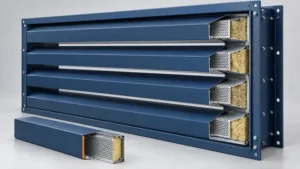
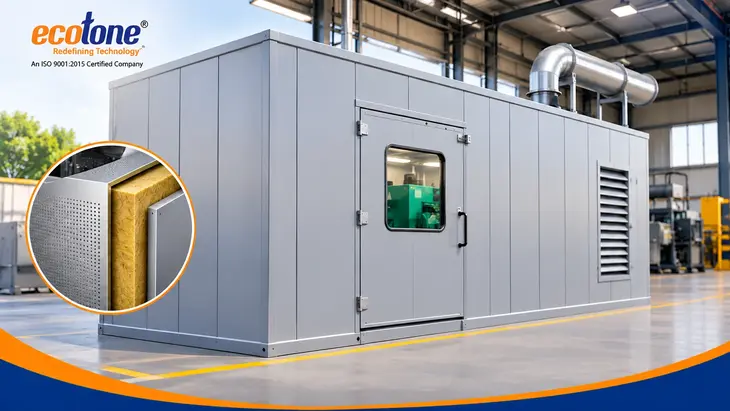
Single-skin panels cost less but block less. Double-skin panels with a dense mineral wool or rockwool core and a perforated inner liner cost more and perform far better. Heavier gauge steel adds mass, and mass is what blocks low-frequency noise from engines and compressors.
3. Ventilation and cooling
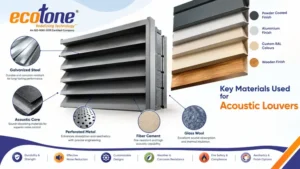
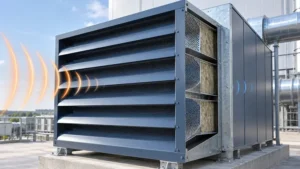
An enclosed machine still produces heat, and the air path that cools it is also the easiest route for noise to escape. Silenced ventilation, using acoustic louvers and splitter silencers sized to the machine’s airflow, can be a significant share of the cost. You can see how this works on our acoustic louvers page. Skipping it is the most common way an enclosure both overheats and leaks noise.
4. Access, doors, and windows
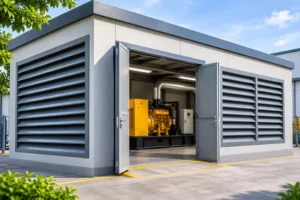
Acoustic doors, viewing windows with laminated acoustic glass, and removable panels for maintenance all add cost. A machine that needs frequent operator access, like the setups in our DG acoustic enclosures and operator cabins, needs more openings, and every opening has to be sealed without losing performance.
5. Modular versus built in place
Modular enclosures use pre-fabricated bolt-together panels that install fast and can be relocated later. Built-in-place enclosures are welded on site for a permanent, tightly sealed fit. Neither is always cheaper. Modular saves on installation time, while built in place can save on panel tooling for an odd shape.
6. Machine type and size
A close-fitting enclosure around a small pump costs a fraction of a walk-in room around a gas turbine. Larger and hotter machines need more surface area, more cooling, and more structural support, which all scale the price. Reference projects such as our gas turbine acoustic enclosures sit at the top of the range for exactly these reasons.
7. Finish, environment, and extras
Weatherproofing for outdoor units, corrosion-resistant panels for wet or chemical sites, fire rating, and powder-coated finishes all add to the base price. The right specification here depends on where the enclosure will live, a point we cover in our acoustic enclosure design guidelines.
Typical enclosure cost by machine
Buyers usually think in terms of the machine, not square metres. These indicative totals, supplied and installed, help you set a budget before a site survey.
| Machine | Indicative enclosure cost | What drives it |
|---|---|---|
| Air compressor (small to mid) | ₹1.5 to ₹5 lakh | Cooling airflow, service access |
| Industrial pump / pump house | ₹2 to ₹6 lakh | Pipe seals, vibration, drainage |
| DG set (up to ~1000 kVA) | ₹3 to ₹9 lakh | Exhaust, high heat, silencers |
| CNC / press / machine tool | ₹2.5 to ₹8 lakh | Doors, windows, conveyor gaps |
| Gas turbine / large genset | ₹10 lakh and above | Walk-in size, high dB target |
These are starting points, not quotes. A proper figure comes only after a noise survey and a site visit, because the current noise level and the target level together decide the construction.
Budgeting tip: Ask for the price with the guaranteed dB(A) reduction written into the quote, and with on-site insertion-loss testing included after installation. A low price that does not state a measured noise result is not comparable to one that does.
How to keep the cost reasonable without losing performance
- Fix a realistic noise target. Design to the limit you actually need, usually 75 dB(A) at the workplace, rather than the lowest number possible.
- Right-size the enclosure. A close-fitting enclosure uses less material than a walk-in room, when access allows it.
- Plan ventilation from the start. Retrofitting cooling after the enclosure overheats costs more than designing silenced vents in from day one.
- Standardise where you can. Modular panels reuse tooling and install faster, which lowers cost across multiple similar machines.
- Buy the testing, not just the box. An enclosure that is measured and signed off avoids expensive rework when an inspection fails.
For the full picture of how enclosures are specified, built, and tested, start with our main soundproof enclosures guide, and when you are ready to compare suppliers, read how to choose a soundproof enclosure manufacturer in India.
Frequently asked questions
Is a soundproof enclosure cheaper than a soundproof room?
Usually yes. A close-fitting enclosure wraps only the machine, so it uses far less material than building an acoustically treated room around it. A room makes sense only when several machines or operators share the same space.
Why do two enclosures of the same size cost differently?
Because noise reduction, not size, sets the price. A 25 dB(A) enclosure and a 45 dB(A) enclosure of identical dimensions differ sharply in panel mass, sealing, and silencer size, and therefore in cost.
Does the price include installation?
Reputable suppliers quote supplied and installed, including sealing and commissioning. Always confirm whether site work, cranage, and post-installation noise testing are inside the number or extra.
Can I reduce cost by skipping ventilation silencers?
No. The ventilation opening is the main escape route for noise. Removing silencers lowers the price but reopens the noise leak and risks overheating the machine, which defeats the purpose of the enclosure.