An acoustic louver is a ventilation opening that blocks, absorbs and redirects sound while still letting air pass through. It is used on plant rooms, generator enclosures, test cells, data centres and cooling systems, where airflow is needed but noise must stay within limits. Performance is typically verified against standards such as ASTM E90, ISO 10140 and AMCA 500-L, alongside local occupational and environmental noise regulations.
Understanding how acoustic louvers noise reduction works helps you specify the right product the first time, instead of discovering a mismatch after installation.
What the term means
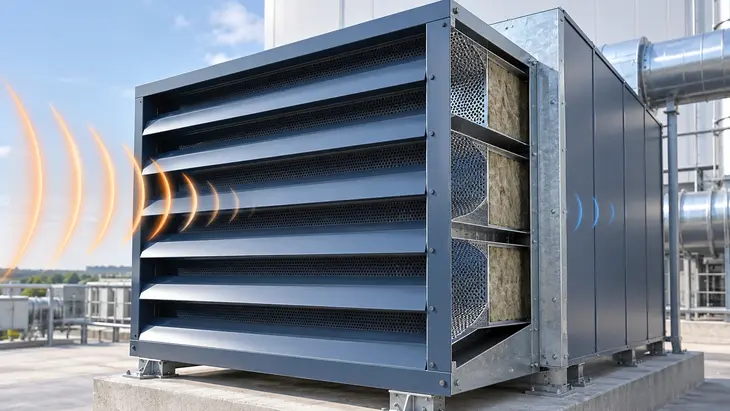
“Louver” comes from the Old French lover, meaning an opening or skylight. Traditional louvers use angled slats to admit air and light while keeping out rain. “Acoustic” adds the second job: controlling sound. An acoustic louver is an angled-blade ventilation barrier whose blades are filled with sound-absorbing material, so air can pass through while sound energy is dissipated along the way.
A simple analogy
Shout in an empty hall and you hear an echo, because hard walls reflect sound back at you. Now fill the same hall with curtains, carpets and soft furniture. The echo disappears because those materials absorb sound energy and convert it to tiny amounts of heat.
An acoustic louver applies that principle to an air path. Sound can’t travel in a straight line through it. It is forced to bounce between absorptive surfaces, losing energy with each reflection, while air still finds its way through the gaps.
Where they are used
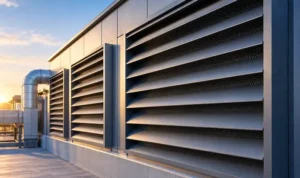
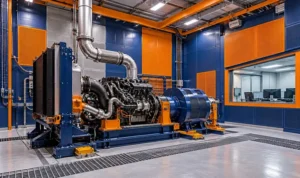
Acoustic louvers are used in power generation and backup generator rooms, data centres and telecom shelters, automotive and aerospace engine test cells, hospitals and medical facilities, consumer-electronics test labs, HVAC plant rooms, and manufacturing plants.
Different standards lead to different configurations. A hospital rooftop plant is driven by community noise limits and often needs broadband attenuation. An engine test cell must also handle high airflow, heat and low-frequency noise, which calls for deeper blades and heavier construction. A telecom shelter may prioritise weather resistance and free area for cooling. The standard that governs your site largely determines blade depth, material and frame.
Common types and use cases
The main configurations are fixed-blade acoustic louvers for general plant and generator rooms, high-attenuation deep-blade louvers for test cells and low-frequency sources, weather-resistant acoustic louvers for outdoor intakes, acoustic louvers with integrated dampers for fire or airflow control, acoustic door-and-louver combinations for enclosures, and custom-sized or modular louvers for retrofit projects. Material choice (galvanised steel, stainless steel or aluminium) depends on corrosion exposure and budget.
Standards and typical specifications
Several standards define how performance is measured and compared:
- ASTM E90 / ISO 10140: laboratory measurement of sound transmission loss.
- ASTM E477 / ISO 7235: insertion loss and airflow resistance testing for silencers and similar attenuators.
- AMCA 500-L and AMCA 511: louver air performance, pressure drop and water penetration.
- ISO 717-1: single-number rating (Rw) for airborne sound insulation.
As typical ranges, not guarantees, acoustic louvers deliver insertion loss of roughly 10 to 40 dB across octave bands from 125 Hz to 8 kHz. Blade depth is commonly 150 to 300 mm, and free area is usually 30% to 50%. Pressure drop at design airflow often falls between 20 and 100 Pa. Low-frequency attenuation (below 250 Hz) is the hardest to achieve and generally requires deeper blades.
THE CORE TECHNOLOGY: HOW ACOUSTIC LOUVER BLADES ATTENUATE NOISE
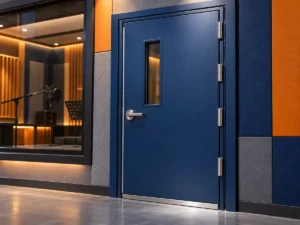
Each blade is a sealed, perforated casing filled with mineral wool or similar absorptive fill, usually protected by a fabric or glass-tissue facing against moisture and airflow erosion. Sound entering the louver passes through the perforations and is absorbed in the fill, while the angled blade profile adds reflections and blocks line-of-sight transmission. Frame stiffness and sealed joints matter too, because leaks can undermine the whole assembly. An acoustic door, where one is part of the enclosure, needs the same airtight sealing.
The trade-off in acoustic louvers design is attenuation against airflow. Deeper blades and narrower gaps improve noise reduction but increase pressure drop, and an undersized louver can starve a generator or chiller of air. Free area and airflow resistance should always be assessed together with insertion loss.
One practical tip: specify performance by octave band, not by a single dB figure. A louver that looks excellent on an average rating may underperform at the exact frequency your equipment emits, often a low-frequency tone from a fan or engine. Request third-party test data at your dominant frequencies.
Cost is shaped by blade depth, materials, size, certified test data and custom engineering. For that reason, acoustic louvers price varies widely, and comparing acoustical louvers manufacturers on tested performance rather than headline cost tends to avoid expensive rework.
Choosing with confidence
Are you in the process of choosing or installing acoustic louvers? Don’t hesitate to contact us. Our account managers and acoustic experts can review your site conditions, noise targets and airflow needs, and recommend a suitable design. Even if you aren’t sure what you need yet, we can help you define it.