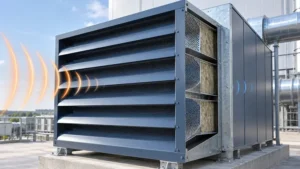
Acoustic louvers design is the engineering of ventilation openings that let air pass while absorbing and blocking sound. They are used on plant rooms, generator enclosures, chiller yards and data centres, where equipment needs airflow but neighbours and occupants need quiet. Their performance is judged against sound-transmission and airflow standards such as ISO 10140, ISO 717-1 and AMCA 500-L, along with local noise regulations.
What the term means
“Louver” comes from the Old French lover, a roof opening that let smoke escape from a hall. Today it means a set of angled blades that admit air and restrict direct line of sight. The British spelling “louvre” and the term “acoustical louvers” refer to the same product.
An Acoustic Louvers is a blade-type ventilation opening that attenuates sound through absorption and reflection while maintaining a defined free area for airflow.
A simple analogy
Imagine shouting through an open doorway into a long corridor. Your voice carries straight through. Now imagine the corridor has a zigzag path with soft, padded walls. The sound bounces repeatedly, loses energy at each contact, and arrives much quieter.
Acoustic louver blades work the same way. Air follows the gaps between blades, while sound waves are forced into absorbent infill and lose energy.
Where acoustic louvers are used
Commercial buildings, hospitals, data centres, power generation, industrial plants, hotels, educational campuses and residential towers all rely on them. Requirements differ because each sector faces different noise limits and equipment.
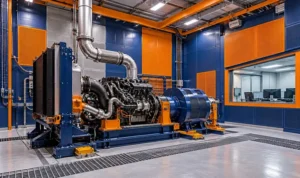
A hospital may need strict night-time limits near wards, while a data centre prioritises airflow for heavy cooling loads. A diesel generator room, meanwhile, must meet emission-level noise rules at the property boundary. These priorities change blade depth, free area and the material specification.
Types and common uses
Single-bank louvers, double-bank louvers, acoustic plenum louvers, exterior louvered panels, acoustic screens for chiller yards, and weather-resistant sound proof louvers make up the main configurations.
Single-bank units suit moderate noise reduction in tight spaces. Double-bank and plenum designs add depth and absorptive volume for higher attenuation, so they are common on generator and compressor rooms. Exterior louvered panels are often used as visual screening for rooftop plant, with acoustic infill hidden behind a clean facade. Any of these can be supplied as fixed or motorised-damper versions.
Standards and typical specifications
Sound performance is usually reported as insertion loss in dB across octave bands. It is tested under ISO 7235 or ASTM E477, and sound reduction is rated per ISO 10140-2 with the single-number rating in ISO 717-1. Airflow resistance, free area and water penetration are verified under AMCA 500-L.
In India, the Noise Pollution (Regulation and Control) Rules, 2000 set ambient limits by zone, and CPCB norms for DG sets require acoustic treatment. NBC 2016 Part 8 addresses building acoustics.
Typical values vary by depth and infill. Blade depths of 150–300 mm commonly give around 10–25 dB insertion loss in mid frequencies, with deeper plenum designs reaching 30 dB or more. Free area usually falls between 30% and 50%. Low frequencies below 125 Hz are the hardest to treat, so check band-by-band data rather than one headline number.
ACOUSTIC LOUVER DESIGN TECHNOLOGY
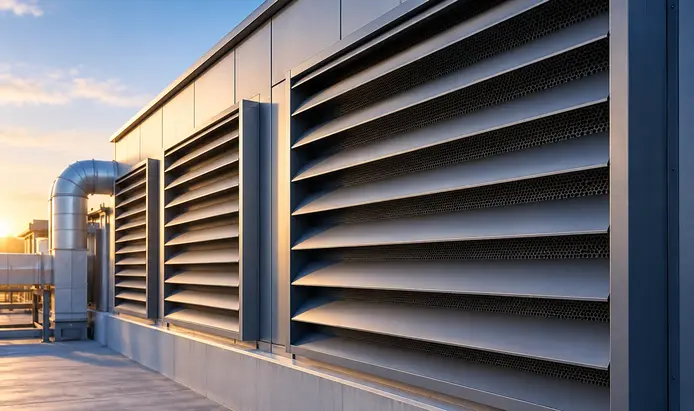
Performance comes from three elements: blade profile, absorptive infill and frame construction. Blades are typically made from galvanised or aluminium sheet in an aerofoil or chevron shape. They are perforated on the inside face and packed with mineral wool or glass fibre, often wrapped in a fleece or film to resist moisture and dust.
The perforation lets sound enter the infill, where it is converted to heat. The blade angle blocks direct line of sight so sound cannot pass straight through. Careful blade spacing keeps pressure drop low, which protects fan and cooling performance.
Material choice affects life and cost. Powder-coated or marine-grade aluminium suits coastal sites, and stainless fixings resist corrosion. When comparing acoustic louvers price, consider lifecycle, fire rating of the infill and certified test data alongside the initial cost.
Practical tip: Always size the louver for the airflow first, then check noise. A louver chosen only for attenuation can choke ventilation, which raises equipment temperature and defeats the purpose. Ask acoustical louvers manufacturers for pressure-drop curves at your actual air velocity, ideally below about 3 m/s through the free area.
Talk to an expert
Are you in the process of choosing or installing acoustic louvers? Don’t hesitate to contact us. Our account managers and acoustic specialists can review your site, noise limits and airflow requirements with you. Even if you’re not sure what you need yet, we can help you define the right acoustic louvres specification.