Acoustic Curtains | Soundproof Curtains Manufacturer in India
Summary: Acoustic curtains, also called soundproof curtains, are multi-layered fabric panels, typically wool fabric sandwiched between a decorative face and a blackout liner, designed to absorb sound and reduce reverberation around machinery, workshops, and interior spaces without structural construction. Acoustic consultants, and interior designers in India who need a flexible, cost-effective sound control option, while understanding exactly what acoustic curtains can and cannot replace.
Is This Acoustic Curtains Guide Right for You?
01
Who It's For
Factories and workshops with noisy machinery, auditoriums and studios needing echo control, and commercial or architectural interiors wanting acoustic comfort without permanent construction.
02
When to Use This Guide
Before specifying acoustic curtains over a rigid noise barrier, while comparing fabric and fire-rating claims across an acoustic curtains manufacturer in India, or when an installed curtain system isn't delivering the noise reduction expected.
What Are Acoustic Curtains?
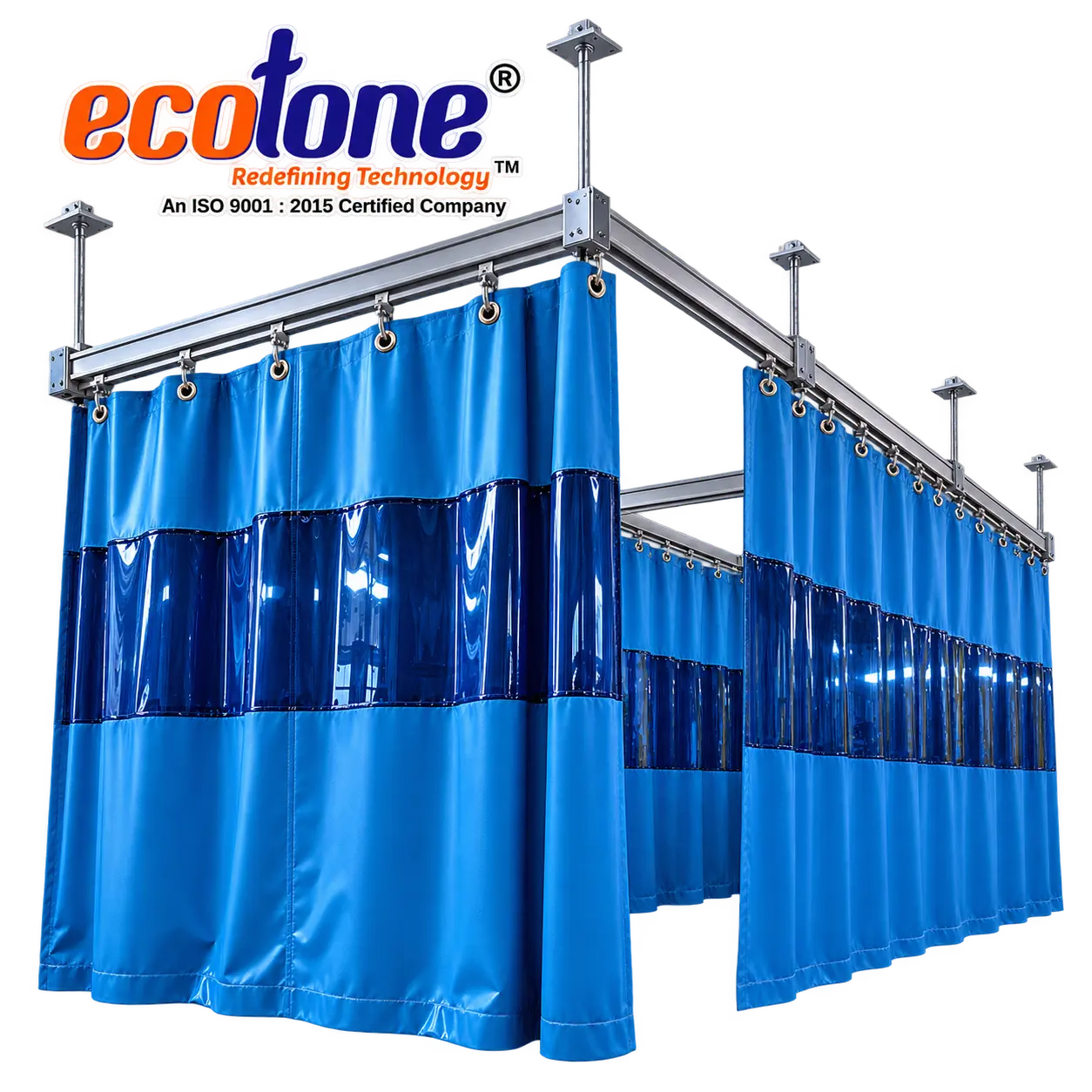
Acoustic curtains, or soundproof curtains, are specially engineered fabric panels designed to absorb significantly more sound than a standard decorative curtain, typically built from a core layer of wool fabric sandwiched between a decorative face fabric and a blackout liner. Unlike a rigid acoustic enclosure or noise barrier, an acoustic curtain works primarily by absorbing sound energy as it passes through and reflects within the fabric layers, reducing reverberation and echo in a space rather than blocking sound transmission the way a dense wall or panel does. They’re commonly specified as soundproof curtains for machinery, enclosing noisy equipment on a factory floor, but are equally used architecturally in auditoriums, studios, and interiors where flexibility and ease of installation matter more than maximum isolation. If you needed the one-line definition, that’s it. The sections below cover what actually determines whether a curtain performs as expected once installed, and when it isn’t the right tool for the job.
Why Facilities Choose Acoustic Curtains Over Permanent Barriers, and When They Shouldn't
Acoustic curtains, and industrial acoustic curtains in particular, exist to solve a specific problem: reducing noise and reverberation without the cost, weight, and permanence of structural soundproofing. Fire safety is a real consideration in that decision, and the standard most directly relevant to hanging textiles like curtains and drapery is NFPA 701, which specifies fire test methods for flame propagation of textiles and films used in curtains, window shades, and similar hanging materials. A core material that passes this kind of flame propagation testing resists igniting and spreading flame readily, which matters in machinery enclosures and industrial settings where fire risk is a genuine concern. This guide explains what to check in a soundproof curtain’s fabric, hardware, and fire rating before specifying noise reduction curtains, and where a curtain is the right call versus where it isn’t.
Specifications, Benefits, Applications & Installation Process
| Parameter | Standard Specification |
|---|---|
| Core Material | Wool fabric, sandwiched construction |
| Layers | Decorative face fabric, wool core, blackout liner |
| Fire Performance | Fire-resistant core, tested for flame propagation |
| Additional Properties | VOC filtration, thermal reflection, light blocking |
| Customisation | Size, color, thickness to match interior or industrial use |
| Primary Function | Sound absorption and reverberation reduction |
| Mounting | Track or rail-mounted, movable panels |
| Benefit | Impact |
|---|---|
| No Structural Changes Needed | Installs without construction or permanent fixtures |
| Flexible and Movable | Can be repositioned, opened, or relocated easily |
| Fire-Resistant Construction | Core materials engineered to fire-safety standards |
| Air Quality Support | Wool core helps filter airborne VOCs |
| Thermal and Light Control | Reflects heat and blocks light alongside sound |
| Cost-Effective | Lower cost than rigid enclosures or barriers |
| Custom Appearance | Matches interior design or industrial colour schemes |
| Application | Typical Use |
|---|---|
| Machinery Enclosures | Wrapping noisy equipment on a factory floor |
| Workshops and Production Floors | General industrial noise reduction |
| Auditoriums and Theatres | Reverberation and echo control |
| Studios | Acoustic treatment for recording or rehearsal spaces |
| Commercial Interiors | Acoustic comfort in open-plan offices |
| Architectural Interiors | Decorative sound control matching design themes |
| Temporary or Movable Partitions | Flexible acoustic zoning of larger spaces |
| Step | Action |
|---|---|
| 1. Requirement Study | Confirm noise source, space size, and fire safety needs |
| 2. Fabric and Size Selection | Choose thickness, colour, and panel dimensions |
| 3. Fabrication | Curtain panels manufactured to size with core and liner |
| 4. Track or Rail Planning | Mounting hardware positioned for coverage and overlap |
| 5. On-Site Installation | Panels hung with adequate overlap at seams |
| 6. Hem Weighting | Bottom weights fitted to reduce billowing and gaps |
| 7. Performance Check | Noise reduction verified against the original target |
Technical Data Sheet
| Property | Value / Standard |
|---|---|
| Product | Soundproof Curtain / Acoustic Curtain |
| Core Material | Wool fabric |
| Construction | Decorative fabric, wool core, blackout liner (sandwich layup) |
| Fire Test Reference | NFPA 701, flame propagation of textiles and films |
| Acoustic Function | Sound absorption, reverberation reduction |
| Additional Functions | VOC filtration, thermal reflection, light blocking |
| Mounting | Track or rail-mounted, movable panels |
| Customisation | Size, thickness, colour, fire rating level |
| Primary Limitation | Not a substitute for rigid noise barriers at high isolation needs |
Absorption vs Blocking: Why Acoustic Curtains Reduce Echo But Rarely Stop Sound Cold
Most buyers assume “soundproof” means sound stops at the curtain, but a curtain’s physics work differently from a wall or enclosure panel. Acoustic curtains are fundamentally light, flexible materials, typically a few kilograms per square metre at most, and sound transmission loss through a barrier is governed by its mass, heavier, denser materials block more sound energy from passing through. A curtain’s wool core and layered construction are genuinely effective at absorbing sound within a space, reducing reverberation, echo, and the perceived harshness of a noisy room, but that absorption happens mostly at mid to high frequencies, and the curtain’s light mass means low-frequency sound transmits through it fairly easily regardless of how well-made the fabric is. This is exactly why a curtain that measurably improves a noisy workshop’s reverberation can still let a meaningful amount of machinery noise pass straight through to the next room, and why curtains are correctly described as a sound absorption solution, not a sound blocking one.
Why Overlap and Hem Weight Determine Real Performance More Than Fabric Spec Alone
A curtain fabric’s tested absorption performance is measured under laboratory conditions, a flat panel, properly hung, with no gaps. Real installations rarely match that exactly, and the two details that most often separate a curtain system’s rated performance from its actual on-site performance are panel overlap at seams and bottom hem weighting. Adjacent curtain panels need enough overlap at their shared edge that sound cannot pass directly through a vertical gap between them, and a curtain without adequate hem weight tends to billow or shift with air currents from HVAC systems or nearby machinery, opening small but acoustically significant gaps at the floor line. Neither of these show up in a fabric spec sheet, but both can meaningfully undercut a correctly specified curtain’s real-world noise reduction, which is why installation detailing deserves the same scrutiny as the fabric choice itself.
What NFPA 701 Fire Testing Actually Confirms, and What It Doesn't
A fire-resistant acoustic curtain is a genuine safety feature, but it’s worth understanding precisely what that claim is backed by. NFPA 701 is the standard most directly applicable to hanging textiles like curtains, testing how readily a fabric ignites and propagates flame under defined test conditions. Passing this test means the fabric resists sustaining and spreading flame the way an untreated fabric would, which is exactly why it matters for machinery enclosures and industrial settings with real fire risk nearby. What it does not directly address is smoke toxicity or heat release rate in a fire, properties covered by other, separate fire performance standards. This distinction matters specifically in enclosed industrial spaces, where smoke behaviour during a fire can matter as much as how quickly flame spreads. A supplier describing a curtain as simply “fireproof” without specifying what standard it was tested to, and what that standard actually measures, is giving an incomplete answer to a safety-relevant question.
Important Note on Curtain Limitations
Acoustic curtains help absorb sound and reduce echo, but they are not a replacement for heavy-duty noise barriers or acoustic enclosures when extreme soundproofing is required. For machinery producing very high noise levels, or where strict noise limits must be guaranteed rather than improved, a rigid acoustic enclosure or structural barrier remains the correct solution, with curtains better suited to reverberation control, moderate noise reduction, and flexible or temporary applications.
How to Choose an Acoustic Curtains Manufacturer in India
✓
Check Acoustic Performance:
Ask for the fabric's tested absorption performance and the frequency range it actually covers, not just a general "soundproof" claim.
✓
Verify Fire Certification:
Confirm fire test certification, referencing NFPA 701 or an equivalent standard, and ask what specifically it covers.
✓
Review Installation Details:
Discuss panel overlap and hem weighting as part of the installation plan, not just the fabric specification.
✓
Choose the Right Noise Control:
Clarify whether your noise levels genuinely need a curtain or a rigid enclosure, since curtains absorb rather than block sound.
✓
Check Additional Performance:
Ask about VOC filtration and thermal properties if indoor air quality or temperature control also matter for your space.
✓
Request Relevant References:
Request examples of similar installations, machinery enclosures, auditoriums, or workshops, relevant to your use case.
Frequently Asked Questions
No, they mainly absorb sound and reduce echo, not eliminate it entirely.
They are fire-resistant when tested to standards like NFPA 701, not fireproof.
Typically a wool fabric core between a decorative face and blackout liner.
No, enclosures suit extreme noise, curtains suit moderate absorption needs.
Yes, they also reflect thermal energy and block light penetration.
Poor panel overlap or missing hem weights let sound leak through gaps.
Yes, they are commonly used for reverberation and echo control.
Yes, they are made to match interior design or industrial requirements.
Yes, the wool material can help filter airborne VOCs from the air.
Mounted on tracks or rails, with overlap and hem weights for sealing.
Site-Specific Acoustic Curtain Solutions
Get a Site-Specific Soundproof Curtain Quote
Whether you need acoustic curtains to wrap noisy machinery, control reverberation in an auditorium, or add acoustic comfort to a commercial interior, Ecotone Systems designs and delivers soundproof curtains engineered with the fabric, fire rating, and installation detailing that actually determine real-world performance, not just a fabric spec sheet.
Talk to Our Acoustic Solutions Team
→
Or Call Our Team
+91 98103 19823
|
+91 98913 20678
Our Clients
Trusted by India's Leading Brands
Hover to pause · Logos scroll continuously
500+
Projects Completed
40+
Years Experience
200+
Happy Clients
15+
States Covered