Industrial Air Ventilation and Smoke Extraction
Summary: Industrial ventilation and smoke extraction systems are engineered airflow systems, mechanical or natural, general or local, that supply clean air and remove smoke, heat, dust, and airborne contaminants from a facility, with duct sizing and capture point design determining whether the system actually protects workers or just moves air around the problem. EHS managers, and facility planners in India who are specifying a smoke extraction system, comparing ventilation system manufacturers, or troubleshooting a system that isn’t clearing smoke or fumes as expected.
Is This Industrial Ventilation & Smoke Extraction Guide Right for You?
Who It's For
Engine testing centres, welding workshops, automotive and two-wheeler manufacturing plants, and any factory or workshop generating smoke, fumes, dust, or heat that needs to be controlled at the source.
When to Use This Guide
Before finalising an industrial ventilation system manufacturer in India, while comparing CFM claims across quotes, or when an installed smoke extraction system isn't clearing the workspace the way its specification promised.
What Is an Industrial Ventilation and Smoke Extraction System?
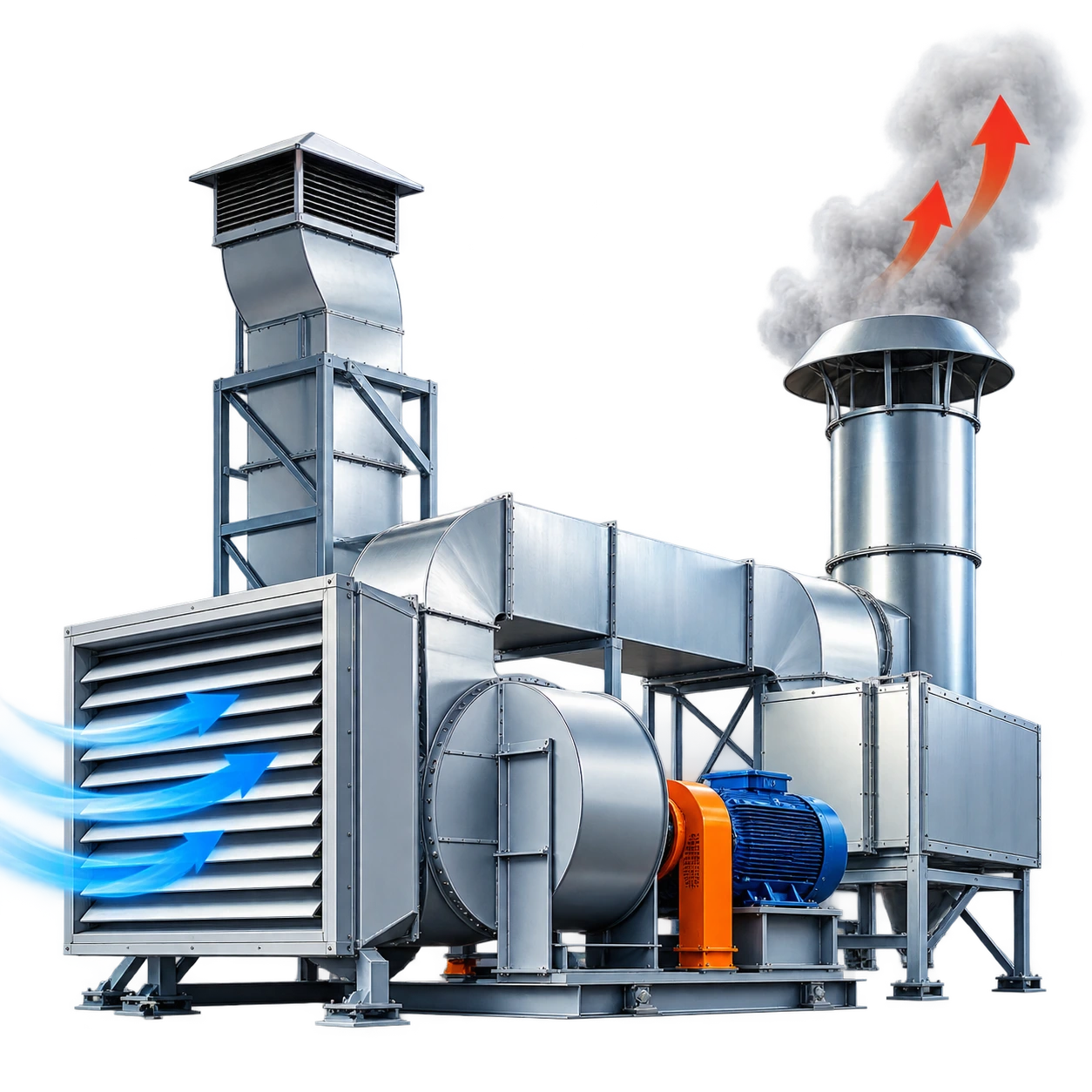
An industrial ventilation and smoke extraction system is an engineered airflow system designed to supply clean air into a workspace and remove smoke, heat, dust, and airborne contaminants before they spread, using either natural ventilation, pressure differences and architectural openings, or mechanical ventilation, powered fans, blowers, and air-handling units that give complete, consistent control over airflow regardless of weather or internal heat load. Systems are further split by purpose: general ventilation balances air across an entire facility, while local exhaust ventilation targets a specific machine, workstation, or process generating smoke or fumes at a concentrated point. A dedicated industrial smoke extraction system captures, filters, and purifies smoke before releasing clean air back into the environment, since smoke must never be released directly into the workplace or the outside atmosphere. If you needed the one-line definition, that’s it. The sections below cover what actually determines whether a system performs to its rated CFM once installed.
Why Indian Manufacturing Plants Are Moving to Engineered Smoke Extraction Over Generic Exhaust Fans
Smoke extraction system design is not simply a matter of choosing a big enough fan. NFPA 91, the standard governing exhaust systems for air conveying of vapours, gases, mists, and particulate solids, specifies minimum duct transport velocities, commonly around 4000 feet per minute for many particulate-laden streams, precisely because air moving too slowly through a duct lets material settle inside it rather than carrying it to the filtration unit. Engine testing centres, welding workshops, and automotive manufacturing plants generate dense, often toxic smoke that can severely affect worker health and disrupt operations if the extraction system is undersized at the duct, not just the fan. This is why facilities are increasingly specifying systems engineered around duct velocity and capture point design, not a generic exhaust fan sized only by CFM. This guide explains what to check before committing to a ventilation and smoke extraction system manufacturer.
Specifications, Benefits, Applications & Installation Process
| Parameter | Standard Specification |
|---|---|
| Ventilation type | Natural or mechanical |
| Ventilation scope | General (facility-wide) or local (point-source) |
| Duct transport velocity | Typically around 4000 fpm for particulate streams |
| Filtration | Multi-stage smoke and particulate filtration units |
| Capacity range | Custom CFM, matched to process and contaminant load |
| Equipment | Fans, blowers, motors, ejectors, heaters, automated controls |
| Control | Automation systems for consistent, stable air quality |
| Benefit | Impact |
|---|---|
| Worker health protection | Removes smoke, fumes, dust, and harmful gases at source |
| Regulatory compliance | Supports occupational health and environmental standards |
| Operational continuity | Prevents smoke buildup from disrupting production |
| Stable air quality | Mechanical systems stay effective regardless of weather |
| Reduced contamination | Protects machinery and testing equipment from residue |
| Fire and explosion risk control | Correct duct velocity avoids particulate settling in ducts |
| Energy efficiency | Engineered systems balance airflow without excess fan power |
| Application | Typical Facility |
|---|---|
| Engine testing centres | Engine dyno and diesel engine test cells |
| Welding workshops | Welding fume and smoke extraction |
| Automotive manufacturing plants | Production line air quality control |
| Two-wheeler production units | High-volume assembly line ventilation |
| Workshop and factory floors | General workplace air quality |
| Foundries and process industries | Heat and particulate extraction |
| Testing and R&D facilities | Controlled air quality for sensitive equipment |
| Step | Action |
|---|---|
| 1. Contaminant and source study | Identify smoke, fume, dust, or heat source and load |
| 2. System design | Size CFM, duct velocity, and capture point layout |
| 3. Equipment selection | Select fans, blowers, filtration units, and controls |
| 4. Ductwork fabrication | Ducting sized and routed per transport velocity requirement |
| 5. Site installation | Fans, ducting, and filtration units installed on site |
| 6. Automation integration | Controls and sensors configured for stable operation |
| 7. Commissioning | Airflow, capture efficiency, and CFM verified against design |
Technical Data Sheet
| Property | Value / Standard |
|---|---|
| Product | Industrial Ventilation and Smoke Extraction System |
| Ventilation types | Natural, mechanical, general, and local exhaust |
| Governing standard | NFPA 91, exhaust systems for air conveying of particulates |
| Minimum duct velocity | Approximately 4000 fpm (20.3 m/s), material dependent |
| Equipment | Fans, blowers, motors, ejectors, heaters, automated controls |
| Filtration | Smoke and particulate filtration, various CFM capacities |
| Discharge | Purified air recirculated indoors or discharged outdoors |
| Control systems | Automated airflow regulation and monitoring |
| Deployment | Indoor factory, workshop, or test facility installation |
| Customisation | CFM capacity, ducting layout, filtration stage, controls |
Duct Velocity Isn't Optional: Why Undersized Ductwork Silently Clogs Itself
Most buyers evaluate a smoke extraction system by its fan’s CFM rating, but CFM alone says nothing about whether the ductwork is actually sized correctly. NFPA 91 sets minimum duct transport velocities, often in the range of 4000 feet per minute for many particulate-laden streams, varying by the specific material being conveyed, because air moving below that threshold loses the energy needed to keep particulate matter suspended and carried along the duct. Fall below it, and material begins settling inside the ductwork rather than reaching the filtration unit, which doesn’t show up immediately. It shows up months later as gradually reduced airflow, increased static pressure, and in facilities handling combustible dust, a real fire and explosion risk from accumulated material inside the duct. A system quoted purely on fan CFM, without duct diameter and velocity calculated against the actual contaminant being conveyed, is incomplete engineering, not a finished design.
CFM Capacity Alone Doesn't Tell You If a System Will Actually Capture the Contaminant
A system can be rated for impressive total CFM and still fail to protect a welder or test technician if the capture point, the hood or pickup positioned near the smoke or fume source, isn’t close enough to actually pull the contaminant in. Capture velocity, the air speed needed at the point of generation to draw smoke or fumes into the extraction system, falls off sharply with distance from the hood, roughly with the square of that distance, which means a hood positioned even a modest distance too far from a welding arc or a test cell’s smoke source can see capture effectiveness drop dramatically even though the system’s total CFM looks more than adequate on paper. This is why local exhaust ventilation design success depends far more on hood placement and capture velocity at the source than on the headline CFM figure quoted for the whole system.
Why General and Local Ventilation Need to Work Together, Not Be Chosen Instead of Each Other
General and local ventilation are often presented as alternative choices depending on facility size or budget, but a properly engineered system treats them as complementary, not competing. Local exhaust ventilation captures concentrated contamination right at its source, a welding station, an engine test cell exhaust point, before it can spread into the wider workspace. General ventilation then handles everything local extraction doesn’t catch, fugitive emissions, diffuse heat load, and background air quality across the whole facility, diluting and removing what remains. A facility relying on local extraction alone leaves itself exposed to non-point sources and fugitive leaks that never pass near a hood, while a facility relying on general ventilation alone lets concentrated smoke or fumes build up and spread before dilution ever catches up. The right design question isn’t “general or local,” it’s how much of each a specific facility’s contaminant sources actually require.
Types of Industrial Ventilation Systems
Ventilation and smoke extraction systems fall into two primary categories: natural ventilation and mechanical ventilation. Natural ventilation relies on environmental pressure differences and architectural openings to move air, effective in some conditions but often insufficient where smoke, heat, and airborne contaminants are generated in high volumes. Mechanical ventilation uses engineered equipment, blowers, fans, automation systems, and air-handling units, to provide complete airflow control regardless of temperature, environmental conditions, or internal heat load, which is why it remains essential for industries needing precise air movement, targeted extraction, and controlled air exchange.
Ventilation is also categorised by purpose and application area. Ventilation systems supply clean air to the workspace, while air extraction systems remove contaminated or stagnant air. General ventilation covers the entire facility for a balanced environment, while local ventilation positions extraction close to machines, workstations, or specific processes generating smoke, fumes, or heat, helping industries maintain compliance with occupational health and safety standards.
Myth vs Reality
| Myth | Reality |
|---|---|
| A higher CFM rating always means better extraction | Duct velocity and capture point design matter just as much |
| Capture hoods work the same at any distance from the source | Capture velocity drops sharply as distance increases |
| General or local ventilation is an either-or choice | Well-designed systems combine both for full coverage |
| Smoke extraction only protects worker comfort | Undersized ducts also create fire and explosion risk |
| Natural ventilation is enough for most industrial smoke | Mechanical ventilation is needed for high smoke and heat loads |
Smoke Extraction for Clean and Safe Airflow
Smoke extraction systems play a vital role in engine testing centres, welding workshops, automotive manufacturing plants, and two-wheeler production units, facilities that generate dense and highly toxic smoke capable of severely impacting worker health and disrupting operations if not managed properly. Smoke must never be released directly into the workplace or the outside atmosphere, since it poses real health risks and can lead to regulatory violations. A properly engineered industrial smoke extraction system captures, filters, and purifies smoke before releasing clean air back into the environment, with filtration units manufactured in various CFM capacities to match different industrial processes. The filtration process removes particulate matter, chemical pollutants, and airborne contaminants, ensuring only purified air is recirculated indoors or discharged outdoors.
How to Choose a Ventilation and Smoke Extraction System Manufacturer in India
Ask for duct sizing and transport velocity calculations referenced to NFPA 91 or equivalent, not just a fan CFM figure.
Confirm capture point and hood placement is designed around your specific contaminant source, not a generic layout.
Check whether the system combines local exhaust ventilation with general ventilation where your facility needs both.
Verify filtration stage and CFM capacity match your actual contaminant type and load, smoke, dust, fumes, or heat.
Ask how the system avoids particulate settling in ductwork over long-term operation.
Request references from facilities with a similar process, engine testing, welding, or high-volume manufacturing.
Frequently Asked Questions
Ventilation supplies clean air, smoke extraction specifically removes smoke and contaminants.
Low velocity lets particulate settle in ducts, reducing airflow over time.
General covers the whole facility, local targets a specific contamination source.
Usually not alone, mechanical ventilation is needed for high smoke loads.
Capture velocity at the source, not total CFM, determines actual capture.
Yes, welding fumes require dedicated local exhaust ventilation.
Yes, settled particulate in low-velocity ducts can create ignition risk.
Through multi-stage filtration removing particulate matter and chemical pollutants.
Yes, engine testing generates dense smoke requiring engineered extraction systems.
Yes, CFM, ducting, and filtration are matched to each process.
Let's Design a Ventilation System That Actually Clears the Smoke.
Whether you need a new industrial smoke extraction system or want to improve an existing setup, Ecotone Systems designs around your actual duct velocity, capture point and contaminant load, not a fan selected by CFM alone.
Get a Site-Specific System Quote
Tell our engineering team what you're extracting, where it's generated and what isn't working in your current setup.
Talk to Our Ventilation & Exhaust Experts »New systems • Upgrades • Industrial applications
Trusted by India's Leading Brands
Hover to pause · Logos scroll continuously