Noise Test Booths | Noise Test Chamber Manufacturer in India
Summary: A noise test booth is an engineered acoustic enclosure that isolates a product from shop floor noise and eliminates internal sound reflections so its noise, vibration, and sound intensity can be measured accurately, whether integrated into a production line for 100% inspection or set up in an R&D lab for prototype testing. Quality engineers, R&D teams, and production managers in automotive, appliance, motor, compressor, transformer, and electronics manufacturing who are specifying a noise test booth, comparing manufacturers, or trying to understand why a booth’s internal noise target actually matters.
Is This Noise Testing Booth Guide Right for You?
Who It's For
Manufacturers of automotive components, refrigeration and air conditioning equipment, electrical motors, fans, compressors, transformers, and speakers who need to verify products against a noise specification before they ship.
When to Use This Guide
Before finalising a noise testing booth manufacturer in India, while comparing internal noise level and door cycle claims across quotes, or when specifying a booth for either production-line or R&D use.
What Is a Noise Test Booth?
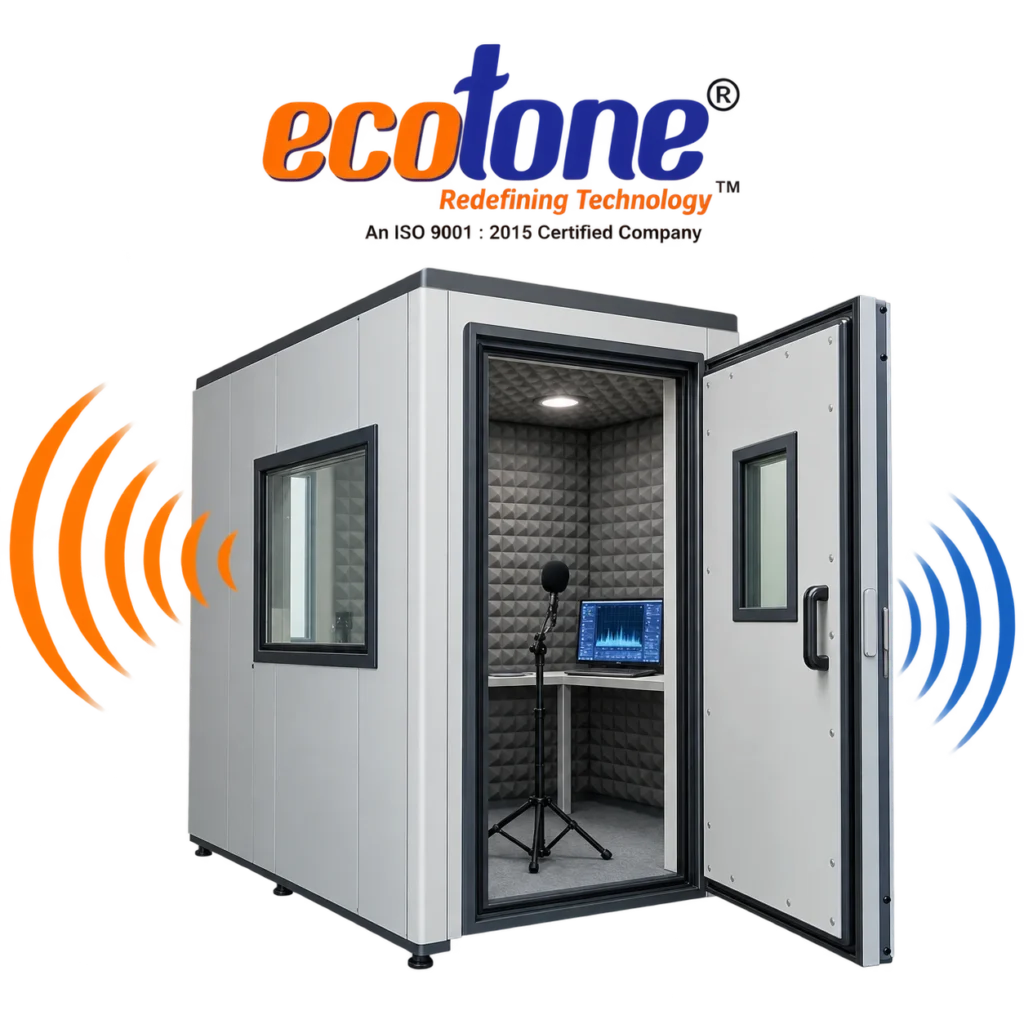
A noise test booth, also called an acoustic testing booth or sound testing room, is a specialised acoustic enclosure built to isolate a product from external shop floor noise while controlling internal sound reflections, creating a stable, repeatable environment for measuring noise, vibration, and both airborne and structural sound intensity. Booths come in two operating models: online booths, integrated directly into a production or conveyor line for 100% inspection of every unit, and offline booths, used in R&D labs for prototype testing and detailed acoustic analysis. A properly engineered noise test booth needs to achieve an internal noise floor low enough, and stable enough, that it doesn’t distort the very measurement it exists to take. If you needed the one-line definition, that’s it. The sections below cover what actually determines whether a booth’s internal noise floor is good enough for your product’s test requirements.
Why Indian Manufacturers Are Standardising on Engineered Noise Test Booths Instead of Makeshift Rooms
Noise measurement accuracy depends on one relationship that’s easy to state and easy to get wrong in practice: the test environment’s background noise has to sit well below the noise level you’re trying to measure, or your reading includes the room’s own noise floor, not just the product’s. This is not a soft guideline. ISO 3745, the precision-grade method for determining sound power levels in anechoic and hemi-anechoic environments, treats a background noise level at least 10 dB below the source under test as the threshold for negligible measurement error, while less stringent engineering-grade methods such as ISO 3746 still require a minimum 3 dB separation before any correction can be applied at all. A shop floor running at 80 to 85 dB(A) ambient noise, common in motor, compressor, and appliance manufacturing, makes an uncontrolled test area essentially useless for this purpose. This guide explains what separates a booth engineered to hold its rated internal noise floor from one that only looks acoustically treated.
Specifications, Benefits, Applications & Installation Process
| Parameter | Standard Specification |
|---|---|
| Booth types | Online (line-integrated) or offline (R&D lab) |
| Typical internal noise level | 32 to 35 dB(A) |
| Tolerated shop floor ambient | Up to 80 to 85 dB(A) |
| Noise margin rule | Internal noise at least 10 dB(A) below product spec |
| Door systems | Manual or automatic, synchronisable with test benches |
| Construction | Modular components for fast on-site assembly |
| Engineering scope | Acoustic, civil, structural, mechanical, electrical |
| Benefit | Impact |
|---|---|
| Measurement accuracy | Isolates product noise from shop floor interference |
| Early defect detection | Identifies noise issues before final production |
| Reduced rejections | Catches non-compliant units before they ship |
| Faster testing cycles | Automatic doors sync with production line takt time |
| Lower lead time | Design flaws caught earlier reduce rework cycles |
| Repeatable results | Controlled acoustics remove test-to-test variability |
| Flexible deployment | Online and offline configurations suit different stages |
| Industry | Typical Testing Use |
|---|---|
| Automotive | Engine, motor, transmission, and cabin noise testing |
| Aerospace | Aircraft component and turbine noise testing |
| Electronics | Smartphone, laptop, and appliance noise evaluation |
| Home appliances | Noise verification for household appliances |
| Medical equipment | Testing MRIs, ultrasound machines, ventilators |
| Industrial machinery | Heavy machinery noise compliance measurement |
| R&D laboratories | Prototype testing and soundproofing analysis |
| Step | Action |
|---|---|
| 1. Requirement study | Confirm product noise spec, ambient level, and booth type |
| 2. Acoustic design | Engineer internal noise floor and sound transmission loss |
| 3. Structural fabrication | Modular panels and frame manufactured off-site |
| 4. Door system design | Manual or synchronised automatic door engineered |
| 5. On-site assembly | Modular components installed with minimal downtime |
| 6. Line or bench integration | Booth synchronised with production line or test bench |
| 7. Acoustic verification | Internal noise floor tested against target specification |
Technical Data Sheet
| Property | Value / Standard |
|---|---|
| Product | Noise Test Booth / Acoustic Test Chamber |
| Configurations | Online (production-line) and offline (R&D lab) |
| Internal noise floor | 32 to 35 dB(A) typical |
| Tolerated ambient | 80 to 85 dB(A) shop floor noise |
| Design margin reference | 10 dB(A) below product noise specification |
| Related measurement standards | ISO 3745 (precision), ISO 3746 (engineering grade) |
| Door options | Manual, automatic, synchronised with test bench |
| Engineering disciplines covered | Acoustic, civil, structural, mechanical, electrical |
| Construction | Modular, panelised for fast assembly |
| Customisation | Size, acoustic treatment, door cycle, integration method |
Why "10 dB Lower" Isn't a Rule of Thumb, It's an ISO Precision Threshold
A noise test booth’s internal noise floor being at least 10 dB(A) below the product’s specified noise level is sometimes treated as an internal design convention, a safe margin rather than a hard requirement. In reality, this figure tracks closely with the background noise criterion used in ISO 3745’s precision-grade sound power measurement method, where a 10 dB separation between background and source noise is the threshold at which measurement correction becomes negligible. Fall below that margin, even engineering-grade methods like ISO 3746 require a minimum 3 dB separation before applying a mathematical correction, and every dB closer than that, the more your reading reflects the booth’s own noise floor rather than the product you’re actually testing. A booth quoted as “very quiet” without a stated dB(A) figure relative to your specific product’s noise limit hasn’t actually been engineered to your test requirement, it’s been engineered to a generic target that may or may not be adequate for what you’re measuring.
Online vs Offline Booths: Why Line-Integrated Testing Needs a Completely Different Door Design
Online and offline noise test booths are often described as the same product deployed in two locations, but the door system alone represents a fundamentally different engineering problem between them. An offline R&D booth might open a handful of times a day, so door sealing performance matters, but cycle durability is a secondary concern. An online booth integrated into a production line has to open and close in sync with line takt time, potentially hundreds of times per shift, with zero noise leakage on every single cycle, which means the door’s gasket and seal system has to maintain acoustic performance under continuous mechanical cycling, not just when new. A door system that seals perfectly in a factory acceptance test but wasn’t engineered for the specific duty cycle of a 24-hour production line will degrade acoustically long before it fails mechanically, and the noise leak often isn’t obvious until a batch of products fails a downstream audit for no apparent reason.
Why Peak Shop Floor Noise, Not Average Noise, Should Drive Your Booth's Design Target
Buyers often specify a noise test booth’s required sound transmission loss based on the shop floor’s average ambient noise level, but average ambient noise is the wrong number to design against. A shop floor might sit at 80 dB(A) on average but spike well above that when an adjacent stamping press cycles, a forklift passes, or another test station runs simultaneously, and a booth engineered only for average conditions will show measurement drift or occasional false readings exactly when those peak events occur, which is often unpredictable and hard to correlate back to the cause. A properly engineered booth is designed against the worst-case, not average, ambient condition your specific shop floor location will realistically experience, which is why an experienced noise testing booth manufacturer will ask about your loudest nearby equipment and its duty cycle, not just request a single average dB(A) figure for the space.
Myth vs Reality
| Myth | Reality |
|---|---|
| Any acoustically treated room is a valid test booth | Internal noise floor must be measured against the product spec |
| Average shop floor noise is enough to design against | Worst-case peak ambient noise should drive the design |
| Online and offline booths need the same door design | Line-integrated doors need duty-cycle-rated sealing |
| A "very quiet" booth claim is sufficient proof | A stated dB(A) margin against your product spec is required |
| Booths only matter for final production testing | Prototype-stage testing also benefits from controlled booths |
What We Provide
- Complete design and engineering drawings for noise test booths and chambers
- Manual or automatic product entry and exit systems with zero noise leakage
- Synchronisable automatic door systems compatible with test benches for seamless test cycles
- High acoustic performance engineered to the specific testing parameters required
- In-house expertise across acoustic, civil, structural, mechanical, and electrical engineering
- End-to-end project management and access to available testing facilities
Applications by Industry
| Industry | Typical Testing Use |
|---|---|
| Automotive | Engine, motor, and transmission noise testing; drivetrain and gearbox sound analysis; cabin noise evaluation |
| Aerospace | Acoustic analysis of aircraft components; engine and turbine noise testing; interior noise compliance |
| Electronics | Noise testing of smartphones, laptops, and electronics; appliance and professional audio equipment evaluation |
| Home appliances | Noise verification for household appliances to ensure quieter product performance |
| Telecommunications | Acoustic clarity testing for communication devices; noise performance of network equipment |
| Medical equipment | Testing MRIs, ultrasound machines, and ventilators to support quiet hospital environments |
| Industrial machinery | Measuring heavy machinery noise for occupational noise standard compliance |
| R&D laboratories | Material acoustic property research, prototype testing, soundproofing efficiency analysis |
| Consumer goods | Noise testing of electric fans, heaters, and grooming devices; soundproof packaging evaluation |
| Educational and research institutions | Acoustic research and development, noise pollution studies |
How to Choose a Noise Testing Booth Manufacturer in India
- Ask for the booth's internal noise floor as a specific dB(A) figure measured against your product's actual noise specification.
- Confirm whether the design accounts for your shop floor's worst-case ambient noise, not just its average level.
- For line-integrated booths, verify the door seal system is rated for your production line's actual cycle duty, not just tested new.
- Check whether the manufacturer's engineering scope covers acoustic, structural, mechanical, and electrical design in-house.
- Ask whether the booth supports the specific product entry and exit method your line or lab actually needs.
- Request post-installation acoustic verification data, not just a theoretical design specification.
Frequently Asked Questions
What is the difference between an online and offline noise test booth?
How quiet does a noise test booth need to be inside?
Can a noise test booth work on a noisy shop floor?
How much does a noise testing booth cost in India?
Do noise test booths need automatic doors?
What industries commonly use noise test booths?
How is a noise test booth different from a soundproof room?
Can noise test booths be integrated into an existing production line?
How long does noise test booth installation take?
Do noise test booths need periodic recalibration or testing?
Get a Site-Specific Noise Test Booth Quote
Whether you need an online booth synchronised with your production line or an offline booth for R&D prototype testing, Ecotone Systems designs and delivers noise test booths engineered against your product's actual noise specification and your shop floor's real ambient conditions, not a generic "quiet room" claim.
Trusted by India's Leading Brands
Hover to pause · Logos scroll continuously