
Blast-Resistant Modular Buildings
Summary: Blast-resistant modular buildings are factory-manufactured, structurally engineered modules, control rooms, MCC rooms, analyzer shelters, operator cabins, and safe havens, designed to protect personnel and equipment from blast overpressure, fire, and toxic release hazards at high-risk industrial sites, deployed significantly faster than site-built RCC or steel construction. EHS managers, project engineers, and procurement teams at refineries, petrochemical plants, fertilizer units, power plants, and defense facilities in India who are specifying a blast-resistant building, comparing manufacturers, or planning facility siting compliance.
Is This Blast-Resistant Modular Buildings Guide Right for You?
Who It's For
Oil and gas facilities, petrochemical and chemical processing plants, fertilizer manufacturing units, power plants, and defense or ammunition storage facilities that need occupied buildings inside a blast-hazard zone.
When to Use This Guide
Before finalising a blast-resistant modular buildings manufacturer, while comparing blast rating and response-type claims across quotes, or when running a facility siting study for a new or existing occupied building.
What Is Blast-Resistant Modular Buildings?
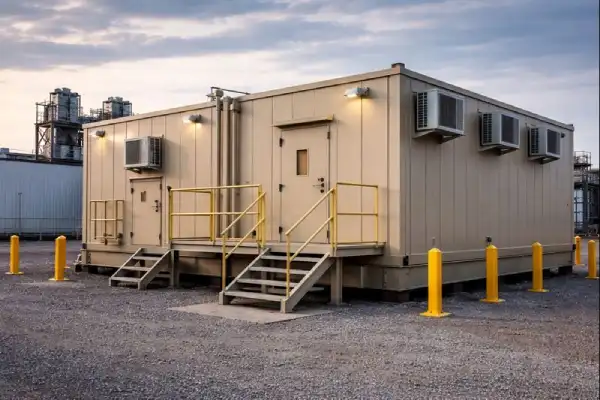
Blast-resistant modular buildings, also called blast-proof modular buildings or blast rated buildings, are pre-engineered structures manufactured in a factory-controlled environment and designed to withstand a specific blast overpressure and impulse duration without collapsing or generating lethal fragments, while keeping occupants safe inside. Each module is engineered against a site-specific hazard analysis covering blast overpressure, impulse duration, occupancy density, and equipment sensitivity, then welded, quality-checked, and largely finished before it ever reaches site. Unlike a conventional RCC or on-site steel structure, a blast resistant module is built to a known, tested structural response, low-response or medium-response depending on the site’s risk profile, and can include forced entry and ballistic resistance, positive pressure gas detection, and hazardous-area rated electrical systems as configured options. If you needed the one-line definition, that’s it. The sections below cover what actually separates a building that performs in a real blast event from one that only looks rated on paper.
Why Indian Industrial Sites Are Standardising on Custom Modular Blast Resistant Buildings
Facility siting for occupied buildings inside a process hazard zone is not a matter of guesswork. Internationally, API RP 752 and RP 753 provide the recognised methodology for managing explosion, fire, and toxic release risks to personnel in permanent and portable buildings at refineries, petrochemical, and gas processing facilities, covering blast overpressure evaluation, occupancy vulnerability, and building siting criteria. Traditional blast-resistant construction using site-built RCC or structural steel typically means longer construction timelines, higher costs, and extended plant disruption during installation, exactly the constraints a modular, factory-built approach is designed to remove. This is why oil and gas, petrochemical, fertilizer, power, and defense sites across India are increasingly specifying custom modular blast resistant buildings engineered to a documented response type and blast rating, rather than a generic reinforced structure with no stated design basis. This guide explains what to check before you commit to a manufacturer.
Specifications, Benefits, Applications & Installation Process
| Parameter | Standard Specification |
|---|---|
| Structural response type | Low-response or medium-response design |
| Blast rating | Site-specific overpressure and impulse duration rating |
| Construction | Factory-welded steel or reinforced modular structure |
| Configuration | Single module or multi-module complex |
| Security option | Forced entry and ballistic resistance (FE/BR) |
| Electrical classification | Class I Division 2 for hazardous area compliance |
| Safety systems | Positive pressure, gas detection, and alarm integration |
| Benefit | Impact |
|---|---|
| Rapid deployment | Significantly faster than conventional RCC or on-site steel |
| Quality assurance | Controlled manufacturing ensures dimensional accuracy |
| Reduced installation risk | Minimal on-site construction lowers safety hazards |
| Operational continuity | Less disruption to existing plant operations |
| Documented protection | Engineered against a known blast rating, not assumed |
| Scalability | Single or multi-module complexes as needs grow |
| Compliance support | Aligns with API RP 752/753 facility siting principles |
| Application | Typical Facility |
|---|---|
| Control rooms | Oil and gas, petrochemical process monitoring |
| Electrical and MCC rooms | Hazardous area power infrastructure |
| Analyzer shelters | Protected housing for process instrumentation |
| Operator cabins | On-site personnel near hazardous equipment |
| Safe havens and refuge areas | Emergency shelter during a blast or release event |
| Ammunition storage support buildings | Defense facilities |
| Utility and power plant buildings | Power generation and utility installations |
| Step | Action |
|---|---|
| 1. Hazard analysis | Assess blast overpressure, impulse duration, occupancy density |
| 2. Structural design | Select low or medium-response design and blast rating |
| 3. Factory fabrication | Module welded, quality-checked, and finished off-site |
| 4. Foundation prep | Site foundation and utility routing prepared in parallel |
| 5. Transport | Completed module transported to site |
| 6. Module placement | Positioned and secured on prepared foundation |
| 7. Commissioning | Electrical, HVAC, and safety systems tested and handed over |
Technical Data Sheet
| Property | Value / Standard |
|---|---|
| Product | Blast-Resistant Modular Building / Blast Rated Module |
| Governing methodology | API RP 752 / RP 753, facility siting for process plant buildings |
| Structural response | Low-response (minimal deformation) or medium-response (controlled deformation) |
| Configuration | Single module, multi-module complex, or scalable safety solutions |
| Security features | Forced entry and ballistic resistance (FE/BR) available |
| Electrical systems | Class I Division 2 rated for hazardous environments |
| Life safety systems | Positive pressure, gas detection, alarm integration |
| Manufacturing | In-house engineering and factory-controlled fabrication |
| Compliance focus | Blast overpressure, impulse duration, occupancy vulnerability |
| Customisation | Size, configuration, response rating, electrical classification |
Why Are Blast-Resistant Modular Buildings Critical for Industrial Safety?
Short answer: Because occupied buildings sited inside a process hazard zone face explosion, fire, and toxic release risks that conventional construction is not engineered to survive, and site-specific hazard analysis is the recognised way to size the protection a building actually needs.
Industrial facilities across India face increasing safety regulation and operational risk, and traditional blast-resistant construction often means long construction timelines, higher cost, and significant disruption during installation. Every properly engineered project begins with a detailed, site-specific hazard analysis covering:
- Blast conditions: Blast overpressure and impulse duration expected at the building's location
- Occupancy: Occupancy density and how many personnel the building must protect
- Equipment sensitivity: Equipment sensitivity for control rooms, analyzers, and electrical systems
- Facility type: The facility type, refinery, petrochemical plant, fertilizer unit, power plant, or defense site
Low-Response vs Medium-Response Design: The Structural Choice That Changes Everything
Most blast-resistant building content treats “blast rated” as a single, binary property, either a building is rated or it isn’t. In practice, the response type selected for a module has major cost and reusability consequences that rarely get explained upfront. A low-response design is engineered so the structure experiences little to no permanent deformation under its design blast load, meaning the building can potentially remain in service after the event it was designed for. A medium-response design allows controlled, predictable permanent deformation, absorbing more blast energy at a lower structural cost, but the building may need significant repair or replacement after experiencing its design-level blast. Neither is universally “better,” a control room protecting critical, continuously staffed operations often justifies the low-response premium, while a less frequently occupied support building may be sized to medium-response criteria to control cost. A manufacturer who doesn’t ask which response type your risk assessment calls for, and simply quotes “blast resistant” without qualification, hasn’t actually engineered the structure to your site’s risk profile.
Why Blast Overpressure Rating Alone Doesn't Tell You If a Building Is Safe
A blast rating expressed only as a peak overpressure number, for example “10 psi,” is an incomplete specification, because the same peak overpressure delivered over a longer impulse duration does significantly more structural work than a short, sharp spike. API’s facility siting methodology explicitly treats overpressure and impulse duration as separate inputs to a hazard analysis precisely because a structure engineered against a short-duration blast wave can still fail against a longer-duration event at the same peak pressure. Buyers who compare manufacturers purely on a headline psi figure, without asking what impulse duration that rating assumes, are not comparing like for like. A credible manufacturer of blast rated buildings will provide both figures, and explain which blast curve, or which specific hazard scenario, the module’s design is based on.
The Positive Pressure Mistake That Turns a Safe Haven Into a Gas Trap
A safe haven or control room near a process area commonly uses a positive pressure system, keeping internal air pressure slightly above ambient so that any leak path pushes air outward rather than pulling contaminated air in. What is often left out of a basic specification is that this system has to be correctly interlocked with the building’s gas detection system, so that if a gas release is detected outside, the fresh air intake automatically isolates rather than continuing to draw in contaminated air to maintain pressure. A positive pressure system running on a fixed, un-interlocked air supply during an active gas release can actively pull the hazard into the one space designed to protect people from it. This is a controls and sequencing detail, not a structural one, but it is just as critical to the building actually functioning as a safe haven during a real event, and it is worth confirming explicitly with your manufacturer rather than assuming it is included.
Myth vs Reality
| Myth | Reality |
|---|---|
| Any blast rated building suits any risk level | Response type must match the site's actual hazard analysis |
| A higher psi number always means a safer building | Impulse duration matters as much as peak overpressure |
| Positive pressure systems work automatically | They need gas detection interlocks to stay safe |
| Modular buildings are less durable than RCC | Modular structures meet the same engineered blast rating |
| One design fits control rooms and safe havens alike | Occupancy and equipment sensitivity change the design brief |
Advanced Module Technology and Configuration Options
Each blast-resistant module is manufactured in a controlled environment for consistent quality, dimensional accuracy, and reduced on-site installation risk. Configuration options typically include:
- Single or multi-module complexes for scalable safety solutions
- Varying blast overpressure and duration ratings based on site requirements
- Low-response and medium-response structural designs for different threat levels
- Forced entry and ballistic resistance (FE/BR) for enhanced security
- Positive pressure systems with gas detection and alarm integration
- Class I Division 2 electrical systems for hazardous environment compliance
Fully Operational Spaces for the Petroleum Industry
Specialised blast-resistant modular buildings for the petroleum industry are built as fully operational spaces, with comfort, visibility, ventilation, and maintainability designed in from the start, not added afterward:
- Control rooms: advanced monitoring capability for continuous process oversight
- Electrical and MCC rooms: hazardous area compliant enclosures for critical power infrastructure
- Analyzer shelters: protected housing for critical instrumentation and analyzers
- Operator cabins: enhanced visibility and communication for on-site operators
- Safe havens and refuge areas: secure spaces for personnel during emergency situations
How to Choose a Blast-Resistant Modular Buildings Manufacturer in India
- Ask whether the design is based on a documented hazard analysis, overpressure, impulse duration, and occupancy density specific to your site.
- Confirm whether a low-response or medium-response structural design is being quoted, and why.
- Check if the positive pressure system is interlocked with gas detection, not running on a fixed air supply.
- Verify electrical classification (Class I Division 2 or equivalent) matches your hazardous area requirements.
- Ask for the manufacturer's in-house engineering and fabrication capability, rather than a subcontracted build.
- Request examples of modules delivered for your specific industry, refinery, petrochemical, fertilizer, or defense.
Frequently Asked Questions
The Ecotone Difference
- In-house engineering and manufacturing: complete control over quality and delivery timelines
- Proven industrial experience: a track record in industrial safety and acoustic systems
- Custom design approach: solutions aligned to actual site risks and operational requirements
- Predictable quality: controlled manufacturing with faster deployment capability
- Reliable execution: proven performance in high-risk industrial environments across India
What this really means is reliability. When conditions are extreme, your building needs to perform exactly as engineered, not approximately.
Secure Your Facility with Confidence
Whether you need a control room, an analyzer shelter, an operator cabin, or a safe haven engineered to your site's specific blast, fire, and toxic release risk profile, Ecotone Systems designs and delivers custom modular blast resistant buildings backed by in-house engineering and a documented hazard analysis, not a one-size-fits-all rating.
Trusted by India's Leading Brands
Hover to pause · Logos scroll continuously