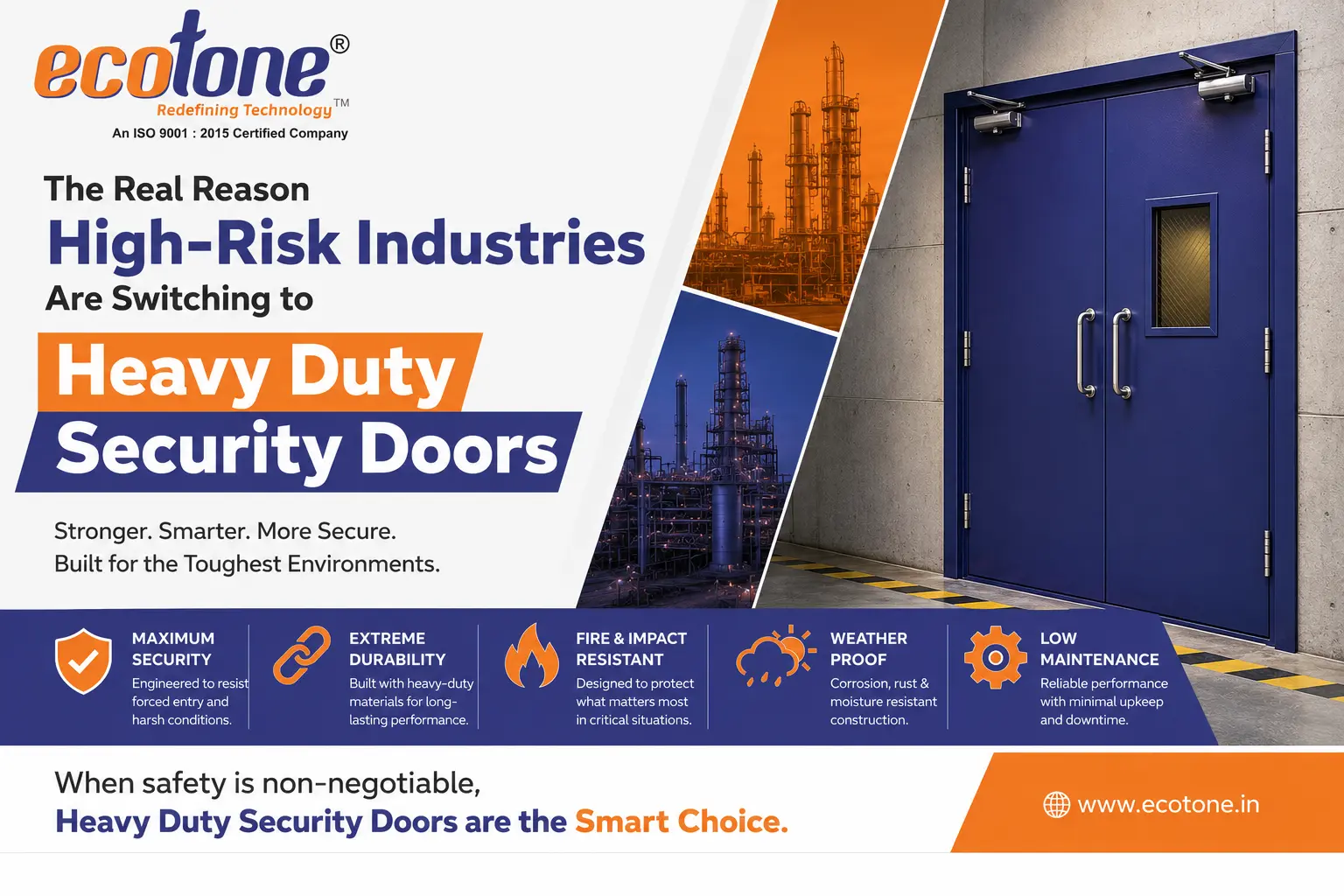
Think about the most sensitive spot in your facility. Maybe it’s the server room, the vault, the armoury, or the control room. Now ask yourself — what’s actually standing between that space and someone who wants to get in by force?
For most industries, the honest answer used to be “a lock and a steel door.” That’s no longer good enough. Today, facilities that handle critical assets, sensitive data, or public safety are moving toward heavy duty security doors — and the reasons are pretty straightforward once you understand what’s at stake.
So, What Exactly Are Heavy Duty Security Doors?
A heavy duty security door is not just a thicker version of a regular door. It’s a completely different category of product. These doors are built to take punishment — whether that’s a sustained forced entry attempt, a ballistic attack, or blast pressure from an explosion.
What makes them different? It starts with the core. Most heavy duty security doors use layered ballistic steel combined with energy-absorbing materials inside the panel. The frame is bolted deep into the structure of the wall, not just surface-mounted. The hinges are reinforced. The locks are multi-point systems that can’t be pried open easily.
And here’s something people often miss — the glass. A door with a standard glass panel is still a weak point. Quality heavy duty security doors use bullet-resistant glazing tested to the same standards as the door itself. The whole assembly holds, not just the steel.
For Any Inquiries Please Email
Our team typically responds within 24 hours on business days.
Contact UsHow Are These Doors Tested and Rated?
You’ll come across two main standards when shopping for heavy duty security doors.
The first is EN 1522, a European standard that rates doors from FB1 all the way to FB7 based on what kind of firearm they can stop. FB1 handles basic handgun rounds. FB6 stops multiple hits from a high-powered rifle — the kind of specification you’ll see on bank vaults, defence bunkers, and embassy entry points. FB7 goes further into armor-piercing territory.
The key takeaway here is simple: always ask for the test report. Any manufacturer worth dealing with will have third-party certified documentation proving their heavy duty security doors actually performed at the rated level — not just in theory, but in a real ballistic test.
Which Type of Doors Ecotone Systems Provide
Ecotone Systems provides four main types of heavy duty security doors to meet the varying needs of high-risk industries. These include Steel Acoustic Doors for facilities requiring both physical security and sound isolation, Wooden Acoustic Doors for environments where aesthetics and acoustic privacy go hand in hand, Blast Resistant Doors engineered to withstand explosion overpressure and fragmentation, and Bullet Resistant Doors tested to EN 1522 FB6 certification to stop ballistic threats ranging from handgun rounds to high-powered rifle fire. Each door type is available in single or double-leaf configurations and can be tailored with bullet-resistant glazing, fire-rated builds, and biometric or electronic access integration.
1. Steel Acoustic Doors
Steel Acoustic Doors combine the robust physical security of heavy-gauge steel construction with advanced sound-dampening technology. These doors are engineered to prevent both forced intrusion and sound transmission — making them ideal for environments where confidentiality and physical security must coexist.
Key Features:
- Constructed with multi-layer steel skins filled with acoustic-grade insulation materials such as mineral wool or viscoelastic compounds
- Achieves Sound Transmission Class (STC) ratings typically between 40–55 dB, significantly reducing noise bleed
- Reinforced frame and multi-point locking for high-security perimeter protection
- Available in single-leaf and double-leaf configurations with vision panels using acoustic-rated glazing
- Customisable finishes and powder-coat colours to suit interior environments
Ideal For:
- Government intelligence and SCIF (Sensitive Compartmented Information Facility) rooms
- Recording studios and broadcast facilities with high-security perimeters
- Corporate boardrooms handling sensitive negotiations
- Data centres where server noise must be contained alongside strict access control
- Military communication rooms and command centres
2. Wooden Acoustic Doors
Wooden Acoustic Doors offer a professional and aesthetically refined alternative where the environment demands acoustic performance without a purely industrial appearance. Unlike standard interior doors, these are engineered with precision-layered cores that deliver genuine sound isolation.
Key Features:
- Built with solid or laminated timber cores combined with acoustic damping layers — often incorporating mass-loaded vinyl (MLV) or lead composite sheets
- Perimeter acoustic seals and automatic drop seals at the base to eliminate air gaps through which sound travels
- STC ratings typically ranging from 35–52 dB depending on construction specification
- Available in high-quality veneers, laminates, or painted finishes for seamless integration into formal interiors
- Can be fitted with acoustic glass panels for natural light without sacrificing sound control
Ideal For:
- Executive offices, courtrooms, and legal chambers where confidentiality is paramount
- Medical consultation rooms, psychiatric facilities, and private clinics
- Conference centres and private meeting rooms in government buildings
- VIP areas in hotels, embassies, and diplomatic residences requiring both elegance and privacy
- Educational institutions with secure administrative zones
3. Blast Resistant Doors
Blast Resistant Doors are engineered to withstand the overpressure wave, fragmentation, and structural forces generated by an explosion. They are a critical life-safety and asset-protection measure in any facility that faces the risk of explosive threats — whether from terrorism, industrial accidents, or military conflict.
Key Features:
- Designed and tested to withstand specific blast pressure levels, typically measured in pounds per square inch (PSI) or kiloPascals (kPa)
- Constructed with high-tensile steel skins, energy-absorbing core materials, and blast-rated frame anchoring systems embedded into reinforced concrete
- Door leafs are designed to flex under blast load rather than shatter, preventing deadly fragmentation
- Multi-point locking bars distribute force across the full frame perimeter during a blast event
- Available in single and double configurations, with options for blast-rated vision panels
- Tested against international standards including ASTM F2927 and ISO 16933 for verified performance
Ideal For:
- Embassies and diplomatic missions in high-threat environments
- Military installations, armouries, and ammunition storage facilities
- Oil and gas refineries, chemical plants, and petrochemical facilities where explosion risk is inherent
- Power plant control rooms and critical infrastructure protection zones
- Counter-terrorism safe rooms and bunkers for VIPs and government officials
4. Bullet Resistant Doors
Bullet Resistant Doors are purpose-built to stop ballistic threats — from handgun rounds to high-powered rifle fire — without compromising on door functionality or operational workflow. They form a critical line of physical defence in environments where armed attack is a credible risk.
Key Features:
- Ballistic protection achieved through layered ballistic steel, Kevlar composite panels, or ultra-high-molecular-weight polyethylene (UHMWPE) within the door core
- Rated per EN 1522 / EN 1063 (European standard) covering levels FB1 through FB7, corresponding to threats ranging from .38 Special handgun rounds to armour-piercing rifle ammunition
- Bullet-resistant glazing panels — tested to matching ballistic levels — can be incorporated without creating weak points in the assembly
- Reinforced frame and hinge system ensure the door does not separate from the structure under ballistic impact
- Multi-point locking mechanisms provide additional forced-entry resistance
- Available in steel or clad wood finishes to suit both industrial and formal environments
Ballistic Rating Quick Reference (EN 1522):
- FB1–FB2: Protection against pistol calibres (.38 Special, 9mm)
- FB3–FB4: Protection against Magnum handgun rounds (.44 Mag, .357 Mag)
- FB5–FB6: Protection against rifle calibres (5.56mm, 7.62mm NATO — standard for banks, embassies, defence facilities)
- FB7: Protection against armour-piercing rifle ammunition
Ideal For:
- Banks, currency vaults, and gold storage facilities
- Police stations, armouries, and law enforcement secure zones
- VIP protection rooms and executive panic rooms
- Border security posts and military checkpoints
- Jewellery showrooms, cash-in-transit facilities, and high-value retail
Which Industries Actually Need These Doors?
This isn’t just for the military, though that’s obviously a big user. The list of industries using heavy duty security doors has grown significantly over the past decade.
Defence and Military
Armouries, command posts, ammunition storage — these have always needed serious physical security. The requirement here is typically FB6 or above, sometimes with blast resistance added on top.
Banks and Financial Institutions
Cash vaults, currency processing rooms, and gold storage areas in banks rely on heavy duty security doors as a core part of their physical security setup. Often paired with time-delay locks and bullet-resistant windows.
Government Buildings
Ministries, courts, and secretariats deal with sensitive documents and people who are potential targets. Entry points and secure rooms inside these buildings increasingly use certified heavy duty security doors, often combined with biometric access.
Data Centres
A data centre breach isn’t just theft — it can take down systems for thousands of businesses. The server room door is a critical control point, and more facility managers are specifying heavy duty security doors for exactly this reason.
Embassies and Diplomatic Missions
Embassies sit in a complicated risk environment. They need doors that can handle both ballistic threats and, in some cases, blast pressure from an explosion nearby. This is one sector where multi-certified heavy duty security doors are essentially the baseline requirement.
Power Plants and Oil & Gas Facilities
The control room of a power plant is more important than most people realise. If someone gains forced entry there, the damage can affect entire cities. Heavy duty security doors protect these control environments from both intrusion and sabotage.
Police Stations and Border Posts
Law enforcement facilities, especially in high-risk zones, use heavy duty security doors for armouries and holding areas. Border security posts near active conflict zones need even higher specifications.
VIP Safe Rooms
Panic rooms for senior government officials, executives, or high-profile individuals are fitted with heavy duty security doors that can be quickly sealed from inside. These are designed for rapid lockdown in an emergency.
What Should You Check Before Buying?
A few things are worth verifying before you commit to any supplier of heavy duty security doors.
First, check the certification. EN 1522 test reports from an accredited lab are non-negotiable. Printed brochures don’t count — ask for the actual document.
Second, look at the full assembly. Some manufacturers sell a well-built door leaf but pair it with a mediocre frame or standard hardware. The entire system needs to meet the same standard, not just the panel.
Third, understand what customisation options exist. Your facility may need a fire-rated version, an acoustic variant for sensitive areas, or integration with your existing access control system. Not every supplier can do all of that.
Why Ecotone Systems Keeps Coming Up in This Space
If you’ve been researching heavy duty security doors for any serious application in India, you’ve probably come across Ecotone Systems. There’s a reason for that.
Ecotone Systems manufactures bullet-resistant and heavy duty security doors tested to EN 1522 FB6 certification — one of the toughest ballistic standards available. They’ve been doing this for over 25 years, with more than 500 installations across India and abroad. That kind of track record matters when you’re making a decision this important.
What’s practical about working with Ecotone Systems is the range of what they offer. Single-leaf or double-leaf configurations, fire-rated builds, acoustic insulation, bullet-resistant glass panels, and full integration with biometric and electronic access systems — all of it can be tailored to what your project actually needs.
They’re not just a door supplier. Ecotone Systems handles the engineering consultation, the manufacturing, and the installation. If something needs adjusting after the fact, their technical team is available. For industries that don’t have the bandwidth to manage five different vendors for one security door project, that end-to-end approach matters a lot.
Installation and Upkeep — Don’t Skip This Part
Even a certified, well-built heavy duty security door can underperform if the installation is done poorly. The frame needs to be properly anchored into reinforced concrete — not just surface-fixed. The alignment has to be right so the multi-point lock actually engages correctly under pressure.
After installation, basic maintenance keeps performance where it should be. Hinges need periodic lubrication. Locking mechanisms should be checked for smooth operation. Bullet-resistant glass panels should be inspected for stress cracks, since even minor damage can compromise the rated protection level.
Ecotone Systems includes installation support and post-installation technical guidance as part of their service, which removes a lot of the uncertainty that comes with a product this specialised.
The Bottom Line
Heavy duty security doors have moved from being a niche product for defence applications to a mainstream requirement across industries that handle anything of critical value — data, cash, energy infrastructure, government operations, or human safety.
The market has matured, standards are clearer, and there are now manufacturers in India like Ecotone Systems who can deliver internationally certified products without the lead times and costs of importing from abroad.
If your facility has a room, a floor, or an entry point that genuinely needs protection — not just a deterrent, but actual resistance to a determined attack — heavy duty security doors are worth understanding properly. And getting it right from the start is a lot easier than trying to fix a security gap after something goes wrong.
Trusted by India's Leading Brands
Hover to pause · Logos scroll continuously