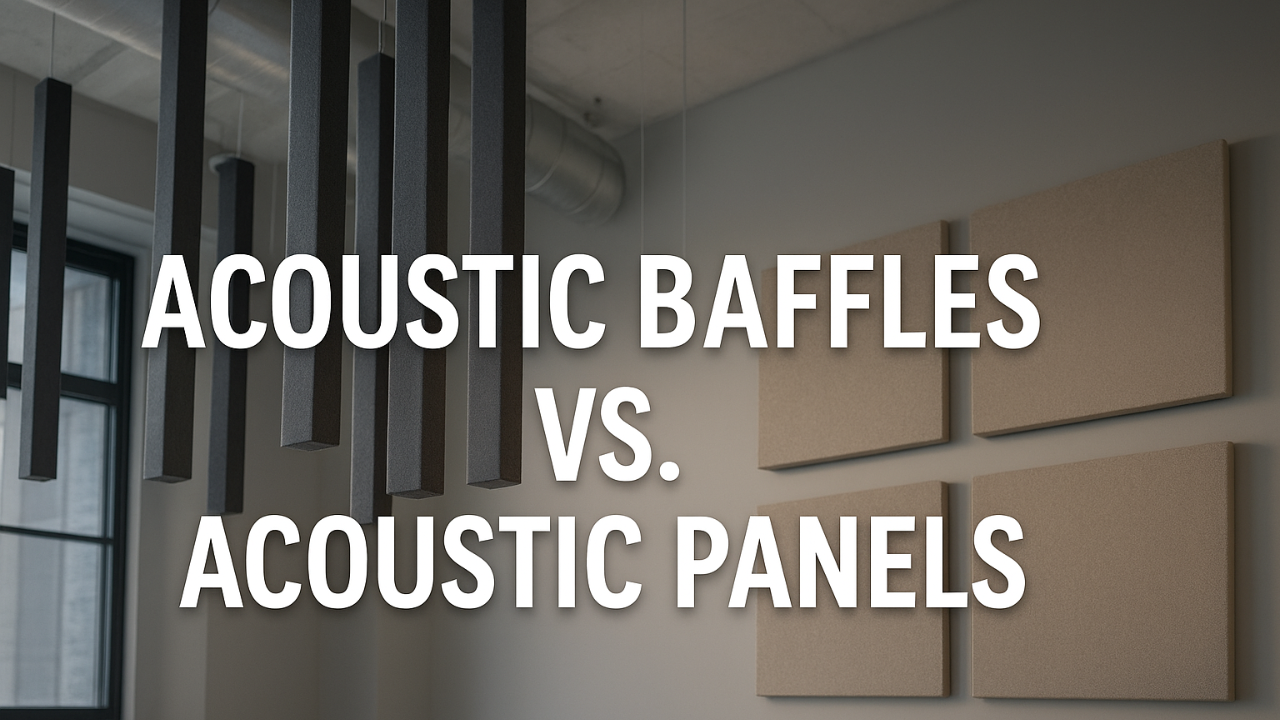
As spaces grow larger, acoustics have become a crucial part of modern building design. Whether in industrial units, commercial buildings, educational facilities, transportation hubs, or recreational environments, the way sound behaves inside a room directly affects comfort, communication, and productivity. Without proper treatment, sound reflects off hard surfaces, causing echo, reverberation, and excessive noise buildup. This is where Acoustic Baffles play a vital role. By absorbing unwanted sound and controlling reflections, they help maintain speech clarity, improve working conditions, and enhance overall acoustic performance in both small and large spaces.
Architects and acoustic consultants today rely heavily on engineered sound-absorbing products to control these issues. Two of the most versatile and effective solutions are acoustic panels. Although both share the objective of managing sound reflections, their structure, orientation, installation method, and performance levels make them suitable for different environments. Acoustic Baffles offer exceptional performance in large spaces with high ceilings, while acoustic panels are ideal for small to medium rooms with controlled widths and confined surfaces.
For Any Inquiries Please Email
Our team typically responds within 24 hours on business days.
Contact UsThis comprehensive guide explains the differences between these two solutions, including the types available, their benefits, their installation methods, and how they work. With high-quality solutions offered by companies like Ecotone Systems, it becomes easier for designers and facility planners to create acoustically balanced environments across a wide range of projects.
This article explores acoustic baffles and acoustic panels in detail, helping you determine which solution is the right fit for your space.
What Are Acoustic Baffles
Acoustic Baffles are vertically suspended sound-absorbing elements designed to treat large rooms with heavy echo problems. Their suspended orientation allows them to absorb sound from multiple directions. When sound waves travel upward or sideways, these baffles intercept and absorb them. This helps reduce noise buildup, especially in spaces with high ceilings where sound tends to bounce continuously.
Key Features of Acoustic Baffles
- Installed vertically from the ceiling
- Absorb sound from all sides
- Ideal for large and open spaces
- Available in various materials like PET fiber, fabric, foam, and metal
- Provide excellent reverberation control
Acoustic Baffles are especially beneficial in environments such as factories, sports complexes, auditoriums, airports, and classrooms where large volumes and reflective surfaces create excessive reverberation.
What Are Acoustic Panels
Acoustic panels are flat-mounted sound-absorbing units fixed on walls or ceilings. They manage reflections from directional sound sources and improve speech clarity in enclosed spaces. Acoustic panels typically treat mid and high frequencies, making them effective in rooms where communication, focus, and accuracy are required.
Key Features of Acoustic Panels
- Wall-mounted or ceiling-mounted
- Absorb sound from the front-facing side
- Available in multiple shapes, colors, and textures
- Improve speech clarity and reduce flutter echoes
These panels are commonly installed in offices, meeting rooms, classrooms, recording studios, home theaters, restaurants, and other enclosed spaces.
Acoustic Baffles vs. Acoustic Panels: Detailed Comparison Table
| Parameter | Acoustic Baffles | Acoustic Panels |
|---|---|---|
| Installation Method | Suspended vertically from the ceiling | Mounted on walls or ceilings |
| Absorption Style | Multi-directional from all sides | Absorbs from the exposed front side |
| Ideal Use Case | Large and open rooms with high ceilings | Small to medium-sized enclosed rooms |
| Space Requirement | Does not use wall space | Requires an available wall or ceiling area |
| Common Variants | Acoustic Ceiling Baffles, Hanging Baffles, Industrial Acoustic Baffles, Sound Baffles | Fabric panels, foam panels, PET panels, wooden panels |
| Aesthetic Impact | Creates a dynamic, suspended architectural effect | Offers a clean, minimalistic visual finish |
| Noise Handling Capacity | Handles high reverberation in large spaces | Best for clarity and sound balance in rooms |
| Typical Locations | Warehouses, gyms, airports, and factories | Offices, studios, classrooms, theaters |
| Installation Cost | Moderate to high, depending on complexity | Generally moderate |
Types of Acoustic Baffles
Acoustic baffles come in different types based on the environment, noise level, and architectural design considerations.
Acoustic Ceiling Baffles
These baffles are suspended directly from the ceiling, making them suitable for commercial and industrial applications. Acoustic Ceiling Baffles capture echoes from tall structures where traditional wall-mounted solutions are not feasible.
Benefits
- Highly efficient in large volume spaces
- Improves sound uniformity across the room
- Allows natural airflow and lighting systems to operate freely
Hanging Baffles
Hanging Baffles are visually appealing and serve as both an acoustic and aesthetic solution. Designers use them to complement interior styles while maintaining acoustic balance.
Benefits
- Absorb sound from two sides
- Available in various shapes and sizes
- Lightweight and suitable for creative installations
Industrial Acoustic Baffles
Industrial Acoustic Baffles are specifically engineered for environments with high-level industrial noise. They are constructed using durable cores and robust outer layers to handle harsh operational conditions such as heat, dust, moisture, and vibration.
Benefits
- Superior sound absorption
- Long-lasting performance
- Suitable for heavy machinery areas and manufacturing units
Sound Baffles
Sound Baffles are a category that covers all vertical suspended acoustic units. They effectively reduce echo, eliminate unwanted reflections, and improve clarity in both commercial and industrial settings.
Benefits
- Enhance overall sound comfort
- Provide efficient noise reduction
- Affordable and scalable for large installations
Trusted by India's Leading Brands
Hover to pause · Logos scroll continuously














Types of Acoustic Panels
Acoustic panels come in a variety of options depending on their application, design, and material.
Fabric-Wrapped Panels
Fabric-wrapped panels feature an acoustic insulation core wrapped in fabric. They are a preferred choice for spaces that need elegance with acoustic performance.
Foam Panels
These lightweight panels are primarily used in studios and practice rooms. Foam panels reduce reflections and minimize flutter echoes.
PET Polyester Panels
Made from compressed PET fibers, these panels are durable, eco-friendly, and visually attractive. They support sustainable building designs and are preferred in modern commercial interiors.
Wooden Acoustic Panels
Wooden acoustic panels offer a combination of visual appeal and acoustic control. They provide diffusion and absorption in environments such as conference halls and auditoriums.
How Acoustic Baffles Work
Acoustic Baffles use their absorbent surfaces to capture sound energy coming from different directions. When sound waves travel through a room, they encounter the suspended baffles. As sound interacts with the baffle material, the energy is absorbed and converted into low-level heat. This process reduces sound reflection and reverberation.
Why Acoustic Baffles Perform Well in Large Rooms
- Sound travels farther in large spaces
- Echo levels are naturally higher
- Vertical surfaces reduce repeated reflections
- Dual-sided absorption enhances performance
Acoustic Baffles are therefore suitable for environments where controlling reverberation is more challenging due to size and height.
How Acoustic Panels Work
Acoustic panels absorb sound reflections primarily from their front-facing surface. They reduce mid and high-frequency reflections that interfere with clarity. By absorbing these reflections, panels create a balanced sound environment that improves communication, reduces distraction, and enhances usability.
Panels are most effective when mounted strategically on walls where sound reflections are strongest.
Applications of Acoustic Baffles and Panels
Both solutions serve different environments depending on the acoustic requirements.
Ideal Environments for Acoustic Baffles
- Factories
- Warehouses
- Gymnasiums
- Auditoriums
- School halls
- Shopping malls
- Airport terminals
- Industrial manufacturing units
These spaces typically have limited wall area and large reflective surfaces, making baffles a suitable choice.
Ideal Environments for Acoustic Panels
- Offices
- Recording studios
- Podcast rooms
- Restaurants
- Libraries
- Classrooms
- Home theaters
- Conference rooms
Panels are used where clarity and comfort are essential within smaller enclosed spaces.
Benefits of Using Acoustic Baffles
Superior Reverberation Control
Acoustic Baffles are extremely effective in environments where sound reflections are intense and difficult to manage.
Dual-Sided Absorption
Their structure allows sound to be absorbed from multiple directions, improving overall performance.
Architectural Enhancement
Baffles add a modern dimension to interiors and complement high-end architectural concepts.
Space Optimization
They do not occupy wall space, making them practical in environments where walls are filled with equipment or windows.
Airflow Efficiency
Baffles do not obstruct HVAC systems, ensuring optimal air circulation.
Industrial-Grade Noise Reduction
Industrial Acoustic Baffles are engineered for harsh and noisy environments.
Benefits of Using Acoustic Panels
Improved Clarity
Panels enhance speech intelligibility, making them beneficial for offices, classrooms, and communication-focused spaces.
Versatile Designs
Panels come in multiple shapes, sizes, colors, and finishes to match interiors.
Easy and Fast Installation
They require minimal installation time, reducing downtime.
Cost Efficiency
Acoustic panels are generally more economical for small to medium rooms.
How to Choose Between Acoustic Baffles and Acoustic Panels
Consider the following factors when making a decision.
Size of the Space
Large areas require Acoustic Baffles while smaller rooms benefit more from acoustic panels.
Ceiling Height
High ceilings support baffle installations, while lower rooms are better suited for panels.
Aesthetic Design
Suspended Hanging Baffles create dynamic ceilings, while panels provide a clean and flat surface finish.
Noise Intensity
Industrial Acoustic Baffles are suitable for noisy environments, whereas panels handle moderate noise.
Wall Availability
If wall space is limited, Acoustic Ceiling Baffles offer the best solution.
Why Acoustic Baffles Are Becoming More Popular
Acoustic Baffles are gaining popularity in modern commercial and industrial architecture because they combine functionality with contemporary aesthetics. Their suspended design integrates easily with lighting fixtures, mechanical systems, and interior layouts.
Key Advantages of Using Baffles
- Effective in open-plan layouts
- High-performance noise reduction
- Customizable in shape and size
- Suitable for large and industrial environments
Installation Methods for Acoustic Baffles
Suspended Cable Systems
A versatile method allowing height adjustments.
Direct Ceiling Installation
Used where available height is limited.
Grid Suspension Systems
Ideal for large commercial spaces such as gyms and halls.
Heavy-Duty Brackets
Used for Industrial Acoustic Baffles in factories.
Installation Methods for Acoustic Panels
Adhesive-Based Installation
Suitable for lightweight foam or PET panels.
Metal Clips or Z-Clips
Provide secure and durable mounting.
Hook and Loop Systems
Enable easy repositioning and maintenance.
Flush Mounting
Creates a seamless and clean appearance on walls.
Do Acoustic Baffles Offer Better Reverberation Control
In large spaces, Acoustic Baffles generally outperform acoustic panels. Because of their vertical placement and multi-directional absorption, baffles reduce reverberation more effectively in large rooms where sound reflection is intense. Their ability to expose more surface area to sound waves makes them a preferred choice for architects and acoustic specialists working with high-volume spaces.
Maintenance of Acoustic Baffles and Panels
Acoustic Baffles
- Periodic dusting or vacuuming
- Check suspension accessories regularly
- Replace worn components when needed
Acoustic Panels
- Light dust removal
- Fabric cleaning
- Check adhesive or metal clips
Both solutions offer excellent lifespan when properly maintained.
How Ecotone Systems Supports Acoustic Design
Ecotone Systems specializes in high-performance acoustic baffles and panels designed for both commercial and industrial applications. The company focuses on durability, acoustic efficiency, and modern design to ensure spaces achieve high-quality sound performance and comfort.
Final Thoughts
Acoustic Baffles and Acoustic Panels each play a crucial role in improving sound performance, but their application depends on the nature of the space. Large, open environments with high ceilings benefit most from Acoustic Ceiling Baffles, Hanging Baffles, Industrial Acoustic Baffles, and Sound Baffles. Smaller, enclosed spaces require panels to manage reflections and enhance clarity.
Understanding their differences helps architects, designers, and facility managers select the right solution for optimal acoustic comfort. Both are valuable components of modern acoustic design, and with quality products from companies like Ecotone Systems, achieving sound-controlled environments becomes easier and more effective.