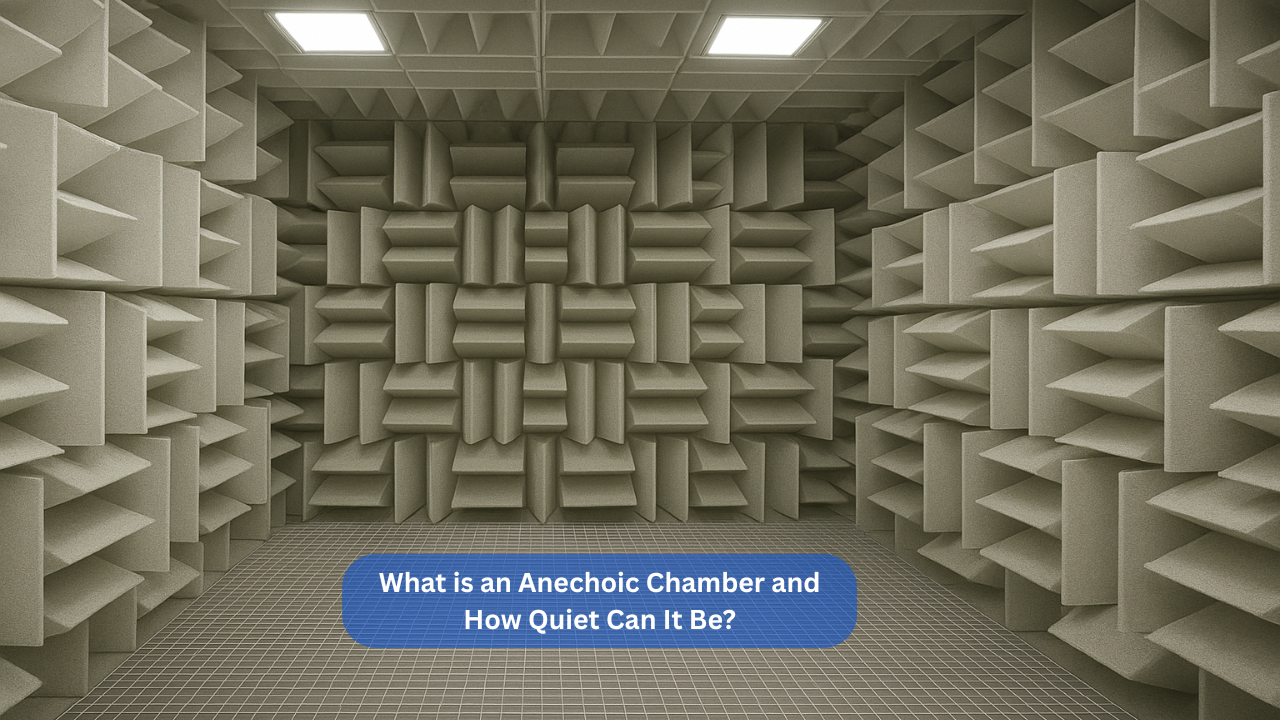
Imagine walking into a room so silent that you can hear the faint beating of your own heart or the subtle sound of your lungs expanding as you breathe. You pause, expecting to hear the familiar background noises of life, but there are none. Every sound disappears the moment it’s made. This is what it feels like to step inside an Anechoic Chamber, one of the quietest environments ever created by humans.
In a world dominated by noise from traffic and industrial machines to the constant buzz of electronic devices, silence has become a luxury. For researchers, scientists, and engineers, silence isn’t just peaceful; it’s essential. Whether testing the sound quality of a new speaker, measuring how quiet an engine can be, or studying how humans perceive sound, having a space completely free of echoes and background noise is critical. That is where the Anechoic Chamber comes in. The word anechoic literally means “without echo.” These chambers are designed to absorb all sound reflections and prevent outside noise from entering. The result is a room that can simulate conditions of perfect silence, a space so quiet that it challenges our normal perception of sound and space.
In this article, we’ll explore what an Anechoic Chamber is, how it works, why it’s used, how quiet it can actually get, and what it feels like to experience complete silence. We’ll also highlight how Ecotone Systems, a leading provider of acoustic solutions, designs and constructs world-class Acoustic Anechoic Chambers and noise control systems for a wide range of industries.
For Any Inquiries Please Email
Our team typically responds within 24 hours on business days.
Contact UsWhat is an Anechoic Chamber?
An Anechoic Chamber is a specially designed room built to completely absorb sound waves and block external noise. It is often referred to as a “soundproof” or “echo-free” room. Unlike a normal room where sound bounces off walls, floors, and ceilings, an Anechoic Chamber prevents any sound reflection, creating an environment of total acoustic isolation.
The chamber’s interior is lined with wedge-shaped foam or fiberglass panels that trap sound energy. These wedges are carefully designed and positioned to absorb specific frequencies of sound, ensuring that no reflections reach the center of the room. The floor is typically made of a suspended mesh or grid that allows sound to pass through and be absorbed by the wedges below.
Semi Anechoic Chambers and Full Anechoic Chambers are variations of this design. A Semi Anechoic Chamber has sound-absorbing material on the walls and ceiling but retains a reflective floor for specific testing needs. A Full Anechoic Chamber, on the other hand, absorbs sound from all directions, including the floor, for maximum isolation.
Anechoic Chambers are often described as “free-field” spaces because they replicate the conditions of open air but without any environmental noise. This allows for highly accurate Anechoic Chamber Measurements and experiments.
How Does an Anechoic Chamber Work?
The working principle of an Anechoic Chamber revolves around sound absorption and isolation.
Sound Absorption
When sound is produced inside the chamber, it travels outward in all directions. Instead of bouncing back as it would in a regular room, the sound waves strike the foam wedges and get absorbed. The wedge shape plays a key role here; it traps the sound waves and gradually reduces their energy, converting it into a small amount of heat.
Sound Isolation
The second critical element is preventing external sounds from entering the chamber. To achieve this, the chamber is usually built as a room within a room, separated from the building’s structure by air gaps or vibration isolators. This design stops vibrations, footsteps, and airborne noise from leaking inside.
The walls, ceiling, and floor are made with multiple layers of dense materials like steel and concrete, lined with acoustic insulation. Doors and ventilation systems are also specially designed to maintain the chamber’s isolation. Together, these features create a perfectly silent and controlled acoustic environment ideal for research and testing.
How Quiet Can an Anechoic Chamber Be?
The quietest Anechoic Chambers in the world reach sound levels as low as –20 to –25 decibels (dB). To understand how quiet that really is, take a look at the comparison table below:
| Environment / Sound Source | Approximate Sound Level (dB) | Description |
|---|---|---|
| Jet Engine (close range) | 140 dB | Extremely loud, it can cause hearing damage instantly. |
| Rock Concert / Siren | 110 dB | Very loud noise, discomfort possible. |
| City Traffic | 85 dB | Typical street noise, prolonged exposure may harm hearing. |
| Normal Conversation | 60 dB | Standard talking level. |
| Quiet Office / Library | 40 dB | Noticeably calm environment. |
| Whisper | 30 dB | Gentle sound, barely audible. |
| Human Breathing | 10 dB | Very soft, near silence. |
| Absolute Silence (Threshold of Hearing) | 0 dB | The lowest level the human ear can detect. |
| Anechoic Chamber | –20 to –25 dB | Sound below the human hearing threshold; near-complete acoustic silence. |
At these extremely low levels, sound energy is so minimal that it’s below what the human ear can normally detect. In fact, people inside such chambers often start hearing their own body sounds, such as heartbeat, blood flow, and even the clicking of joints.
What is the Purpose of an Anechoic Chamber?
Anechoic Chambers are used in a wide variety of industries for sound testing, research, and development:
Acoustic Testing
These chambers allow accurate testing of sound-producing or sound-receiving devices such as microphones, speakers, headphones, and hearing aids.
Product Noise Measurement
Many industries, including consumer electronics and automotive manufacturing, use Anechoic Chambers to measure how much noise a product generates.
Automotive and Aerospace Research
Vehicle manufacturers use large-scale Anechoic Chambers to test cabin acoustics, engine noise, and aerodynamic sound. Similarly, aerospace companies test aircraft components to minimize noise and vibration.
Hearing Research
Audiologists and scientists studying human hearing use Anechoic Chambers to conduct experiments on sound perception and auditory behavior.
Electromagnetic Testing
Apart from acoustic uses, RF (Radio Frequency) Anechoic Chambers are used for electromagnetic compatibility testing to test antennas, radars, and wireless devices.
Design and Construction of an Anechoic Chamber
Building an Anechoic Chamber requires deep technical expertise in acoustics, materials, and structural engineering. Key design features include:
- Wedge-Shaped Acoustic Foam: Absorbs sound waves effectively across frequencies.
- Double-Layered Walls: Prevent external noise intrusion.
- Floating Floor System: Reduces vibration transfer.
- Silent Ventilation and Lighting: Maintains comfort without noise.
- Precision Door Seals: Ensures complete sound isolation.
Each of these elements works together to create an environment where sound behaves predictably and can be measured accurately.
What Does It Feel Like Inside an Anechoic Chamber?
Stepping into an Anechoic Chamber is unlike any other experience. The moment the heavy door closes, the outside world disappears. Even the smallest sounds, such as breathing, heartbeat, or clothing moving, become startlingly loud compared to the silence around you.
Most people describe the experience as both fascinating and unsettling. Because there are no echoes, your brain has no spatial reference for sound. This can make you feel slightly disoriented or off-balance. Some people report feeling a mild pressure in their ears or even dizziness after a few minutes.
Despite the discomfort, many find the experience strangely calming once they adjust. For professionals, it’s an essential environment that allows them to study the true nature of sound, free from distortion or interference.
Ecotone Systems: Experts in Acoustic and Noise Control Solutions
If your organization requires advanced acoustic testing facilities or professional soundproofing systems, Ecotone Systems is your trusted partner. With years of experience in acoustic engineering, Ecotone Systems specializes in designing and constructing high-performance Anechoic Chambers tailored to meet specific industrial and research needs.
Our services include:
Each project is handled with precision engineering and high-quality materials to ensure excellent sound absorption, durability, and performance. Whether it’s for a university research lab, an industrial testing center, or a corporate R&D facility, Ecotone Systems delivers acoustic environments that meet international standards.
Conclusion
An Anechoic Chamber is far more than just a silent room. It’s a masterpiece of acoustic engineering that provides a controlled, echo-free environment for researchers and engineers to study and measure sound with unmatched precision. Whether you need a Full Anechoic Chamber for detailed research or a Semi Anechoic Chamber for specific product testing, these chambers are crucial tools in advancing scientific understanding and technological development.
Ecotone Systems continues to lead the way in providing cutting-edge Acoustic Anechoic Chambers that ensure superior sound control and accurate Anechoic Chamber Measurements for industries across the globe.
Frequently Asked Questions (FAQ) About Anechoic Chambers
What is the main purpose of an Anechoic Chamber?
An Anechoic Chamber is designed to completely absorb sound reflections and block external noise, creating a “free-field” environment. It’s mainly used for testing microphones, loudspeakers, electronic devices, and conducting precise acoustic or electromagnetic experiments.
How quiet can an Anechoic Chamber really get?
The quietest Anechoic Chambers in the world can reach sound levels between –20 dB to –25 dB, which is quieter than absolute silence (0 dB). At this level, people can hear their heartbeat, blood flow, and even the sound of their joints moving.
What materials are used inside an Anechoic Chamber?
The inner walls of an Anechoic Chamber are lined with wedge-shaped foam or fiberglass acoustic panels. These wedges absorb sound waves by trapping them and converting their energy into heat, ensuring no echo or sound reflection inside the room.
What is the difference between a Full Anechoic Chamber and a Semi-Anechoic Chamber?
A Full Anechoic Chamber absorbs sound on all six surfaces — walls, ceiling, and floor — providing total acoustic isolation. A Semi-Anechoic Chamber absorbs sound on the walls and ceiling but keeps a reflective floor, allowing for specific testing scenarios like vehicle or machinery sound measurements.
How does an Anechoic Chamber block outside noise?
An Anechoic Chamber is built using double-layered steel or concrete walls, floating floors, and air gaps between structural layers. These act as barriers that isolate the chamber from external vibrations and airborne sound, preventing any noise leakage.
What does it feel like to be inside an Anechoic Chamber?
Inside an Anechoic Chamber, the absence of echoes creates an unusual and sometimes disorienting experience. Many people report hearing their own heartbeat or breathing clearly. The silence can feel both calming and unsettling because your brain has no sound cues for orientation.
Who uses Anechoic Chambers and why?
Anechoic Chambers are used by automotive manufacturers, aerospace companies, electronic product designers, research laboratories, and universities. They are essential for sound testing, noise measurement, product development, and hearing research.
Trusted by India's Leading Brands
Hover to pause · Logos scroll continuously