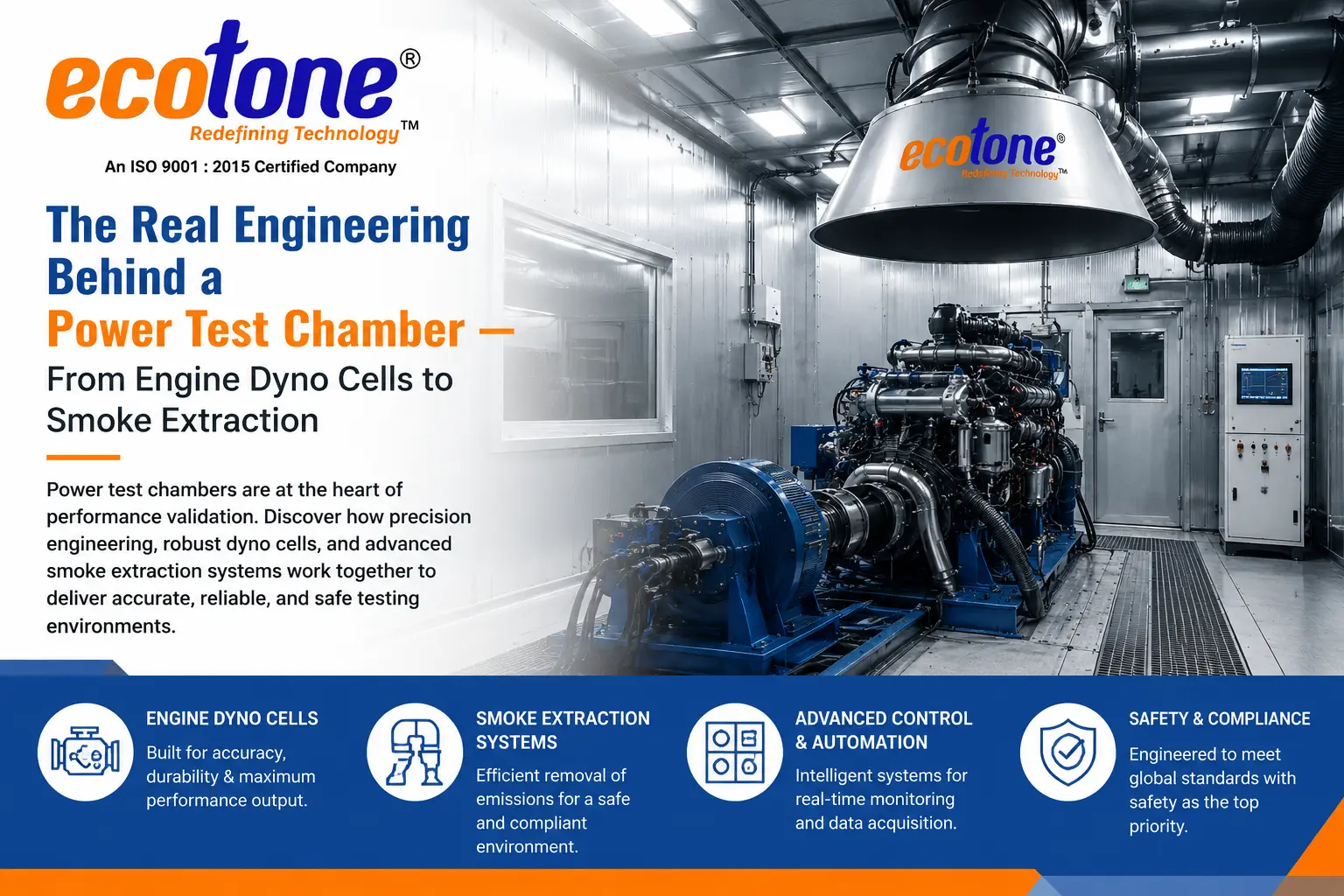
Let’s be honest — most engineers don’t think about the room until the equipment is already ordered.
That’s usually when the trouble starts. The dynamometer arrives, the engine mounts go in, and then someone realizes the ventilation can’t handle peak heat load, or the walls are transmitting noise into the control room, or the exhaust extraction isn’t rated for the particulate output of a diesel running at full torque. Suddenly a testing facility that looked straightforward on paper becomes a six-month headache.
A power test chamber isn’t just a room with an engine in it. It’s an integrated system — and understanding what goes into building one properly can save a lot of grief down the line.
What a Power Test Chamber Actually Does
Here’s the simplest way to think about it: an engine running on a test stand is doing everything it would do on the road, minus the road. It’s burning fuel, generating heat, producing exhaust, vibrating at frequencies that travel through concrete, and making noise that would be illegal outside the building.
The power test chamber is what makes all of that manageable. It contains the noise. It routes the exhaust. It keeps air moving so engineers can actually work in the space. It handles fire risk. It gives the measurement systems a stable, controlled environment so the data you collect means something.
Miss any one of those functions and you’ve got a problem — either a safety problem, a data quality problem, or both.
India’s automotive, defence, and power test chamber generation sectors have been scaling up test capacity for years now. BS VI norms, export certification requirements, EV-adjacent powertrain development — all of it is driving demand for facilities that actually perform. Which means the cost of getting a power test chamber wrong has never been higher.
Engine Dyno Test Cell — The Workhorse of Engine Development
Pull the engine out of the vehicle. Mount it on a stand. Connect it to a dynamometer. Run it.
That’s the basic concept of an Engine Dyno Test Cell, and it sounds simple enough. What it doesn’t convey is what that running engine is actually doing to the space around it.
A petrol or diesel engine on a dyno at full load is radiating heat in every direction, pushing exhaust gas through a duct system at high temperature, vibrating its mounting structure at frequencies that shift constantly with RPM, and generating sound pressure levels that make conversation impossible without ear protection. The cell has to handle all of that simultaneously — during a test run that might last several hours.
The acoustic panels matter. Not just any panels — panels designed around the specific frequency content of that engine’s combustion and mechanical noise signature. The cooling circuits matter, because charge air temperature affects power test chamber output and therefore data accuracy. The exhaust extraction matters, because backpressure affects engine behavior in ways that corrupt your measurements.
Automotive OEMs use engine dyno test cells for calibration. Component suppliers use them for part validation. Defence contractors use them for certification. Each use case has different requirements, which is why off-the-shelf solutions rarely deliver what’s actually needed.
Ecotone Systems designs and builds engine dyno test cells where the acoustic performance, ventilation, cooling, and structural elements are all engineered as a single system — not assembled from separate vendor specs and hoped to work together.
Diesel Engine Test Cell — Harder Than It Looks
Diesel engines get a test cell of their own category for good reason. They’re not just louder than petrol engines — they behave differently in ways that matter for facility design.
Higher compression ratios. More torque at low RPM, which means higher structural loads on the test stand and its mounting points. Exhaust that carries significantly more particulate matter, which means filtration and extraction systems need to be specified accordingly. Vibration characteristics that differ from spark-ignition engines in both frequency and amplitude.
A Diesel Engine Test Cell built to the same spec as a petrol engine cell will underperform. Sometimes it’ll be uncomfortable. Sometimes it’ll be unsafe. The difference in engineering requirements isn’t cosmetic — it’s fundamental.
Who actually needs these facilities? Truck and bus manufacturers running BS VI certification programs. Locomotive builders doing endurance testing on traction engines. Marine OEMs validating propulsion systems before they go into vessels. Generator set manufacturers doing factory acceptance testing before a genset ships to a power test chamber plant. Agricultural equipment companies validating tractor engines for durability.
Emission regulations in India aren’t getting looser. BS VI is here, and whatever comes next will be stricter. For any company with diesel engines in its product lineup, having access to a properly designed diesel engine test cell isn’t a luxury — it’s a competitive requirement.
Ecotone Systems builds diesel engine test cells around the actual thermal and acoustic profile of the engines being tested. Every project starts with the spec sheet, not a standard template.
For Any Inquiries Please Email
Our team typically responds within 24 hours on business days.
Contact UsChassis Dynamometer Test Room — When You Need the Whole Vehicle
Sometimes the question isn’t “how much power test chamber does this engine make?” It’s “how much power actually reaches the road?” Those are different questions, and answering the second one means leaving the engine in the vehicle.
A Chassis Dynamometer Test Room places the complete vehicle on a set of rollers that simulate road-load resistance. The engine, gearbox, transfer case, driveshafts, differentials, and wheels all work together exactly as they would in normal operation. Engineers capture emissions from an unmodified tailpipe, measure wheel-end power test chamber, and run standardized drive cycles — WLTC, MIDC, whatever the certification protocol demands.
This is where homologation testing happens. This is where fuel economy figures get officially confirmed. This is where NVH behavior under real drivetrain loading gets characterized.
The room design challenges are different from a bare-engine cell. You’re working with a complete vehicle’s noise signature, which involves wind noise from cooling fans, tire contact noise from the rollers, and the full exhaust system rather than a test-stand pipe. The room is physically larger. The exhaust extraction has to handle a production tailpipe, not a dyno rig. The roller pit design is a structural engineering problem in itself.
Ecotone Systems handles chassis dynamometer test room projects from the structural acoustics through to the ventilation engineering — the kind of integrated design thinking that keeps these rooms safe, compliant, and producing clean data.
Ventilation and Smoke Extraction — This Is the Part That Gets People Hurt When It's Wrong
No other element of a power test chamber carries the direct safety consequences that ventilation and smoke extraction do. And no other element gets shortchanged more often in early project budgets.
Here’s what happens inside a test cell during a diesel engine run at full load. Carbon monoxide is being produced in quantities that can reach dangerous concentrations in minutes in a poorly ventilated space. Oil mist is accumulating on cool surfaces. Unburned hydrocarbons are mixing with hot exhaust components. The ambient temperature is climbing because the engine is radiating heat in all directions.
A ventilation system that isn’t moving enough air — or isn’t moving it in the right direction — creates an environment where none of those things get properly managed. Test engineers working in that space are being exposed to conditions that should not exist in a professional facility.
Trusted by India's Leading Brands
Hover to pause · Logos scroll continuously














Beyond the safety argument, there’s the data argument. Engine output is sensitive to inlet air conditions. Temperature, density, humidity — all of it affects power and fuel consumption measurements. A test cell where ambient temperature drifts upward through a test run, or where inlet air isn’t being properly conditioned, is producing data with systematic errors baked in. Those errors don’t announce themselves. They just make your results slightly wrong in ways that compound over time.
Ventilation and Smoke Extraction Systems need to be sized for peak conditions — not average conditions, not typical conditions, but the worst-case operating scenario your power test chamber will ever see. And smoke extraction needs to function as a properly integrated emergency system, not a standalone fan bolted to the wall.
Ecotone Systems engineers ventilation and smoke extraction as core components of the overall power test chamber design. Airflow is calculated based on actual heat load and combustion output. Emergency extraction is integrated with detection and shutdown systems. Nothing is an afterthought.
The Industries Running These Facilities Right Now
Automotive OEMs are the obvious answer, but the list goes well beyond that.
Defence establishments — DRDO labs, government vehicle manufacturers, military equipment suppliers — rely on power test chambers for engine qualification programs where failure in the field carries consequences far beyond a warranty claim. Power generation companies run genset acceptance testing before equipment ships to remote or critical sites. Rail manufacturers test diesel prime movers and traction systems. Marine industry players validate propulsion units before installation. Agricultural equipment makers run durability programs on tractor powertrains.
Research institutions are increasingly in the picture too. IITs and autonomous research labs running work on alternative fuels, hybrid architectures, and combustion optimization need real test infrastructure, not just simulation models.
India’s manufacturing expansion under PLI schemes and the Make in India program is pulling more of this capability onshore. What previously got sent to overseas test facilities is increasingly being done in India — which means the number of organizations investing in power test chamber infrastructure is growing fast.
Three Things That Separate Good Test Cells from Bad Ones
After looking at a lot of these facilities, the difference usually comes down to the same three issues.
Acoustics designed in versus bolted on. Transmission loss across walls, floors, and ceilings depends on mass, construction detail, and — critically — how penetrations are handled. Every duct hole, cable entry, and observation window is a potential acoustic weak point. When these are designed as part of the power test chamber from the start, they get handled properly. When they’re addressed after the walls are built, you’re usually patching.
Ventilation sized for peak, not average. A system that works fine at part load and struggles at full power is a system sized for the wrong condition. This is a design error that costs operators every single day the power test chamber runs.
Safety systems that actually integrate. Fire suppression, gas detection, emergency shutdown interlocks — these need to communicate and respond as a coordinated system. Independent components that happen to be installed in the same room are not the same thing as an integrated safety system.
Ecotone Systems brings over 40 years of combined engineering experience to power test chamber projects, with ISO 9001, ISO 14001, and ISO 45001 certification backing up the quality and safety commitments. Over 500 completed projects across India — with clients including Mahindra, HAL, and DRDO — reflect a track record that goes well beyond promises on a brochure.
Getting This Right From the Start
The facilities that work best — the ones where engineers actually want to spend time, where data quality is consistent, where safety incidents don’t happen — share one thing in common. The acoustic design, the ventilation engineering, the structural layout, and the safety systems were all designed together, by people who understood how they interact.
A power test chamber designed that way is a long-term asset. One designed any other way tends to become a long-term problem.
For engine dyno test cells, diesel engine test cells, chassis dynamometer test rooms, or ventilation and smoke extraction systems — get in touch with Ecotone Systems at ecotone.in. Their team handles projects from initial technical consultation through to final commissioning, and they respond within 24 hours.