
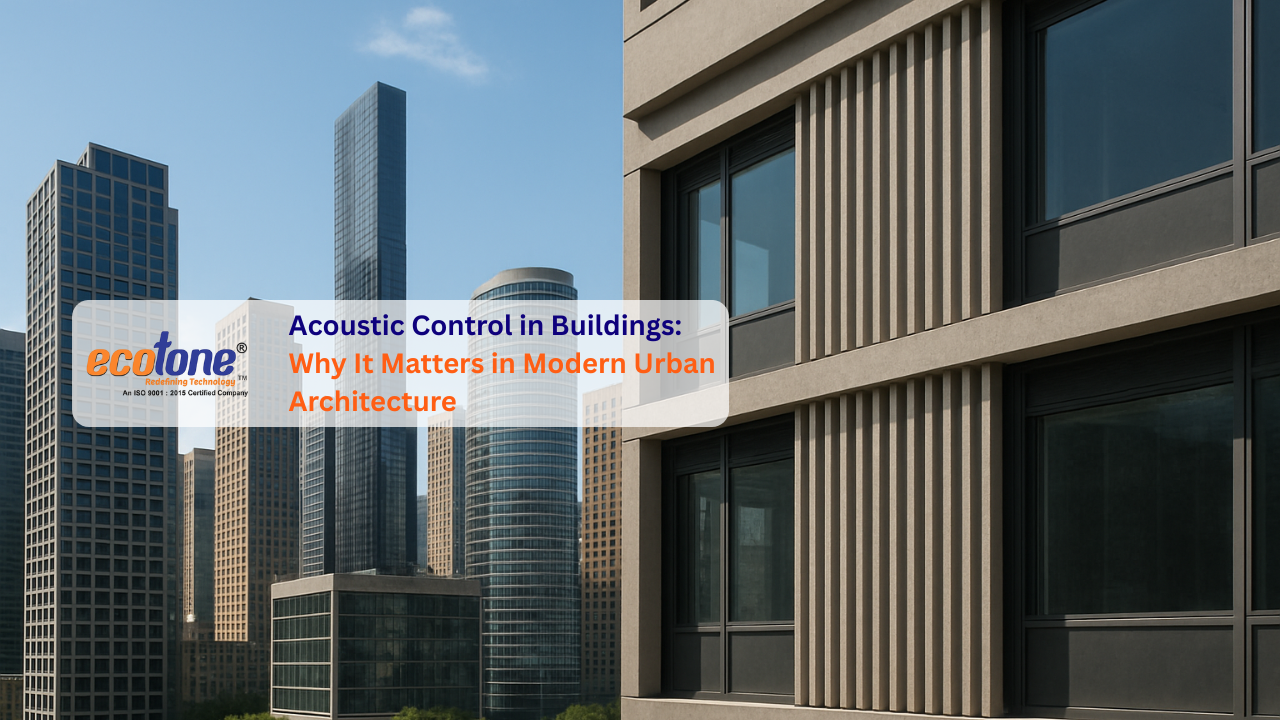
In today’s rapidly expanding cities, noise has become one of the most influential factors affecting comfort, productivity, and overall well-being. Urban environments are filled with traffic sounds, construction activity, HVAC machinery, industrial operations, and dense human movement. As cities grow vertically and horizontally, this constant noise exposure is now considered a major architectural challenge. This is where Acoustic Control in Buildings becomes essential.
Acoustic control refers to the strategic planning, design, and application of solutions that manage sound within and around a building. It involves understanding how sound travels through air, structural elements, and mechanical systems and how it can be controlled through thoughtful architectural decisions and specialised materials. Today’s buildings must handle a wide range of acoustic demands: quiet residential spaces, productive workplaces, clear communication zones, and safe industrial environments.
Poor acoustics can lead to restless sleep, reduced focus, communication difficulties, stress, and long-term health concerns. For commercial and industrial properties, noise can degrade productivity, reduce equipment efficiency, and violate environmental compliance norms. For educational and healthcare facilities, improper sound control directly impacts learning, recovery, and comfort.
For Any Inquiries Please Email
Our team typically responds within 24 hours on business days.
Contact UsModern architecture, with its preference for glass facades, open layouts, and large ceilings, unintentionally increases echo, reverberation, and sound transfer. As a result, acoustics must be integrated from the planning stage, not treated as an optional finishing element. With strategic design, high-performance materials, and engineering expertise from organisations like Ecotone Systems, buildings can achieve consistent sound quality, privacy, safety, and durability.
This blog explores the importance of acoustic design in urban architecture, the best acoustic building materials, and the role of advanced structures such as blast proof and blast-resistant buildings. It provides insights into how well-designed acoustics contribute to healthier, safer, and more productive spaces in modern cities.
Understanding Acoustic Control in Modern Architecture
Acoustic control involves managing how sound behaves within a space. Every material, surface, and structural element affects how sound waves move. Without proper planning, noise easily transfers between rooms, floors, and exterior environments.
Key goals of acoustic control:
- Reduce unwanted noise entering a space
- Prevent internal noise from spreading
- Improve speech clarity
- Provide privacy for sensitive areas
- Increase comfort and productivity
- Maintain a stable indoor acoustic environment
Effective acoustic design is technical but essential for modern buildings.
Why Acoustic Control Matters in Urban Spaces
Cities continue to grow denser, louder, and more complex. Noise challenges are now found in residential, commercial, institutional, and industrial zones.
1. High Urban Density
Buildings share walls and structural elements, making noise transmission common.
2. Mechanical Systems
Generators, pumps, HVAC units, and elevators produce continuous airborne and structure-borne noise.
3. Human Expectations
People expect quiet homes, balanced office acoustics, and peaceful hospitals and schools.
4. Direct Impact on Health
Noise pollution affects sleep, blood pressure, focus, stress levels, and communication.
5. Architectural Trends
Minimalism, glass-heavy designs, and open layouts require enhanced acoustic solutions. Acoustics are now a necessity in modern architecture—not a luxury.
Types of Building Noise
Understanding the type of sound helps in selecting the right treatment.
Airborne Noise
Traffic, speech, music, machinery, and outdoor activity.
Impact Noise
Footsteps, dropped objects, furniture movement, or mechanical vibration.
Structure-Borne Noise
- Vibrations transmitted through beams, columns, floors, and walls.
- Effective acoustic control requires a mix of sound insulation, absorption, and vibration isolation.
Acoustic Building Materials Used in Modern Design
Specialized materials help in absorbing, blocking, or diffusing sound. They reduce reflections, control echoes, and prevent noise transfer between rooms.
Table: Acoustic Building Materials and Their Applications
| Material | Main Function | Usage Areas | Performance |
|---|---|---|---|
| Acoustic Panels | Absorb sound | Offices, studios, classrooms | Medium–High |
| Acoustic Foam | Reduce echo | Home theaters, control rooms | Medium |
| Acoustic Glass | Block external noise | Facades, partitions | High |
| Mineral Wool | Thermal + sound insulation | Walls, ceilings | High |
| Soundproof Drywall | Room-to-room noise reduction | Homes, workplaces | Medium–High |
| Resilient Channels | Control impact noise | Ceilings, walls | High |
| Acoustic Louvers | Noise reduction with airflow | HVAC areas, plants | Medium–High |
These materials form the foundation of building acoustics in modern architecture.
Engineering Techniques Used in Building Acoustics
- Sound Insulation: Prevents noise transfer through walls, floors, doors, and windows. Uses insulated layers, acoustic glass, and dense structural materials.
- Sound Absorption: Reduces echo and improves clarity using panels, baffles, ceilings, and soft finishes.
- Vibration Isolation: Prevents mechanical vibrations from spreading using mounts, pads, and isolators.
- Acoustic Zoning: Places noisy areas away from quiet zones during architectural planning.
- Spatial Design: Thoughtful layouts ensure sound-sensitive spaces are protected. These strategies create balanced, controlled acoustic environments.
Applications of Acoustic Control in Different Building Types
- Residential Buildings: Acoustic insulation ensures peaceful bedrooms, living spaces, and balconies.
- Corporate Offices: Open offices need acoustic zoning, ceiling treatments, and insulated meeting rooms to prevent distraction.
- Schools and Universities: Classrooms require good speech clarity, while auditoriums need balanced reverberation.
- Hospitals: Quiet zones support faster healing and reduce patient stress.
- Industrial Buildings: Factories require advanced acoustic solutions to protect workers and equipment. Each building type demands customised acoustic strategies.
Acoustic Implications of Blast Proof Modular Buildings
Blast proof modular buildings serve industries such as energy, manufacturing, and defense. Besides impact resistance, they offer excellent acoustic performance thanks to their dense, multi-layered construction.
Benefits:
- Blocks extreme external noise from machinery
- Reduces vibration transfer
- Provides stable, insulated indoor environments
- Enhances worker safety and comfort
These structures protect staff from hazards while maintaining high acoustic quality.
Role of Blast Resistant Buildings in Urban Development
Blast resistant buildings are crucial in high-risk urban and industrial zones. Their reinforced walls, strong joints, and high-density materials offer unmatched sound isolation.
Acoustic advantages:
- Superior noise blocking
- Minimal vibration transmission
- Controlled indoor acoustics
- Durable performance over time
Such buildings ensure safety without compromising comfort.
Trends Shaping the Future of Building Acoustics
- Minimalist and Glass-Based Design – Requires enhanced acoustic treatment due to reflections.
- High Ceilings – Increases reverberation; treated using clouds and baffles.
- Smart Acoustic Systems – Automation adjusts sound conditions in real time.
- Eco-Friendly Acoustic Materials – Growing use of natural fibers and sustainable composites.
- Modular Acoustic Pods – Useful in co-working spaces, airports, and public buildings. Acoustics are becoming a central part of smart, sustainable architecture.
How Ecotone Systems Enhances Building Acoustics
Ecotone Systems provides engineered acoustic solutions for industrial, commercial, and residential spaces. Their expertise includes noise surveys, acoustic analysis, product manufacturing, and installation. With proven engineering practices, they deliver consistent acoustic performance across structures of all scales.
Their solutions include:
- Acoustic enclosures
- Noise control barriers
- Soundproof rooms
- Architectural acoustics
- Industrial noise control systems
Their scientific approach ensures high-quality, compliant, and long-lasting results.
Benefits of Effective Acoustic Control
- Higher Comfort – Reduced noise enhances well-being.
- Improved Productivity – Balanced acoustics support focus and communication.
- Regulatory Compliance – Essential for industries, schools, and commercial complexes.
- Increased Value – Acoustic-optimized buildings attract buyers and tenants.
- Flexible Functionality – Spaces become suitable for multiple uses without interference.
Future Evolution of Acoustic Control
Acoustic engineering continues to advance with:
- AI-driven noise analysis
- Adaptive acoustic surfaces
- Advanced simulation tools
- Energy-efficient acoustic materials
- Modular sound control solutions
Future urban spaces will be designed with acoustic wellness as a core priority.
Conclusion
Acoustic Control in Buildings plays a key role in modern urban architecture. With rising noise levels, dense construction, and advanced mechanical systems, buildings require integrated acoustic strategies for comfort, health, safety, and productivity. Using high-performance acoustic building materials, structured design methods, and specialized solutions like blast proof modular buildings and blast resistant buildings, developers can create environments that support modern living and working.
With engineering expertise and high-quality solutions from Ecotone Systems, buildings can achieve outstanding acoustic performance and set new benchmarks for modern architecture.
Trusted by India's Leading Brands
Hover to pause · Logos scroll continuously