Why Reverberation Chambers Matter in 5G/6G Testing
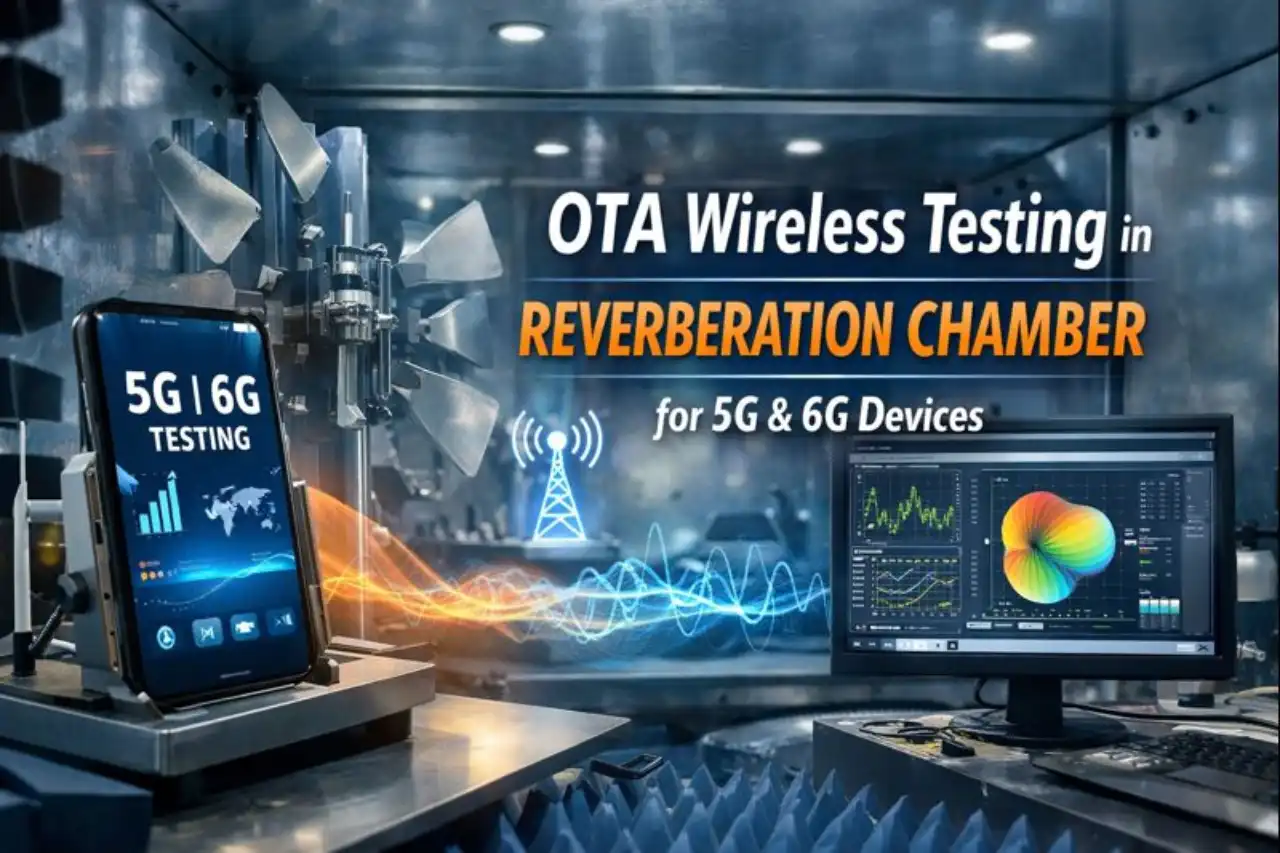
Wireless communication is entering a new era driven by the rapid expansion of 5G networks and the early research phases of 6G technology. Modern devices are no longer limited to simple voice or data transmission. Today’s smartphones, industrial IoT devices, automotive communication modules, and smart infrastructure systems demand ultra-low latency, high reliability, and seamless connectivity across complex environments. To meet these expectations, manufacturers rely heavily on Over-the-Air wireless testing. Among all available testing environments, the Reverberation Chamber has become one of the most effective and scalable solutions for validating 5G and future 6G devices.
OTA testing using a reverberation chamber provides a realistic representation of how wireless devices behave in real-world conditions. Unlike traditional conducted testing, which connects directly to RF ports, OTA testing evaluates the entire antenna system and radio performance as it would function in actual use. This approach is now essential for certification, compliance, and performance optimization of advanced wireless devices.
Introduction to OTA Wireless Testing
Over-the-Air wireless testing is a method used to evaluate the performance of wireless devices without physical RF cable connections. Instead of measuring signals through connectors, OTA testing transmits and receives signals through antennas, allowing engineers to assess how the device performs in free-space conditions. This method is particularly important for modern wireless products where antennas are embedded and cannot be accessed directly.
OTA testing captures real-world factors such as antenna radiation patterns, signal reflections, interference, and multipath propagation. For technologies like 5G and upcoming 6G, these factors significantly influence performance. The Reverberation Chamber enables engineers to replicate these complex environments in a controlled and repeatable way.
Importance of OTA Testing in 5G and 6G Technologies
The transition from 4G to 5G introduced advanced technologies such as massive MIMO, beamforming, higher frequency bands, and dense network deployments. These features dramatically increase data speed and capacity but also add complexity to device testing. Traditional testing methods cannot fully capture the behavior of such systems.
OTA testing ensures that devices meet performance expectations under realistic conditions. As 6G research continues to explore terahertz frequencies, AI-driven communication, and ultra-dense networks, the need for robust OTA testing environments will grow further. The Reverberation Chamber plays a critical role by supporting complex wireless scenarios efficiently.
What is a Reverberation Chamber
A Reverberation Chamber is a fully enclosed metallic structure designed to reflect electromagnetic waves rather than absorb them. The reflective surfaces inside the chamber cause RF signals to bounce repeatedly, creating a statistically uniform electromagnetic field. This environment simulates real-world multipath propagation, where signals reflect off walls, buildings, machinery, and other obstacles.
Unlike absorptive chambers, a reverberation chamber creates a dynamic RF environment that closely resembles practical operating conditions. This makes it highly suitable for OTA wireless testing of modern devices.
Working Principle of Reverberation Chambers
The operation of a Reverberation Chamber is based on controlled reflections and mode stirring. RF signals are transmitted into the chamber using antennas, and mechanical or electronic stirrers continuously change the internal field distribution. As the stirrers rotate or move, the signal paths vary, exposing the device under test to thousands of unique propagation conditions.
This process ensures that measurements represent average real-world performance rather than a single fixed scenario. The result is a repeatable and statistically reliable testing environment that significantly reduces testing time.
OTA Wireless Testing Process in a Reverberation Chamber
During OTA testing, the device under test is placed inside the reverberation chamber without direct RF connections. Test equipment transmits signals into the chamber while measurement systems analyze the received signals. By averaging results over multiple stirrer positions, engineers obtain accurate performance metrics.
The Reverberation Chamber allows for efficient testing of multiple antenna configurations, frequencies, and power levels without extensive repositioning. This efficiency makes it ideal for high-volume testing and R&D environments.
Comparison Between Reverberation Chambers and Anechoic Chambers
While both chambers are used for OTA testing, their working principles differ significantly. Anechoic chambers absorb RF energy to simulate free-space conditions, whereas reverberation chambers rely on reflections to create a multipath environment. Anechoic chambers are typically used for directional antenna measurements, while reverberation chambers are better suited for system-level performance testing.
For modern 5G and 6G devices, the Reverberation Chamber offers faster testing, lower operational cost, and more realistic simulation of everyday environments.
Key Performance Metrics Measured
OTA testing in a Reverberation Chamber enables accurate measurement of critical wireless performance parameters. These include total radiated power, total isotropic sensitivity, antenna efficiency, MIMO throughput, diversity gain, and radiated spurious emissions. These metrics are essential for regulatory compliance, network reliability, and customer satisfaction.
Role of Reverberation Chambers in 5G Device Validation
5G devices operate across a wide frequency range, including sub-6 GHz and millimeter-wave bands. Testing these frequencies requires a controlled environment that can handle high signal losses and complex antenna behavior. The Reverberation Chamber supports wideband testing and large antenna arrays without excessive setup complexity.
This makes reverberation chambers a preferred solution for validating smartphones, base stations, IoT modules, and industrial communication devices in 5G networks.
Future Scope of Reverberation Chambers in 6G Research
As research moves toward 6G, testing challenges will increase further. Higher frequencies, extreme bandwidths, and intelligent beam control systems will demand adaptable testing environments. The scalable nature of the Reverberation Chamber makes it well-suited for early-stage 6G experimentation and validation.
Researchers can modify chamber dimensions, frequency ranges, and stirring techniques to support future wireless technologies without completely redesigning test facilities.
Industrial Applications of Reverberation Chambers
Reverberation chambers are widely used across industries such as consumer electronics, automotive communication, industrial automation, medical devices, aerospace, and defense. Any application that depends on reliable wireless performance in complex environments can benefit from OTA testing in a reverberation chamber.
Advantages of Reverberation Chamber Testing
One of the biggest advantages of using a Reverberation Chamber is testing efficiency. The ability to simulate thousands of real-world conditions in a short time reduces development cycles and testing costs. The chamber also provides excellent repeatability, making it suitable for certification and compliance testing.
Design Considerations and Testing Challenges
Despite their advantages, reverberation chambers must be carefully designed and calibrated. Chamber size, frequency range, stirrer design, and measurement equipment all influence test accuracy. Following international standards such as CTIA and 3GPP ensures reliable and comparable results.
Ecotone Systems: Reverberation Chamber Solutions in India
Ecotone Systems is a trusted provider of advanced Reverberation Chamber solutions in India. The company designs and delivers customized chambers that meet international testing standards while addressing specific client requirements. With strong expertise in RF and acoustic engineering, Ecotone Systems supports industries across telecom, automotive, defense, and research sectors.
Acoustic and Noise Control Solutions by Ecotone Systems
In addition to reverberation chambers, Ecotone Systems also offers comprehensive acoustic solutions that enhance testing environments and industrial facilities. These include Acoustic Ceiling Baffles for noise control, Sound Barriers for industrial noise reduction, Sound Attenuators for HVAC and machinery systems, and Soundproof Curtains for flexible acoustic management.
These solutions help organizations achieve optimal sound control alongside high-precision RF testing.
Conclusion
OTA wireless testing is no longer optional in the era of 5G and emerging 6G technologies. The Reverberation Chamber has proven to be a reliable, efficient, and future-ready solution for validating wireless device performance under realistic conditions. Its ability to support complex antenna systems, multipath propagation, and rapid testing cycles makes it indispensable for modern wireless development.
By partnering with experienced solution providers like Ecotone Systems, organizations can ensure accurate testing, regulatory compliance, and long-term reliability in their wireless products.