Introduction
Factories and warehouses are inherently noisy environments, with constant machinery operation, equipment movement, and large open spaces that amplify sound. Such conditions create challenges for employee comfort, safety, and productivity. Managing noise is essential not only for compliance with occupational safety regulations but also to foster a work environment that allows effective communication, focus, and operational efficiency. One of the most effective solutions for noise control in industrial settings is the installation of Acoustic Ceiling Baffles. These systems absorb and dissipate sound, significantly reducing ambient noise while maintaining the open, functional layout of industrial facilities. By implementing these solutions, businesses can improve employee well-being, increase productivity, and create a safer work environment.
Importance of Noise Control in Industrial Spaces
Industrial noise is more than just an annoyance; it has real consequences for employee health and business operations. Prolonged exposure to high decibel levels can cause hearing impairment, fatigue, increased stress, and reduced concentration. These issues negatively affect productivity and increase the likelihood of operational errors.
Safety is another critical concern. Loud environments can obscure alarms, warnings, or colleague communication, increasing the risk of accidents involving machinery or forklifts. Controlling noise through effective acoustic solutions ensures that warning signals are audible, employees can communicate efficiently, and potential hazards are mitigated.
Investing in noise control measures like Acoustic Ceiling Baffles demonstrates a commitment to occupational health, operational efficiency, and regulatory compliance, making it a strategic necessity for modern industrial facilities.
Key Benefits of Acoustic Ceiling Baffles
The advantages of Acoustic Ceiling Baffles extend far beyond simple noise reduction. They create a measurable improvement in workplace productivity by enabling employees to focus without distractions caused by excessive background noise. Clear communication is another significant benefit, as baffles reduce reverberation and echo, ensuring instructions, announcements, and alarms are easily heard across large spaces.
Safety is also enhanced, as workers can respond more effectively to critical alerts. From a financial perspective, acoustic baffles provide long-term cost efficiency by reducing hearing-related health claims, minimizing accidents, and improving workflow efficiency. Additionally, optimized acoustics can reduce vibration and noise impact on sensitive machinery, extending its operational lifespan. These combined benefits make acoustic baffles a crucial component of industrial infrastructure.
Types of Acoustic Ceiling Baffles
Acoustic ceiling baffles come in several types, tailored to the unique needs of factories and warehouses. Hanging Baffles are vertically suspended panels designed to absorb sound from multiple directions. They are particularly effective in large open spaces with high ceilings, where noise tends to spread extensively. Their modular design allows for flexible placement and easy reconfiguration to address evolving noise challenges.
Industrial Acoustic Baffles are engineered for harsh industrial environments. Made from durable, high-performance materials, these baffles resist moisture, dust, and mechanical wear, ensuring long-term performance in demanding settings. Both types can be customized in terms of size, shape, and acoustic properties to achieve the desired level of noise reduction while complementing the facility’s operational needs.
Comparison of Acoustic Ceiling Baffles Types
Feature / Type | Hanging Baffles | Industrial Acoustic Baffles | Sound Absorption Performance | Ideal Application Areas | Durability & Maintenance |
Design & Structure | Vertically suspended panels, lightweight and modular | Heavy-duty panels designed for harsh industrial environments | High, effective at reducing echo and reverberation | Large open warehouse areas, factories with high ceilings | Moderate, easy to clean and relocate |
Material Composition | Fiberglass, foam, mineral wool | High-density fiberglass, acoustic foam, or composite | Very high, suited for industrial noise | Production floors, packaging, logistics areas | High durability, resistant to moisture, dust, and mechanical wear |
Installation Flexibility | Easy to install, can be reconfigured | Requires professional installation due to size/weight | High efficiency when strategically placed | Open-floor layouts with varying noise sources | Minimal maintenance required after initial setup |
Noise Reduction Capability | Reduces ambient noise, controls reverberation | Excellent for high-decibel machinery and equipment | Superior for heavy industrial noise | Areas with machinery, forklifts, and high foot traffic | Maintains performance over long periods |
Aesthetic Options | Customizable in color, size, and shape | Limited customization due to industrial requirements | Maintains functional effectiveness | Functional over aesthetics but can blend with industrial interiors | Durable finish, rarely needs replacement |
Cost Consideration | Moderate, budget-friendly | Higher initial investment but long-term savings | Cost-effective when considering longevity and productivity gains | High-noise industrial zones | Long-term value outweighs initial cost |
This table provides a clear overview of the characteristics, advantages, and best applications of each type of acoustic ceiling baffle, helping facility managers make informed decisions.
Installation and Maintenance Considerations
Proper installation and ongoing maintenance are key to maximizing the effectiveness of Acoustic Ceiling Baffles. Ceiling height, spacing between panels, and placement above primary noise sources all impact sound absorption performance. Selecting the appropriate material is crucial, as different materials offer varying degrees of acoustic efficiency and fire resistance.
Maintenance involves periodic inspection and cleaning to remove dust accumulation, which can compromise the panels’ sound absorption properties. When installed and maintained correctly, acoustic baffles provide consistent performance, creating a quieter, safer, and more productive industrial environment.
Choosing the Right Acoustic Baffles for Your Facility
Selecting the right baffle system requires an evaluation of the facility’s layout, noise levels, and operational requirements. High-noise areas, such as production floors or loading zones, may need larger or more densely installed panels. Aesthetic considerations, although secondary in industrial settings, can help ensure that the installation does not interfere with operational efficiency or facility design. Budget considerations should account for both the initial investment and long-term benefits, including reduced health risks, fewer accidents, and improved productivity. Collaborating with experienced acoustic solution providers ensures that the chosen system meets operational needs and regulatory standards while providing maximum return on investment.
Additional Services by Ecotone Systems
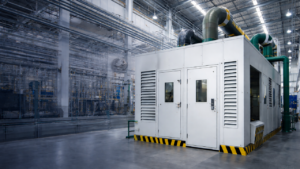
In addition to Acoustic Ceiling Baffles, Ecotone Systems offers comprehensive industrial noise control solutions. Acoustic Enclosures are designed to contain noise generated by machinery or equipment, creating controlled zones that prevent sound from spreading across the facility. Soundproof Doors are engineered with high-density materials and advanced sealing technologies to minimize noise transmission between areas, making them ideal for control rooms or offices. Sound Barriers provide large-scale noise mitigation, separating high-noise zones and reducing external noise intrusion. Together, these solutions complement ceiling baffles, offering a complete approach to industrial noise management that protects employee health, enhances communication, and improves overall operational efficiency.
Conclusion
Installing Acoustic Ceiling Baffles in factories and warehouses is a strategic investment that benefits both employees and operations. These systems reduce ambient noise, improve communication, enhance safety, and contribute to a more productive workplace. By choosing the right type of baffle and integrating additional services such as Acoustic Enclosures, Soundproof Doors, and Sound Barriers from Ecotone Systems, industrial facilities can achieve comprehensive acoustic management. This not only ensures regulatory compliance but also demonstrates a commitment to employee well-being and operational excellence, making factories and warehouses safer, quieter, and more efficient.