Introduction: Selecting the Right Overhead Acoustic System
Acoustic Ceiling Baffles are widely used in modern industrial and commercial projects to manage reverberation and excessive noise in large spaces. When comparing overhead sound treatment systems, acoustic clouds are often evaluated alongside these vertical baffle systems. While both solutions improve sound absorption and reduce echo, their structural design, performance efficiency, and ideal applications vary significantly.
In high-noise environments such as factories, warehouses, and transport terminals, selecting the appropriate acoustic treatment affects speech clarity, worker productivity, safety, and long-term operational efficiency. Understanding how these two ceiling systems differ ensures better acoustic planning and measurable results.
How Sound Behaves in Large and Open Buildings
Sound waves travel freely in large spaces and reflect repeatedly from hard surfaces like concrete, steel, and glass. These repeated reflections increase reverberation time, making speech unclear and amplifying background noise.
Ceiling-mounted absorptive systems help interrupt this reflection cycle. However, the orientation and placement of the panels determine how effectively they control sound. This is the fundamental difference between flat cloud panels and vertically suspended baffle systems.
What Are Acoustic Clouds?
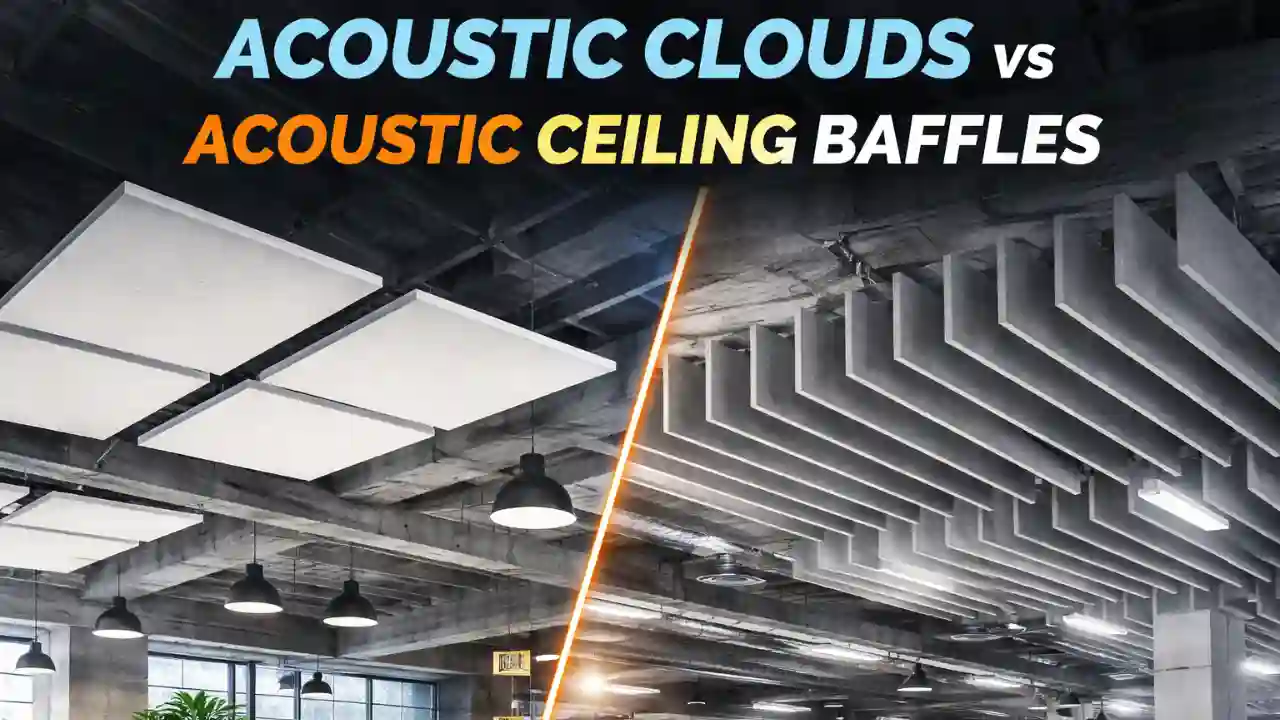
Acoustic clouds are horizontal sound-absorbing panels suspended parallel to the ceiling surface. They appear as floating elements and are commonly arranged in clusters or geometric layouts.
These panels primarily absorb sound that travels upward and reflects downward. Because of their flat positioning, they are most effective in environments where ceiling heights are moderate and noise levels are controlled. Offices, conference rooms, hospitality spaces, and educational facilities often use cloud systems to balance aesthetics and acoustic comfort.
Their design flexibility allows architects to integrate lighting and visual elements seamlessly. However, their absorption pattern mainly addresses vertical reflections rather than multi-directional sound movement.
What Are Vertical Ceiling Baffles?
Vertical ceiling baffles are panels suspended perpendicular to the ceiling. Unlike flat cloud systems, they expose both faces of the panel to sound waves. This significantly increases the surface area interacting with reflected sound.
This configuration allows the panels to absorb sound traveling horizontally and diagonally, making them highly effective in large-volume spaces. These systems are frequently installed in manufacturing plants, warehouses, gymnasiums, airport terminals, and other high-ceiling environments.
Because they are compatible with exposed structural ceilings, they integrate well into industrial settings without interfering with ductwork or lighting systems.
Structural and Functional Differences
The primary distinction between the two systems lies in panel orientation. Horizontal clouds treat sound differently than vertically suspended panels. Flat clouds mainly absorb downward reflections, while vertical baffles interact with sound from multiple directions.
This difference becomes more noticeable in large spaces. When ceilings are high and open, vertical systems often deliver stronger reverberation reduction due to their dual-sided exposure.
Another key factor is airflow. Horizontal panels can partially cover ceiling areas, whereas vertically arranged panels allow air to circulate freely between rows. In industrial environments where ventilation is essential, this advantage becomes particularly important.
Technical Comparison: Acoustic Clouds vs Ceiling Baffles
Technical Parameter | Acoustic Clouds | Ceiling Baffles |
Panel Orientation | Horizontal | Vertical |
Absorption Surface Exposure | Primarily underside | Both sides exposed |
Performance in High Ceilings | Moderate | High |
Multi-Directional Sound Control | Limited | Strong |
Compatibility with Open Ceilings | Requires structured support | Ideal for exposed ceilings |
Industrial Suitability | Moderate | Excellent |
Airflow Integration | Partial obstruction possible | Maintains airflow |
Reverberation Reduction | Effective in small to mid spaces | Highly effective in large spaces |
Maintenance | More dust accumulation | Less dust buildup |
Cost Efficiency in Large Areas | Moderate | Strong performance-to-cost ratio |
This comparison shows why vertically suspended systems are typically chosen for large industrial and infrastructure projects.
Performance in Industrial Environments
In facilities where machinery generates continuous noise, controlling reverberation is critical. Vertically suspended panels are more effective in these settings because sound interacts with both sides of the panel before continuing across the space.
By reducing echo and shortening reverberation time, these systems improve speech intelligibility and enhance workplace communication. This contributes to safer operations and better productivity.
For buildings with high ceilings exceeding four meters, vertical systems often outperform horizontal clouds in terms of measurable acoustic impact.
Installation and Engineering Considerations
Cloud systems usually require suspended grid frameworks or cable supports. Their placement often aligns with architectural layouts and interior design planning.
Vertical systems are typically installed in linear rows using structural anchor points. Because they do not require full ceiling coverage, they are easier to integrate into exposed industrial ceilings. They also allow access to utilities and sprinkler systems.
Maintenance requirements differ as well. Horizontal panels tend to collect dust on their upper surfaces, while vertically suspended panels experience less accumulation due to their orientation.
Design and Visual Impact
Both systems offer customization in size, finish, and color. Cloud panels are often chosen for decorative interiors where visual softness is important.
Vertically suspended systems create a structured, modern aesthetic that complements industrial architecture. When arranged evenly, they provide a clean ceiling rhythm while maintaining functional efficiency.
The choice often depends on whether the project prioritizes visual ambiance or large-scale acoustic control.
Additional Services by Ecotone Systems
Ecotone Systems provides a complete range of engineered acoustic solutions beyond ceiling-mounted absorptive panels.
Their Acoustic Curtains offer flexible sound containment options for machinery enclosures, partitioned work zones, and temporary noise control areas. These systems allow adaptable noise management without permanent structural changes.
Acoustical Door solutions are designed to prevent sound leakage between rooms. These doors are engineered for industrial control rooms, studios, and sound-sensitive facilities where isolation is critical.
For infrastructure and large-scale environmental noise reduction, Ecotone Systems manufactures high-performance Sound Barrier systems. These are widely used in highways, industrial corridors, and public infrastructure projects to control external noise transmission.
By integrating ceiling systems, curtains, doors, and barrier solutions, Ecotone Systems delivers comprehensive acoustic engineering support tailored to project requirements.
Final Thoughts
Acoustic clouds and vertically suspended ceiling panels both serve important roles in modern acoustic design. The correct choice depends on ceiling height, spatial configuration, and noise intensity.
Cloud systems are effective in controlled environments where design flexibility is important. However, in large industrial or high-ceiling spaces, vertical systems generally provide stronger and more consistent reverberation control.
Careful acoustic planning ensures that the selected system improves clarity, comfort, and compliance while delivering long-term performance value.