In the field of acoustics, accurate sound measurement depends heavily on the environment in which testing is carried out. Real-world spaces are filled with sound reflections, background noise, and structural vibrations that interfere with precise analysis. This is why controlled acoustic environments such as reverberation chambers and anechoic chambers are widely used in laboratories and industrial facilities. Although both serve acoustic testing purposes, their design philosophy and applications are fundamentally different. Understanding these differences is essential for selecting the right chamber for your testing requirements.
This article explains the key differences between a reverberation chamber and an anechoic chamber in a clear and practical way, helping engineers, manufacturers, and consultants make informed decisions.
Introduction to Acoustic Testing Chambers
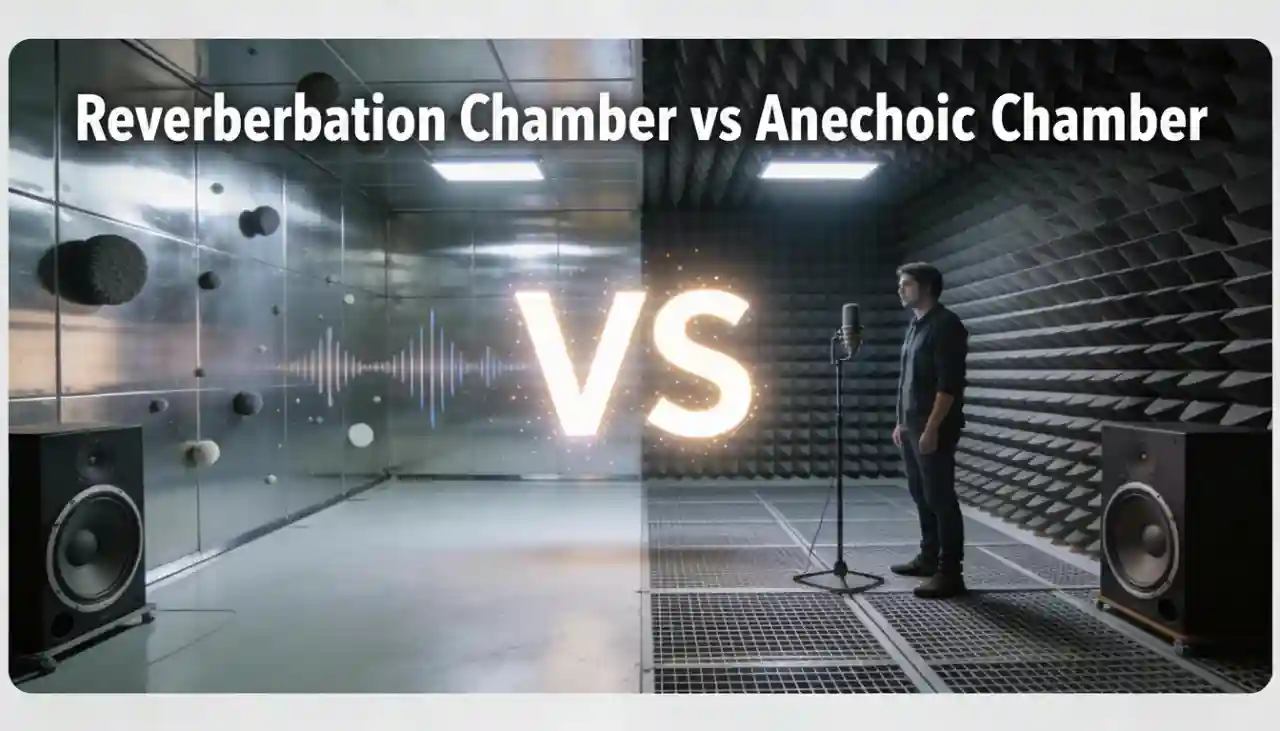
Acoustic testing chambers are specially designed rooms that control how sound behaves within them. Unlike ordinary spaces, these chambers are engineered to either enhance sound reflections or absorb them completely. A reverberation chamber is designed to maximize sound reflections, while an anechoic chamber is built to eliminate echoes altogether. These opposing characteristics make each chamber suitable for specific types of acoustic measurements and standards-based testing.
What Is a Reverberation Chamber?
A reverberation chamber is an enclosed acoustic space with hard, reflective surfaces on all sides. These reflective boundaries allow sound waves to bounce repeatedly throughout the room, creating a diffuse sound field where acoustic energy is evenly distributed. The purpose of this design is to simulate environments where reflections are unavoidable, such as industrial halls, power plants, and large mechanical rooms.
Because of the continuous reflections, reverberation chambers are ideal for evaluating how sound behaves in reflective environments and for measuring sound power levels of noise-generating equipment.
How a Reverberation Chamber Works
When a sound source is activated inside a reverberation chamber, the sound waves reflect off the walls, ceiling, and floor multiple times. Over time, these reflections overlap and form a uniform sound field. The rate at which sound energy decays after the source is switched off is known as reverberation time, and this parameter is critical for acoustic analysis.
By measuring reverberation time with and without a test sample, engineers can calculate acoustic absorption properties and sound power levels with high repeatability.
Applications of Reverberation Chambers
Reverberation chambers are widely used in industrial acoustics and architectural acoustics. They are commonly applied for sound power testing of machinery, HVAC systems, generators, and heavy equipment. They are also used for testing the sound absorption performance of acoustic panels, wall treatments, and insulation materials. Because reverberation chambers follow internationally accepted standards, they are frequently used for compliance testing and product certification.
Advantages and Limitations of Reverberation Chambers
One of the main advantages of a reverberation chamber is its ability to provide reliable sound power measurements regardless of sound direction. It is also cost-effective compared to highly absorptive chambers and can accommodate large test objects. However, the presence of strong reflections means it cannot simulate free-field conditions. This makes reverberation chambers unsuitable for directional noise analysis or precision electro-acoustic testing.
What Is an Anechoic Chamber?
An anechoic chamber is a highly controlled acoustic environment designed to absorb sound rather than reflect it. The term anechoic means “without echo,” and this perfectly describes its function. In an anechoic chamber, sound behaves as if it is traveling in open space, allowing extremely accurate measurement of noise sources.
An acoustic anechoic chamber is typically lined with sound-absorbing wedges that prevent sound waves from bouncing back into the space. This creates a near-silent environment ideal for high-precision testing.
Types of Anechoic Chambers
An acoustic anechoic chamber is primarily used for airborne sound testing and electro-acoustic measurements. It is designed to absorb sound across a wide frequency range and is commonly used for testing speakers, microphones, and small mechanical devices.
A semi anechoic chamber absorbs sound on the walls and ceiling while keeping the floor reflective. This design allows test objects to be placed on the floor, making it suitable for automotive testing and industrial equipment testing where ground reflection is required.
A full anechoic chamber absorbs sound on all surfaces, including the floor. In this configuration, test objects are usually suspended or placed on mesh flooring. A full anechoic chamber provides the most accurate free-field conditions and is used for advanced research and development applications.
How an Anechoic Chamber Works
An anechoic chamber works by converting sound energy into heat through specialized acoustic wedges. These wedges are designed with specific shapes and materials that trap sound waves and prevent reflections. The chamber structure also includes sound insulation and vibration isolation to eliminate external noise interference.
As a result, the background noise level inside an acoustic anechoic chamber is extremely low, allowing even very quiet sound sources to be measured accurately.
Applications of Anechoic Chambers
Anechoic chambers are widely used in industries where precision is critical. They are essential for product noise measurement, acoustic research, automotive NVH testing, and consumer electronics development. A semi anechoic chamber is often used when testing larger equipment or vehicles, while a full anechoic chamber is preferred for laboratory-level accuracy and acoustic research.
Advantages and Limitations of Anechoic Chambers
The biggest advantage of an anechoic chamber is its ability to eliminate reflections completely, providing true free-field conditions. This makes it ideal for directional sound measurements and detailed noise analysis. However, anechoic chambers require careful design, high-quality materials, and significant investment. Space limitations and construction costs can also be challenging for large-scale testing.
Reverberation Chamber vs Anechoic Chamber: Key Differences
The fundamental difference between a reverberation chamber and an anechoic chamber lies in how they treat sound reflections. A reverberation chamber enhances reflections to create a uniform sound field, while an anechoic chamber eliminates reflections to simulate open space. Reverberation chambers are better suited for sound power and absorption testing, whereas anechoic chambers are ideal for precision noise measurement and acoustic research.
The choice between these chambers depends entirely on the type of data required and the standards being followed.
Which Chamber Should You Choose?
If your testing focuses on measuring overall sound power or evaluating acoustic materials, a reverberation chamber is the most practical solution. If your goal is to analyze sound direction, noise source behavior, or product acoustics with high accuracy, an acoustic anechoic chamber is the better choice. For applications that require a balance between real-world conditions and acoustic control, a semi anechoic chamber often provides the best solution.
Ecotone Systems: Trusted Manufacturer of Reverberation and Anechoic Chambers
Ecotone Systems is a leading manufacturer and solution provider for advanced acoustic infrastructure, specializing in the design and installation of high-performance reverberation chambers and anechoic chambers. With extensive industry experience and a strong focus on engineering precision, Ecotone Systems delivers customized acoustic environments that meet international testing standards and project-specific requirements. Each reverberation chamber is designed to provide a uniform diffuse sound field for accurate sound power and absorption testing, while anechoic chamber solutions are engineered to deliver true free-field conditions with exceptional measurement accuracy.
As a manufacturer, Ecotone Systems offers complete turnkey solutions, covering acoustic design, fabrication, insulation, and on-site installation. Their expertise spans across acoustic anechoic chamber designs as well as specialized configurations such as semi anechoic chamber and full anechoic chamber setups. These chambers are widely used in industries including automotive, power generation, electronics, aerospace, and heavy manufacturing, where precise noise measurement and compliance are critical.
Beyond reverberation chambers and anechoic chambers, Ecotone Systems provides a comprehensive range of noise control and soundproofing products. Soundproof curtains are engineered to reduce noise transmission in industrial and temporary workspaces, offering flexibility without compromising performance. Soundproof doors are designed with high acoustic insulation ratings, ensuring effective noise containment while maintaining durability and ease of operation. Sound attenuators are developed to control noise in HVAC systems, ducts, and exhaust paths, helping industries achieve regulatory compliance without affecting airflow efficiency.
Ecotone Systems also manufactures sound barriers that are widely used for outdoor and indoor noise control applications. These barriers are ideal for construction sites, industrial plants, and infrastructure projects where environmental noise reduction is essential. In addition to these solutions, the company offers a wide range of customized acoustic enclosures, noise control systems, and vibration isolation solutions tailored to specific industrial challenges.
By combining advanced acoustic engineering with practical on-site expertise, Ecotone Systems has established itself as a reliable partner for organizations seeking long-term noise control solutions. Whether the requirement is a high-precision anechoic chamber, a robust reverberation chamber, or supporting products such as soundproof curtains, soundproof doors, sound attenuators, sound barriers, and more, Ecotone Systems delivers solutions that are built for performance, compliance, and durability.
Final Thoughts
Both reverberation chambers and anechoic chambers play critical roles in acoustic testing and noise control. While their designs are completely opposite, each chamber serves a specific purpose that cannot be replaced by the other. Understanding their differences helps ensure accurate testing, standards compliance, and better product performance.
Whether you choose a reverberation chamber, an acoustic anechoic chamber, a semi anechoic chamber, or a full anechoic chamber, selecting the right environment will always lead to more reliable acoustic results.
FAQs
Neither is universally better. A reverberation chamber is best for sound power and absorption testing, while an anechoic chamber is ideal for precision noise measurement and directional analysis.
A reverberation chamber is used for sound power level testing, acoustic absorption measurement, and compliance testing of machinery, HVAC systems, and industrial equipment.
Reverberation chambers commonly follow international standards such as ISO 3741, ISO 3744, and ISO 354 for sound power and absorption testing.
Anechoic chambers are designed according to standards like ISO 3745, ISO 26101, and IEC acoustic testing standards.
Automotive, aerospace, electronics, consumer appliances, R&D labs, telecom, and acoustic research institutions widely use anechoic chambers.
Trusted by India's Leading Brands
Hover to pause · Logos scroll continuously